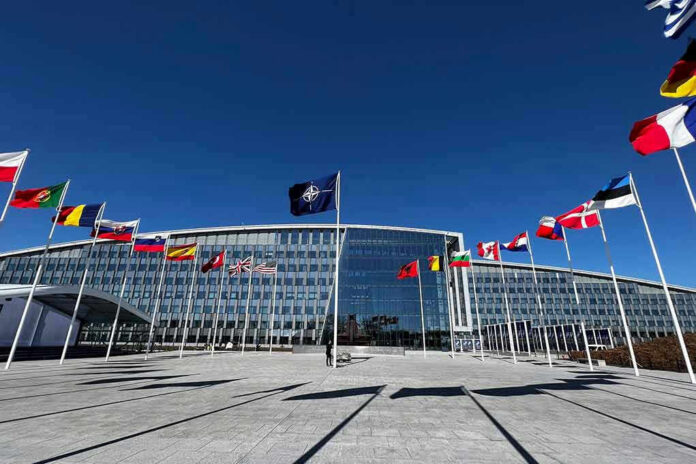
As Washington reviews troop rotations, Lithuania offers to pay every dime to keep U.S. forces on Russia’s doorstep — and says the deterrent is worth it.
Story Highlights
- Lithuania pledges to cover all costs to sustain U.S. troops indefinitely at Pabradė.
- U.S. rotations are “under review,” creating a gap that could leave Lithuania without an armored battalion.
- Current U.S. rotations included Abrams tanks, Bradleys, and Paladin howitzers near Belarus.
- NATO ties the eastern buildup to deterring Russian aggression along the alliance’s flank.
Lithuania’s Offer: Pay It All to Keep U.S. Troops Forward
Lithuania’s defense minister said his country will cover all costs to sustain U.S. troops stationed there. He called the package indefinite and open to all American forces in Lithuania. The announcement came at Pabradė, where new barracks, a dining hall, and a fitness center were added to support the mission. Lithuanian leaders frame the U.S. presence as a vital shield for the Baltic states and NATO’s east. The U.S. Army has echoed that deterrence message at Pabradė [1].
Earlier reporting described the Lithuanian pledge as a decisive step backed by a major support package. The plan links infrastructure and logistics to a lasting American rotation posture. The pitch to Washington is simple: no cost to U.S. taxpayers for on-the-ground sustainment in Lithuania. Lithuanian officials argue that shared training and combined planning sharpen readiness on a tense border. The host nation expects the visible U.S. footprint to help keep Moscow in check [2].
Rotation Uncertainty: A Short-Term Gap and Big Questions
Lithuania’s defense minister said the next U.S. rotation is under review, and the departing troops are leaving on schedule. He said Washington assured Vilnius that a new rotation will arrive, but timing, size, and capabilities remain unknown. The pause could leave Lithuania without an armored U.S. battalion for the first time since 2020. That gap matters because armor has been central to deterrence and joint training in recent years [3].
Reuters reported that the current U.S. rotation included two battalions from the 1st Cavalry Division. Those units brought Abrams tanks, Bradley fighting vehicles, and Paladin self-propelled howitzers. They trained at new facilities near the Belarus border. That forward, heavy presence sends a clear signal to Moscow. It also raises stakes if rotations lapse, because any pause can be read as weaker resolve unless quickly replaced with credible forces [5].
NATO’s Rationale: Deterrence on the Eastern Flank
NATO says it built up forces along the eastern flank in response to Russia’s aggressive actions. The alliance backs multinational battlegroups from the Baltics to the Black Sea. Germany is standing up a full brigade in Lithuania and plans to reach up to 5,000 troops by 2027. Alliance planners argue that visible ground forces, ready to fight with local partners, help stop war by showing strength and unity where Moscow tests borders [13].
POWDER KEG BALTICS: Lithuania Seeks Long-Term US Military Presence in the Russia-Bordering Country https://t.co/iCMdkjMgl9
— Howard Rothenburg (@hrothenb) June 19, 2026
Conservative readers will note the key trade-off. A forward U.S. presence helps avoid a larger war later, but it must be clear, steady, and affordable. Lithuania’s offer lowers costs by paying for sustainment on site. The uncertainty over U.S. rotations adds risk if it lingers. Assurances are helpful; schedules and capabilities are better. America’s interest is simple: deter conflict cheaply, with allies carrying real weight, while keeping U.S. decision-making sovereign and focused.
What the Trump Administration Should Demand Next
Washington should lock in predictable rotations tied to measurable readiness goals. Clear timelines and unit types deter miscalculation by Russia and calm markets in Europe. The White House should require continued host-nation funding, hard security upgrades, and rapid mobility corridors for reinforcements. Lithuania is signaling long-term buy-in. The United States should shape that energy into a firm plan that protects American troops, respects taxpayers, and keeps the peace without open-ended missions abroad [2].
Congress should get regular reports on cost sharing, troop safety, and mission success. Heavy units deter well, but they need training space, maintenance time, and smart rules. If the pause in rotations stretches, allies should cover interim capability gaps with European armor and air defense. That keeps pressure off U.S. budgets and prevents a vacuum. The goal is peace through strength, not mission creep. Clear commitments, paid by partners, deliver that result [3].
Bottom Line for U.S. Conservatives
Lithuania’s message is blunt: “We will pay. Please stay.” The U.S. message should be just as clear: “We will stay if it deters war, saves U.S. money, and serves American interests.” NATO’s line ties the buildup to Russian behavior, not to endless expansion. That framing matters. It keeps focus on deterrence, not adventurism. With rotations under review, the administration must lock in a plan that is firm, frugal, and fearless — and make allies shoulder real costs [13].
Sources:
[1] Web – POWDER KEG BALTICS: Lithuania Seeks Long-Term US Military Presence in …
[2] Web – Lithuania makes long-term sustainment commitment to US Forces
[3] Web – Lithuania to pick up full tab for cost of hosting US soldiers deployed …
[5] YouTube – Why Are There American Soldiers In Lithuania?
[13] Web – Future presence of US troops in Lithuania is ‘under review … – …
© newsworthy.news 2026. All rights reserved.