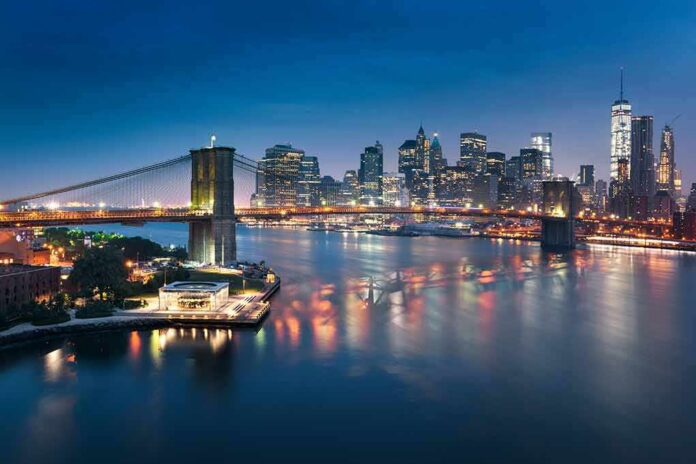
As New Yorkers celebrated a carefully planned Fourth of July mega-show, the Brooklyn Bridge briefly caught fire, raising hard questions about whether America’s public safety systems are as reliable as its patriotic pageantry.
Story Snapshot
- A nationally televised, highly regulated fireworks display still saw fire on the Brooklyn Bridge.
- The event was branded part of America’s 250th birthday, with intense planning and security.
- No detailed public report yet explains exactly why the bridge burned after the show.
- Fireworks accidents and fires have been rising nationwide, adding pressure on regulators.
A showcase event that still saw fire on an iconic bridge
The Macy’s Fourth of July fireworks show is sold as the safest kind of risk: a huge spectacle run by seasoned professionals, locked down by permits, and backed by city and federal oversight. In New York, this year’s event marked the 50th anniversary of the show and was officially promoted as a “250th signature event” for America’s semiquincentennial, which signals high-level planning and review. Yet after the fireworks ended, firefighters had to put out flames on the Brooklyn Bridge itself, a jarring sight in a tightly managed celebration.
New York City officials framed the 2026 fireworks as a big win: 100,000 free viewing tickets along the Brooklyn and Manhattan waterfronts, heavy New York Police Department (NYPD) street closures, and security checkpoints with bag searches. The show launched tens of thousands of shells from barges in the East River and from the bridge, repeating a setup used in past years. Crowds filled Brooklyn Bridge Park and lower Manhattan in a scene designed to show that large public events can be both thrilling and safe.
What we know — and do not know — about the bridge fire
The clearest confirmed fact is simple and stark: after the Macy’s fireworks wrapped, firefighters from the Fire Department of the City of New York (FDNY) responded to flames on the Brooklyn Bridge and extinguished them. Past bridge-based shows used special “waterfall” style effects that pour fire-like cascades off the bridge into the East River, which makes close coordination with structural engineers and fire officials essential. What is missing so far is a public incident report that explains whether the blaze came from leftover pyrotechnic material, debris, equipment failure, or human error.
No detailed statement from Macy’s, the fireworks contractor, the FDNY, or the NYPD has been released that walks through the cause step by step or rules out broader safety issues. There is also no named expert, such as the show’s safety director or crew chief, on record explaining what failed and what worked. That silence matters in a climate where many Americans believe big companies and government agencies hide behind public-relations language instead of owning mistakes, fixing systems, and sharing facts.
A pattern of rising fireworks danger and strained trust
National safety data shows why this incident hits a nerve. The United States Consumer Product Safety Commission (CPSC) reports roughly 13,000 fireworks injuries in a recent year, with burns making up about 38 percent of emergency room visits. Other analyses estimate about 14,700 fireworks-related injuries and a sharp rise in deaths and injuries over the past decade and a half. Fireworks also started an estimated 32,302 fires in 2023 alone, causing civilian deaths, injuries, and millions of dollars in property damage.
Safety organizations repeatedly urge families to avoid backyard fireworks and instead attend professional shows, arguing that trained crews and tight rules reduce danger. Yet events like the Brooklyn Bridge fire show that even the “safe” option carries real risk. Many Americans on both the left and the right already feel that regulators often arrive after the damage is done and that elite institutions protect reputations first and citizens second. A bridge burning, even briefly, during a flagship America 250 event reinforces those fears.
How planning, ticketing, and crowd control feed the frustration
New York City sold the Macy’s celebration as a tightly controlled operation: free tickets, specified viewing zones, and a lottery system in places like Brooklyn Bridge Park. Street-closure maps and official PDFs spelled out where people could stand, how they would be screened, and which routes would be blocked to cars. For many, this level of control feels like government at its strongest, promising order and safety in a complex city. Yet past coverage has already described the Brooklyn Bridge Park fireworks experience as a “total fiasco,” as thousands of ticket-holders were unable to access promised viewing areas.
City Hall still claimed “no serious injuries or violent incidents” and said the event went off “without a hitch,” even while admitting heavy congestion and frustration among residents. That kind of mismatch — good news in the press release, messy reality on the ground — is exactly what fuels the broad sense that officials manage optics more carefully than outcomes. When a bridge catches fire in that setting and details are slow to appear, both conservatives and liberals see one more piece of evidence that the system is more concerned with looking in control than actually being in control.
What comes next: data, transparency, and real accountability
Several simple steps could move this story from rumor and resentment to facts and lessons. A public release of the FDNY incident report would show how serious the bridge fire was and what caused it. A post-event safety audit shared by the fireworks contractor and Macy’s could explain what safeguards worked, what failed, and what will change before the next show. New York City agencies could publish crowd-control reviews so residents see how ticketing, closures, and policing will be improved before another 100,000-person waterfront gathering.
For a country marking 250 years, the stakes go beyond one holiday spectacle. Fireworks data already shows that risk is real and growing, even under professional supervision. Citizens across the political spectrum are tired of being told that everything is fine when video clips and lived experience say otherwise. Honest reporting on the Brooklyn Bridge fire, backed by hard numbers and clear responsibility, would not solve America’s deeper problems. But it would show that at least in one high-profile case, the people running the show remember that their first job is to protect the public, not the brand.
Sources:
nypost.com, fox5ny.com, cbsnews.com, nyc.gov, brooklynbridgepark.org, abc7ny.com, macysinc.com, southstreetseaportmuseum.org, instagram.com, lake.com, brooklynbridgeparents.com, theeducatedpatient.com, hsi.com, cpsc.gov, nationwidechildrens.org, facebook.com
© newsworthy.news 2026. All rights reserved.