On the night America turned 250, a sudden storm and a delayed speech exposed how even a birthday party for the nation can get tangled in politics, money, and mistrust.
Story Snapshot
- Severe heat and thunderstorms forced officials to evacuate the National Mall and push President Trump’s July 4 speech to late night.
- The delay fits a well-known pattern: extreme weather disrupts big public events far more often than political plotting.
- At the same time, House Democrats accuse Trump-linked Freedom 250 organizers of misleading donors and hijacking the semiquincentennial.
- The clash over this one speech shows how both parties use even weather emergencies to feed a deeper story about elites and a broken system.
What Actually Happened on the National Mall
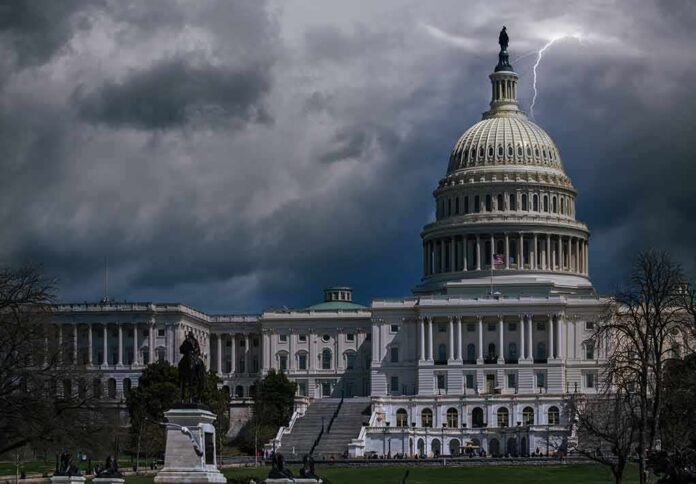
On July 4, 2026, Washington, D.C. faced record heat near or above 100 degrees and a severe thunderstorm watch that stretched into the night. By late afternoon, the National Weather Service warned of strong storms with lightning and dangerous winds in the capital region. As crowds gathered for the Freedom 250 “Salute to America” event on the National Mall, city emergency officials ordered people to evacuate and seek shelter in nearby federal buildings and museums because a severe storm was approaching. Organizers and security agencies said safety was the top priority as thunder, lightning, and high winds threatened the open-air event.
Event organizers later announced that the gates to the National Mall would reopen at 9:45 p.m. Eastern Time, at President Trump’s direction, so the celebrations could resume after the storm passed. Media outlets had originally listed Trump’s start time around 9:45 p.m., but the evacuation pushed his remarks back to about 11 p.m., with fireworks to follow. Earlier that day, the annual National Independence Day Parade had already been canceled because of extreme heat and unhealthy air, showing that weather disruptions were not limited to Trump’s speech. Across the East, parades and fireworks were delayed or scrapped as triple-digit temperatures and storms made outdoor gatherings risky.
How Trump Framed the Delay and the Celebration
In the hours before the storm, President Trump used social media and interviews to project confidence about both the heat and the crowds, saying temperatures were “not as bad as predicted” and calling the turnout “INCREDIBLE.” He also promised a “really long” Independence Day speech, saying he wanted to show he “can do anything” despite the brutal conditions. This fit his broader America 250 message from 2025, when he used earlier July 4 speeches to celebrate his “Big Beautiful Bill,” talk about border security, and cast the multi-year anniversary campaign as proof that his agenda was bringing in a new “golden age of America.” By the time he finally spoke on the Mall after the storm, the delay itself had become part of the political drama.
Television networks and online commentators highlighted White House worry about crowd size and the optics of empty sections on the Mall, especially after the evacuation scattered people and forced them into nearby buildings. Supporters pointed to the severe weather alerts and visible lightning as proof the delay was necessary, arguing that Trump stayed on script by delivering his long-planned patriotic speech once it was safe. Critics, however, used images of thinned-out crowds and disrupted fairgrounds to question the planning and to claim the celebration never matched the grand promises made in the buildup.
Weather Disruption vs. Political Spin
Outside this single event, data on large gatherings and public systems shows that **weather is usually the main reason things get delayed**, not politics or crowd management. The Federal Aviation Administration reports that about three-quarters of major flight delays over recent years were caused by weather, including thunderstorms, lightning, and high winds. Researchers tracking global events have found that storms and their effects, like flooding and hail, are the leading cause of disruptions to public ceremonies, sports, and other mass gatherings. Even elections have been thrown off by extreme weather; at least 94 votes in 52 countries have been affected by natural hazards over the past two decades. In short, when a big outdoor event in a hot, storm-prone city like Washington gets interrupted, bad weather is statistically the most likely culprit.
That does not mean planning and politics do not matter. Security for America’s 250th was treated as a “National Special Security Event,” involving the United States Secret Service, the Federal Bureau of Investigation (FBI), and thousands of National Guard personnel. Organizers set up heavy fencing, closed streets, and banned many everyday items, which changed the feel of the Mall and made access harder for families. These choices, plus the decision to stage a large rally-style speech in extreme heat, reflect a federal government that can mobilize huge resources for spectacle while often struggling to deliver basic services and honest communication. Many Americans who already mistrust “elites” see that mismatch and conclude the system’s priorities are upside down.
Fraud Allegations and the Fight Over America 250
Even before the storm hit, House Democrats were arguing that the July 4 event was not just a patriotic celebration but part of a troubled project called Freedom 250. In an interim report, they accused Trump-linked fundraisers and organizers of misleading donors who believed they were giving to the official bipartisan America 250 commission, only to have money diverted to Freedom 250 accounts instead. The report describes the celebration as a “vanity project” and claims Trump “hijacked” the semiquincentennial, turning a shared national milestone into a personal rally with secretive funding. These are serious charges, but they remain political allegations, not proven crimes in court.
After a weather-related delay, President Donald Trump took the stage on the National Mall to mark America's 250th anniversary with a campaign-style speech.
Despite storms, extreme heat, and heightened security, thousands gathered for the high-profile Independence Day celebration… pic.twitter.com/SC4xo5z3qG
— The UAE Times (@theuaetimes) July 5, 2026
For many people on both the right and the left, these allegations fit a broader pattern: big national events become chances for insiders to raise money, control the narrative, and build their own brands, while ordinary citizens face unsafe conditions, confusing messaging, and rising costs just to participate. Conservatives angry about “woke” spending and globalist priorities see the bureaucracy and security build-out as proof that Washington serves itself. Liberals upset about inequality and attacks on social programs see the same event as proof that populist leaders use patriotism to cover for donor games and self-promotion. Both sides, in different ways, feel the federal government no longer lives up to the founding idea that public power should serve the people first.
What the Speech and Delay Reveal About the System
Taken together, the severe heat, the storm evacuation, the late-night speech, and the fraud fight over Freedom 250 tell a larger story about the state of American governance at 250 years. On the surface, the weather delay looks like a straightforward safety call backed by official alerts and emergency orders. At a deeper level, though, the way leaders and media framed that delay — as either proof of Trump’s toughness or evidence of his ego and poor planning — shows how every event now feeds a larger war over trust. The same facts become fuel for different stories about who runs the country and for whose benefit.
For citizens watching from the Mall or from home, the message is unsettling. Even a simple question — why did the speech start late? — cannot be answered without walking through partisan press releases, donor controversies, and security briefings. Extreme weather is real, and it is getting harder to ignore. Yet the fight over this one delayed speech suggests something else is also storming across American life: a belief, shared by many on both sides, that those in power will use any crisis, even a thunderstorm on the nation’s birthday, to protect themselves first and argue about blame later.
Sources:
thegatewaypundit.com, nbcnews.com, bbc.com, npr.org, usatoday.com, youtube.com, thehill.com, facebook.com, instagram.com, abcnews.com, washingtonpost.com, apnews.com, resist.bot, faa.gov
© newsworthy.news 2026. All rights reserved.