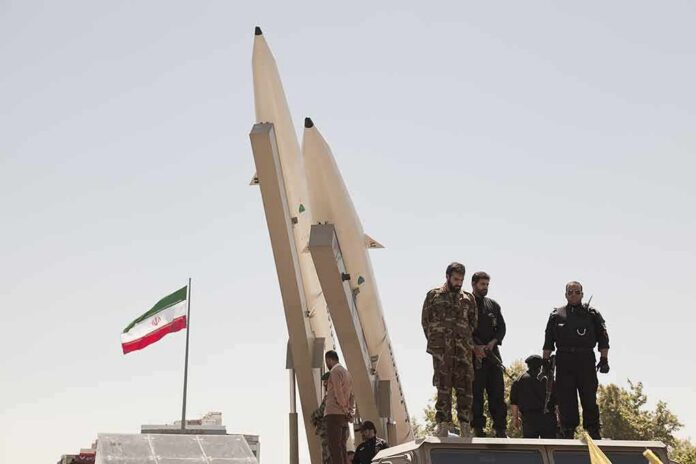
Iran’s top army general publicly tied cash to the killing or capture of American troops — a direct incentive that raises real-world risk for U.S. service members.
Story Snapshot
- Iran’s army chief announced a $30,000 reward for killing or capturing an “aggressor” U.S. service member.
- Reports say the money would come from “the Iranian people” or public contributions, not a clear state fund.
- Some outlets say the bounty applies to troops attacking Iranian territory, showing scope confusion.
- The remarks came amid fresh U.S.-Iran tension after recent U.S. troop deaths and vows of payback.
What Iran’s General Said, and Why It Matters Now
Iran’s Army Commander-in-Chief, Major General Amir Hatami, said any person who kills or captures an “aggressor” American soldier would receive about $30,000, according to state-linked reporting. Some coverage added that women who carry out the act would receive double. The remarks were presented as a public statement at a Journalists’ Day event on August 16. Multiple outlets carried the same dollar figure and quote, anchoring the claim in a clear public message.
President Trump had recently warned Iran it would “pay” after U.S. troop deaths reported in July, which set a tense backdrop for Hatami’s comments. When threats and promises stack up, the chance of missteps grows. Washington and Tehran have long traded signals, but direct cash offers can push fringe actors or proxies to act. That is why this statement has set off alarms across the political spectrum in the United States.
Key Gaps: Who Pays, Which Troops, and Is This Policy?
Reports differ on who would fund the reward. Some say “the Iranian people” or private donors would provide the money, not a formal line in a government budget. That raises a core question: is this a state program or propaganda? There is also inconsistency on scope. Some coverage ties the reward to an American soldier “attacking Iranian territory,” while others imply any U.S. troop. That ambiguity clouds the real operational risk.
Evidence so far comes from press summaries and state-linked outlets that quote Iranian sources. There is no full official transcript in the public record that settles wording, conditions, and authority. Analysts warn that translation drift and title mix-ups can spread confusion. Even so, the basic claim — an Iranian army chief naming a $30,000 figure for killing or capturing an American “aggressor” — appears consistently across several outlets.
How Both Sides of U.S. Politics Will Read This
Conservatives will see a hostile power putting a price on American lives and may press for tougher deterrence. Liberals will see a dangerous cycle where threats fuel more threats, risking another long war. Both groups share a deeper worry: leaders talk tough, but ordinary troops pay the price. When foreign generals wave cash bounties, and Washington answers with vows to “make them pay,” regular families fear where this goes next.
Many Americans also doubt that their own government is focused on their safety. People remember past wars that cost lives and money while elites seemed insulated. A bounty announcement touches that sore spot. It suggests that powerful actors — abroad and at home — play high-stakes games, while working families absorb the fallout at airports, ports, and bases. That anxiety is real across red and blue communities.
What To Watch: Signals, Proxies, and Real-World Effects
Watch for a formal Iranian document, video, or transcript that confirms exact language and rules. Look for any Iranian civilian or proxy groups claiming they will fund or pay bounties. Track whether Iran’s presidency or foreign ministry endorses or downplays the plan. On the U.S. side, look for steps to harden force protection at bases and on ships in the region. Concrete actions will show if this is theater or a live threat.
The leader of the Islamic Republic of Iran’s Army offers a $30,000 bounty to kill or capture a US soldier or #USNavy sailor.
It's unclear if this is a call to attack Americans anywhere in the world, as there are no US troops stationed inside of Iran.
🔗 https://t.co/A8DYQBDZXh pic.twitter.com/WUxwh5RR0n
— Globe Composite Solutions (@globe_composite) August 17, 2026
Also watch the translation issue. If the bounty applies only to “aggressors” on Iranian soil, the risk picture differs from a global threat against all U.S. troops. Some coverage stresses that narrower reading; others do not. Until Iran issues a clear, verifiable directive, the safest read is that rhetoric alone can still inspire lone actors or militias. That is how mixed signals become real danger in a crowded region.
Sources:
nypost.com, presstv.co.uk, kvia.com, youtube.com
© newsworthy.news 2026. All rights reserved.