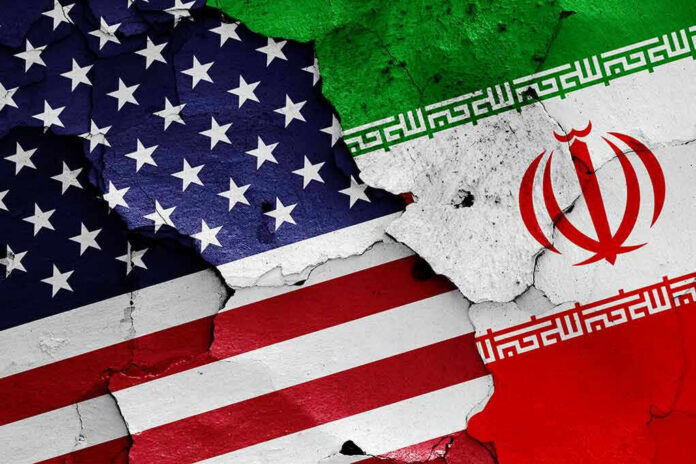
newsworthy.news — Tehran’s sudden “suspension” of U.S. talks looks more like leverage theater than diplomacy—while the White House says the channel is still moving at a rapid clip [1][8].
Story Highlights
- Iran’s state media announced a halt to indirect talks with the U.S., linking it to Israeli strikes in Lebanon [1][2].
- President Trump said negotiations are still moving at a “rapid pace,” rejecting the idea of a full breakdown [1][8].
- Reports indicate the channel is mediator-based, making “suspension” a pressure tactic rather than a formal rupture [1][2].
- The lack of a public ceasefire text fuels narrative warfare over what Lebanon’s role actually is [1][2].
Iran’s Announcement And The Stated Link To Lebanon
Iranian outlets tied to the regime declared a suspension of indirect communications with the United States, asserting Israeli military activity in Lebanon as the trigger. Coverage summarized Tehran’s claim that talks and the exchange of texts through a mediator were halted due to the “continuation of the Zionist regime’s crimes in Lebanon,” explicitly tying Lebanon to the ceasefire context [1]. Independent reporting echoed that Tehran framed the pause as a protest conducted “via mediators,” not a collapse of all contact, underscoring the announcement’s tactical character [2].
Television reports amplified Tehran’s framing, noting that Iran was halting talks with Washington and warning of broader escalation tied to Israel’s actions in Lebanon. The clips relayed that Iranian state media cast the move as conditional on developments there, with rhetoric suggesting readiness to widen conflict fronts if demands were unmet [3]. Additional segments repeated that the suspension was a response to Israeli strikes and presented it as part of a broader pressure campaign synchronized with battlefield narratives [4].
U.S. Response: Keep The Diplomatic Lights On
President Trump countered the suspension storyline by stating talks were continuing at a “rapid pace,” signaling that Washington would not accept a diplomatic freeze as the new normal [1]. In a separate appearance, he reiterated that negotiations were moving despite Tehran’s assertion, maintaining a posture that continuity is both possible and necessary even amid conflict turbulence [8]. That stance projects steadiness, refusing to cede initiative to public theatrics that often accompany indirect, mediator-run negotiations [1][2].
Reports stressed that the channel at issue was indirect and mediator-based. That structure allows Washington to argue that communications can persist despite regional flare-ups, avoiding an all-or-nothing frame that hands Tehran a veto over progress every time rockets fly. By not adopting Iran’s cessation language, the administration preserves room to maneuver, keeps partners engaged, and denies adversaries the headline that America walked away from de-escalation efforts [1][2].
The Documentation Gap And Why It Matters
Coverage highlighted a crucial uncertainty: there is no public ceasefire document clarifying whether Lebanon was explicitly within the operational scope Iran invokes. Without text, each side can advance competing claims, with Tehran asserting linkage and Washington focusing on continuity rather than litigating scope in public [1][2]. That ambiguity rewards narrative warfare. It lets Iran posture as the aggrieved party while the U.S. emphasizes process—useful in keeping channels alive, but vulnerable to charges of opacity and mixed messaging [1][2].
This pattern fits a familiar Middle East dynamic: indirect bargaining under fire, where pauses and resumptions often serve as signaling moves as much as substantive steps. Tehran’s public “halt” message pressures mediators and tries to fracture allied unity; the U.S. counters by denying any real break, assuring partners that diplomacy is still the pressure valve. Until verifiable terms surface, both sides trade leverage claims, and audiences must parse statements against actions on the ground [1][2][3][4].
What Conservatives Should Watch Next
Americans should press for transparency that protects our interests: the operative ceasefire language, any side letters, and mediator notes defining Lebanon’s status. Clear terms deter bad-faith manipulation and keep pressure focused on the regime most responsible for regional proxy violence. The administration’s refusal to concede a diplomatic collapse signals resolve, but Congress and the public deserve documentation that ties negotiations to enforceable limits on Iran’s escalation playbook and its use of fronts beyond Gaza [1][2].
🌍 Iran Suspends US Talks, Escalation Risk Surges
Iran's Revolutionary Guards declared 'no dialogue' expected with Washington on Monday, collapsing ceasefire momentum. Trump said talks were moving fast, but Tehran's suspension leaves energy markets with no diplomatic off-ramp in…
— Gulf Sentinel (@Gulf_Sentinel) June 2, 2026
Energy security, deterrence, and constitutional oversight intersect here. Higher oil prices and global uncertainty follow when Iran weaponizes ambiguity; firm U.S. messaging must be matched by verifiable guardrails. Demanding clarity on mediation channels, timelines, and triggers for snapback consequences aligns with limited government and peace through strength—talk when it serves American security, and hold adversaries accountable when they convert “pauses” into propaganda and pressure against our allies [1][2][8].
Sources:
[1] Web – Iran Suspends US Negotiations as Middle East Ceasefire Efforts Unravel
[2] Web – Trump says Iran talks continuing at “rapid pace” after regime …
[3] Web – Iran suspended negotiations via mediators with US, state media says
[4] YouTube – Iran says it’s suspending talks with U.S., opening “other …
[8] Web – 2025–2026 Iran–United States negotiations – Wikipedia
© newsworthy.news 2026. All rights reserved.