newsworthy.news — A massive new missile-buying push in the Indo-Pacific raises a tough question for taxpayers: is the U.S. Army’s request for 857 THAAD interceptors smart deterrence—or another opaque Pentagon spending surge?
Story Snapshot
- The U.S. Army is asking for 857 Terminal High Altitude Area Defense (THAAD) interceptors in its Fiscal Year 2027 budget, one of the largest such buys ever.
- The Pentagon frames the request as essential to counter growing ballistic missile threats in the Indo-Pacific region.[1][2]
- Public documents confirm the scale and cost but do not clearly show why this exact quantity is needed or how it will be used.[1][4][5]
- Conservatives now face a familiar dilemma: support strong missile defense while demanding transparency, accountability, and a clear strategy for America‑first security.
Army’s 857‑Missile Request Signals Major Indo‑Pacific Buildup
According to Fiscal Year 2027 budget documents, the U.S. Army is preparing a major expansion of its Terminal High Altitude Area Defense missile arsenal, requesting 857 interceptors for Indo-Pacific defense.[1] Reporting describes this as one of the largest Terminal High Altitude Area Defense interceptor procurements the service has ever pursued, a clear signal that planners expect sustained missile threats and potentially prolonged operations.[1][2] The Army links this surge to the need to reinforce deterrence and protect U.S. forces and allies in a theater dominated by long-range ballistic systems.[1][2]
Army reporting notes that, alongside 830 interceptors funded through mandatory appropriations, this new request would significantly increase the Army’s ability to sustain missile defense during an extended conflict.[1][5] The request is tied to broader Indo-Pacific plans, where U.S. and allied forces rely on layered missile defense networks to protect forward bases, logistics hubs, and key infrastructure.[1][3] For conservatives, the core question is not whether to defend American troops, but whether this surge is being sized and explained in a way that respects Congress, taxpayers, and honest oversight.
What THAAD Does—and How Much Capacity Already Exists
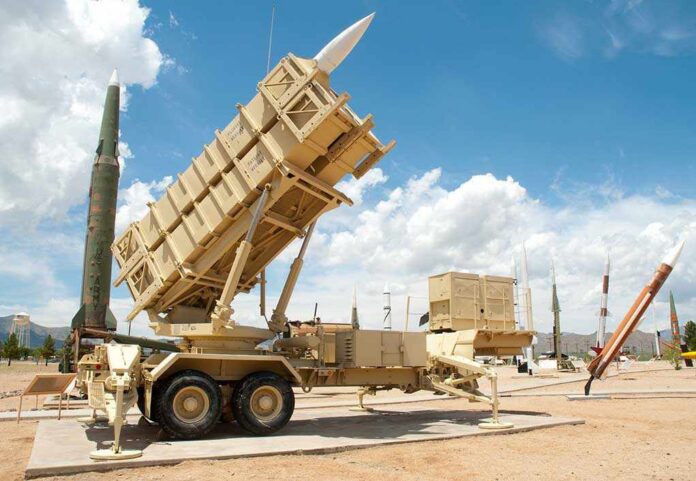
Terminal High Altitude Area Defense is designed to intercept short, medium, and some intermediate-range ballistic missiles during their final flight phase, using hit-to-kill technology instead of an explosive warhead.[2][4] A Terminal High Altitude Area Defense battery typically includes six truck-mounted launchers, each with eight interceptors, plus radar and fire control systems, for 48 interceptors per battery.[3][4] Congressional research reports indicate the Army currently fields seven Terminal High Altitude Area Defense batteries, giving it a doctrinal capacity of more than 300 on-launcher rounds at any one time.[4]
A 2024 congressional report further notes that the Missile Defense Agency had delivered 799 operational Terminal High Altitude Area Defense interceptors by 2023, providing a significant stockpile even before the new 857-missile request.[4] That means the Army is seeking to expand an already large inventory rather than simply replacing a small number of expended interceptors.[1][4] Supporters argue this reflects real-world experience that any high-end conflict can burn through stocks quickly, especially if adversaries attempt to overwhelm defenses with massed launches.[1][2] Critics, however, question whether the public has enough data to judge the claim.
Threats, Transparency, and an America‑First Standard
Open-source analysis of U.S. and allied missile defenses in the Asia-Pacific shows a steady build-up over the last decade, including forward-deployed Terminal High Altitude Area Defense batteries in the region to counter regional ballistic threats.[3] Defense reporting explains that the Fiscal Year 2027 request is justified publicly as an answer to advanced missile developments by regional adversaries and the risk of saturation attacks on U.S. bases and partners.[1][2][5] Yet the underlying threat models, war-game assumptions, and expenditure rates used to pick the number 857 are not disclosed in detail for public scrutiny.[1][4]
This lack of transparency creates a familiar tension for conservatives who back strong deterrence but reject blank-check globalism and wasteful spending. The pattern is one many voters recognize: a massive procurement is framed as urgent and essential, while the sizing logic and long-term strategy remain classified or vague.[1][4][5] An America‑first approach would insist on three basics: clear explanation of why this quantity is needed, firm prioritization of U.S. homeland and forces over foreign commitments, and tough oversight to avoid runaway costs documented in earlier Terminal High Altitude Area Defense acquisition reviews.[5]
Sources:
[1] Web – U.S. Army Requests 857 THAAD Interceptors for Indo-Pacific
[2] Web – U.S. Army Requests 857 THAAD Air Defense Interceptors in Major …
[3] Web – Terminal High Altitude Area Defense – Wikipedia
[4] Web – US Army seeks 857 THAAD interceptors in major 2027 surge
[5] Web – Terminal High Altitude Area Defense (THAAD) – Lockheed Martin
© newsworthy.news 2026. All rights reserved.