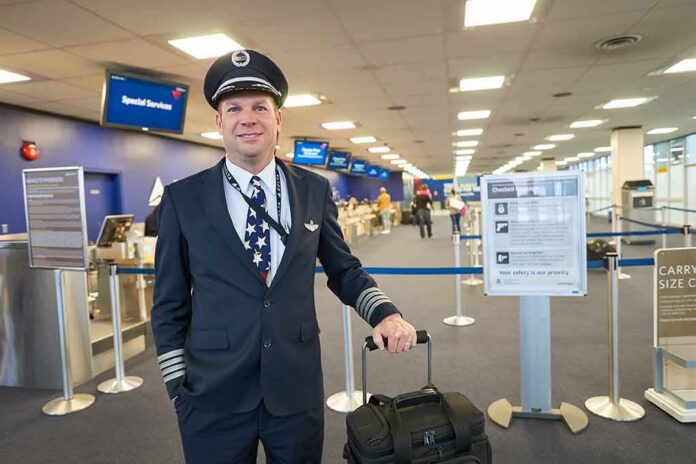
A commercial airline pilot allegedly flew hundreds of passengers while high on multiple hard drugs, with a suitcase packed full of ecstasy waiting in the baggage hall.
Story Snapshot
- Indonesian officials say a Malaysia Airlines pilot landed in Jakarta with over 70,000 ecstasy pills in his luggage.
- Authorities report the 39-year-old pilot’s urine test came back positive for methamphetamine, ecstasy, and cocaine after the flight.
- Officials say he admitted acting as a paid drug courier and having moved narcotics on earlier trips.
- The pilot now faces Indonesia’s harsh drug laws, including the possibility of the death penalty.
Pilot Arrested After Drug-Filled Suitcase Flagged at Jakarta Airport
Indonesian customs officers at Jakarta’s Soekarno-Hatta International Airport say they first spotted the case during a routine X-ray scan of arriving baggage from Kuala Lumpur. Officials describe the suitcase as “suspicious,” so they pulled it aside and waited to see who would claim it. When a 39-year-old Malaysian man, identified only as “MS,” collected the bag, customs staff escorted him to an inspection room. They later confirmed he was the pilot of Malaysia Airlines flight MH727 from Kuala Lumpur to Jakarta.
Inside the suitcase, officers say they found 14 large packages of tablets. Police later counted more than 70,000 pills, described as the party drug ecstasy, with a total weight of about 26 kilograms. Officials also report finding a separate package of methamphetamine in his belongings, believed to be for personal use. Authorities displayed the seized drugs at a joint press conference at the airport, using the case to highlight the scale of cross-border trafficking.
Alleged Drug Use While Flying and Claims of Courier Role
After the arrest, Indonesian narcotics investigators ordered a urine test on the pilot. Officials say the test showed positive results for methamphetamine, ecstasy, and cocaine. An airport customs official told reporters that this meant the pilot was under the influence of these drugs while operating the passenger flight into Jakarta. That claim has not been tested yet in court, but it raises serious questions about airline safety and oversight when someone with that level of impairment is at the controls.
During questioning, investigators say the pilot admitted he was acting as a courier for a trafficking network. Police officials state he told them another person instructed him to bring the ecstasy into Jakarta in exchange for 50,000 Malaysian ringgit, worth around twelve thousand U.S. dollars. Indonesian authorities also say he described two earlier drug runs: one delivering methamphetamine to Sabah in Malaysia, and another moving seven kilograms of methamphetamine to Jakarta. These statements are reported as police claims and will likely be key evidence if the case goes to trial.
Harsh Indonesian Drug Laws and Wider Trust Concerns
Indonesia is known for some of the toughest drug laws in the world, including the death penalty for major trafficking offenses. Officials and local media have already noted that the amount of ecstasy involved and the pilot’s alleged courier role could put him at risk of capital punishment if convicted. For many readers, that harsh response reflects a state trying to show strength on crime. For others, it raises fears about uneven justice and how much power officials hold over ordinary people once they are accused.
Malaysia Airlines 737 pilot arrested at Jakarta ’s international airport for smuggling more than 26 kilograms (57 pounds) of ecstasy and a package of methamphetamine in his luggage.
The case was uncovered late Tuesday when customs officers inspecting baggage at the international… pic.twitter.com/UVSoBCcZA4
— Breaking Aviation News & Videos (@aviationbrk) July 31, 2026
This case also hits a deeper nerve about trust in institutions. Many people already worry that big systems—governments, airlines, regulators—protect insiders while forgetting regular citizens. Seeing a pilot, one of the most trusted jobs in travel, accused of flying while high on cocaine, methamphetamine, and ecstasy reinforces the sense that the system is asleep at the wheel. People on both the left and right ask how someone in that condition passed medical checks, drug screens, and company oversight.
What This Says About Oversight, Safety, and Accountability
Malaysia Airlines has said it will cooperate fully with Indonesian investigators and takes the allegations seriously, but it has not shared many details while the probe continues. That careful statement is common in such cases, yet it can feel thin to travelers who want clear answers about how often pilots are tested and how quickly problems are caught. At the same time, this story shows how much power airport customs and police hold: they shape the first narrative, and media around the world repeat it long before any court verdict.
For Americans and others watching from afar, the story fits a wider pattern. People see elites and big organizations claim to protect them, yet real oversight often breaks only after a crisis. Whether it is a drug-fueled pilot, a failed regulator, or a distant bureaucracy, many feel the people in charge close ranks to guard their image first and fix the problem later. That shared frustration—felt by conservatives and liberals alike—drives growing doubt about how well major institutions are doing their most basic job: keeping the public safe.
Sources:
reddit.com, apnews.com, washingtonpost.com, youtube.com, theedgemalaysia.com
© newsworthy.news 2026. All rights reserved.