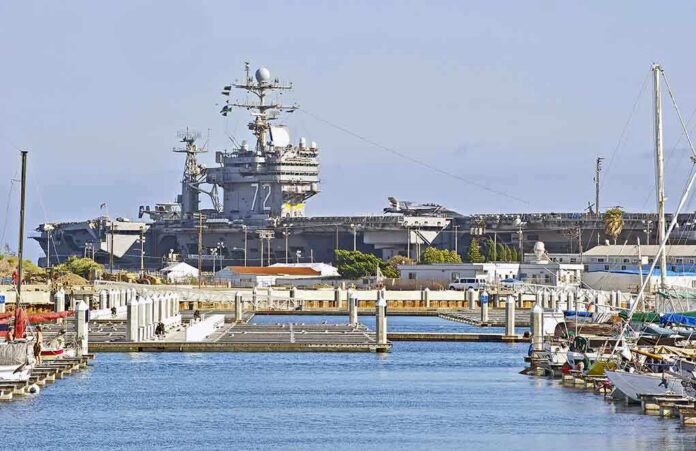
America’s shipyards are struggling to keep up, and that weakness is now biting the Navy at the exact moment the country needs strength.
Quick Take
- Government and policy analysts say U.S. naval shipbuilding is behind schedule across major programs, including submarines and surface ships [2][3].
- Commercial shipbuilding has also withered, leaving the United States with a far smaller industrial base than it once had [1][3].
- Long build times and workforce shortages are slowing fleet growth even as threat levels remain high [2][3].
- The Trump administration is facing a defense-industrial problem built over decades, not a quick fix [2][3].
Shipbuilding Delays Are Now a Strategic Problem
The latest research shows that American shipbuilding is not just inefficient; it is too slow to support the Navy’s needs. Analysts say the service’s major construction programs are running late, with some ships delayed by a year or more and the lead Constellation-class frigate more than three years behind schedule [2]. The Columbia-class ballistic missile submarine program is also slipping, which matters because submarines remain one of the Navy’s most important deterrent assets [2][3].
That delay problem helps explain why the fleet has struggled to grow even after years of large budgets. The Congressional Budget Office (CBO) has warned that longer construction timelines leave the Navy smaller than it otherwise would be, and one projection places the fleet near 283 ships by 2027 [3]. For readers who watched Washington spend heavily while results lagged, that is the familiar story of money poured into a system that cannot translate dollars into delivered hulls fast enough [3].
An Industrial Base Hollowed Out Over Decades
The deeper issue is not one bad program but a long decline in domestic shipbuilding capacity. One historical analysis found that U.S. commercial shipbuilding fell sharply after the 1980s, and the nation has built only a tiny number of oceangoing commercial ships in recent years [1][3]. The same decline shows up in naval work, where fewer active yards, higher costs, and slower production have left the country dependent on a narrow set of specialized facilities [1][3].
That shrinkage has consequences beyond headline ship counts. When shipyards cannot deliver efficiently, the Navy pays more, waits longer, and gets less flexibility in return. The research points to workforce retention problems, aging labor pools, and uncertainty created by changing procurement goals [2][3]. Those are exactly the kinds of failures that frustrate taxpayers who want hard results, not endless studies, and they are the kind of industrial weakness that can weaken national security without a single shot being fired [2][3].
What the Evidence Says About the Trump Administration’s Challenge
The evidence does not show a sudden collapse under the current administration. It shows a long-running problem now landing on the Trump team’s desk with no easy repair. The CBO says the Navy would have a much larger fleet today if it could still build destroyers and submarines as quickly as it once did [3]. At the same time, policy leaders are publicly describing industrial-base rebuilding as underway, which suggests the administration sees the problem as fixable but not quickly reversible .
That is the central takeaway for conservatives who have watched years of globalist neglect, bloated budgets, and bureaucratic drift hollow out core American capacity. The United States still possesses world-class naval engineering, but the research makes clear that design delays, workforce gaps, and sluggish production have become a real constraint [2][3]. Until shipyards can turn investment into ships on time, the Navy will remain smaller and less ready than the nation needs [2][3].
Sources:
[1] YouTube – The US Navy’s Shipbuilding Crisis is Worse Than We Thought
[2] Web – America’s Shipbuilding Crisis: What the New Forbes Report Means …
[3] Web – [PDF] The impact of declining Navy budgets on United States shipyards