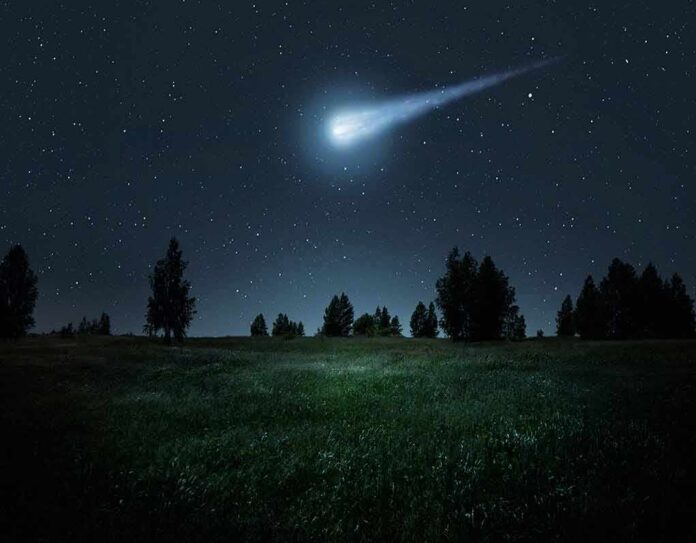
A massive 1973 shockwave that rattled homes from Indiana to New York was likely an SR-71 Blackbird’s sonic boom, not a meteor.
Story Snapshot
- Newspaper reports in October 1973 blamed a multi-state shockwave on a meteorite, citing a Penn State expert.
- An SR-71 pilot later detailed a Mach 3 flight path that matches the reported shockwave corridor.
- National Aeronautics and Space Administration (NASA) studies confirm SR-71 sonic booms at speeds up to Mach 3.0.
- No primary meteor records or impact evidence surfaced to support the meteorite claim.
What People Heard In 1973 And Why A Meteor Was Blamed
Newspapers on October 12, 1973 carried reports of a shockwave felt from Indiana to New York. A Penn State expert named Dr. Alexander said it was conceivable a meteor entering the atmosphere caused it. The Air Force said it would look into the event, and the meteor idea stuck in the public mind. No matching meteor observation, impact record, or fragment recovery has been presented in the available materials, which weakens that early guess.
Physics supports why a meteor was plausible to readers. Fast objects in air create shock waves that can travel far and sound like thunder. That pattern matches what people heard across several states. But “plausible” is not proof. Without time, path, and data, a dramatic story can become the default version. That is how simple explanations take hold when officials stay quiet or slow-walk details.
The Blackbird Flight That Fits The Time And Path
Retired Lieutenant Colonel James Shelton later described an SR-71 mission in aircraft number 979. He said he launched on short notice, refueled over Nevada, then raced east at about 80,000 feet and Mach 3. His route passed south of Chicago and north of Indianapolis toward Griffiss Air Force Base in New York. He recalled seeing both cities’ lights and believed the aircraft’s shock wave was reaching the ground over a wide area that day.
That track lines up with where the shock was felt in the news reports. It also explains why the disturbance spanned multiple states. The SR-71’s boom is not a single “bang.” It is a moving pressure front that sweeps under the flight path. People on the ground hear it as sharp thunder-like reports. At Beale Air Force Base, Shelton said there was an office that handled sonic boom complaints full time, showing how common these events were during that era.
What NASA’s Data Proves About SR-71 Sonic Booms
NASA tested and measured SR-71 shock waves for years. The agency recorded sonic-boom pressure signatures at altitudes between roughly 35,000 and 80,000 feet, and at speeds up to Mach 3.0. Those signatures matched the classic “N-wave” pattern heard as a double bang on the ground. The research also gathered ground measurements to study how the boom spreads and changes as it travels through the atmosphere.
NASA also used the Blackbird in programs to explore how to reduce the loudness of booms. That work confirmed that conditions like speed, altitude, and air can change the boom feel at long distances. Together, these facts support a straightforward point. A Mach 3 SR-71 flying the route described could cause a wide-area shockwave that fit the 1973 reports, without any need for a rare meteor event.
Why The Record Stayed Murky For So Long
The meteor quote offered a tidy public story at the time. The Air Force did not publish a clear correction tied to the October 1973 event in the materials found here. That silence left room for the meteor idea to persist in retellings. Years later, aviation reporting highlighted Shelton’s account and NASA’s sonic-boom data. That specific evidence now outweighs the early speculation, but it took decades to surface in public view.
This pattern feeds distrust across the political spectrum. People see officials keep quiet while simple stories harden. Then better facts appear later. When agencies and experts do not close the loop, citizens feel misled. The fix is not more spin. The fix is fast, plain disclosures with data. On this case, the most supported reading is clear. The 1973 shockwave fits an SR-71’s sonic boom far better than a meteor crossing the sky.
Sources:
19fortyfive.com, archive.org, phys.libretexts.org, nasa.gov
© newsworthy.news 2026. All rights reserved.