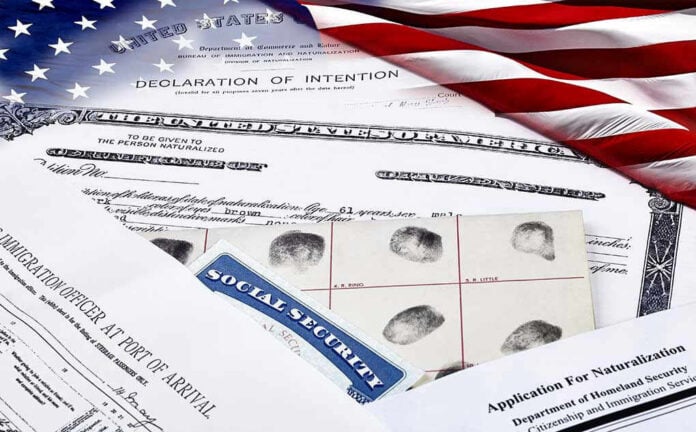
A sweeping new Trump denaturalization push is targeting naturalized citizens who allegedly lied or hid serious crimes, igniting a fight over whether this is long-overdue law enforcement or a dangerous tool the Left will use to scare immigrants into silence.
Story Snapshot
- The Trump administration is pursuing the largest-ever wave of denaturalization cases, starting with at least 17 citizens accused of immigration fraud and other crimes.
- Federal law requires the government to go to court and prove fraud or ineligibility; no agency can simply “flip a switch” and cancel citizenship.
- Supporters say this protects the value of citizenship and punishes criminals who lied; critics warn of mission creep and civil-liberties risks.
- Conservatives must watch closely to ensure tough enforcement does not become a future weapon against law‑abiding, outspoken Americans.
Trump’s Denaturalization Drive: What Is Actually Happening
The Trump administration has launched what officials describe as the largest coordinated denaturalization effort in modern history, moving to revoke the citizenship of at least 17 people accused of immigration fraud and other serious crimes.[5][1] The Department of Justice (DOJ) and allied agencies are combing through old naturalization files to identify cases where people allegedly concealed deportation orders, used multiple identities, or lied about criminal activity when they applied for citizenship.[3][7] Officials frame the campaign as simple accountability: if citizenship was obtained through fraud, it was never valid in the first place, and revocation simply corrects the record.[4]
In public announcements, the Department of Justice has highlighted cases involving gun trafficking, healthcare fraud, and other serious offenses, underscoring that at least some targets are not minor paperwork violators but people already convicted of dangerous or costly crimes.[4] A recent press release described denaturalizing a Ukrainian-born gun smuggler who hid his role in exporting more than a thousand firearm components, along with actions against individuals tied to large-scale healthcare fraud and marriage fraud.[4] Advocates of stronger enforcement argue that letting such people keep U.S. citizenship cheapens the sacrifices of lawful immigrants who followed the rules and of native-born Americans who respect the law.
How Denaturalization Works – And What Government Cannot Do
Despite alarmist rhetoric on social media, denaturalization is not an administrative button that the White House, the Department of Homeland Security, or U.S. Citizenship and Immigration Services can press on their own.[6][5] The Immigrant Legal Resource Center and other legal guides explain that citizenship can only be revoked through a case filed by a U.S. attorney in federal court, where the government must present evidence and the citizen has a right to defend themselves.[6][5] Courts apply demanding standards, requiring proof that the person was never actually eligible for naturalization, usually because of material fraud, misrepresentation, or in some instances prior serious criminal conduct.[6][8] Even critics acknowledge that agencies cannot legally yank citizenship by memo or internal policy change alone.[6][5]
Historically, denaturalization has been rare and reserved for extreme situations, such as former Nazi collaborators or war criminals who hid their pasts to enter the country.[6] Under prior administrations, priority generally went to people tied to national security threats, human rights abuses, or major criminal convictions that were concealed during the naturalization process.[6] During Trump’s first term, officials expanded efforts to review hundreds of thousands of old files for fraud flags and filed dozens of additional cases, building the foundation for today’s larger push.[3][7] That trajectory—rare tool to structured program—explains why civil-liberties groups are nervous even as they concede the underlying legal framework has not changed.
Critics Warn of Overreach and a Chilling Effect
Progressive advocacy organizations argue that the Trump administration has turned denaturalization from an extraordinary remedy into a routine enforcement priority, with new internal guidance urging field offices to feed a steady pipeline of potential cases.[2][5] Groups like the American Immigration Lawyers Association warn that once a bureaucracy is tasked with “finding fraud,” there is pressure to stretch the definition, ensnaring people whose mistakes were minor or unrelated to public safety.[2] Commentators note that the Department of Justice recently broadened its own priority list to include associations with gangs or cartels and various forms of financial fraud, fueling concerns that the campaign could grow beyond the most egregious offenders.[6][5]
Civil-liberties analysts also emphasize what is at stake: citizenship is supposed to be the secure status that lets people put down roots, raise families, and speak their minds without fear of exile if the political winds change.[8] The Brennan Center has pointed out that the Supreme Court has repeatedly blocked attempts to strip citizenship for political beliefs, minor infractions, or after-the-fact disapproval of a citizen’s views, insisting that denaturalization must be tied to actual fraud or mistake at the time of naturalization.[8] Critics worry that aggressive fraud-hunting—especially if paired with heated rhetoric about immigrants—could intimidate naturalized citizens from engaging in civic life or criticizing government policies, which would undercut core First Amendment values.[8]
What This Means for Law‑Abiding Conservatives and Their Families
For conservative readers who support secure borders and the rule of law, there is a crucial distinction: targeting genuine fraudsters who lied about crimes or national-security threats protects the integrity of citizenship; using denaturalization as a broad political weapon would threaten the very constitutional order we defend.[4][6] Legal fact sheets stress that for ordinary naturalized Americans—people who told the truth on their applications and have not hidden serious crimes—there has been no change to foundational rights like traveling, voting, and returning to the United States.[6][7] Citizenship still cannot be revoked for lawful political activity, religious belief, or mere association, despite breathless claims from some commentators.[8]
The Trump administration announces its largest, unprecedented denaturalization campaign.
The actual campaign: pic.twitter.com/O1VvriIv7y
— The Constitutionalist 🇺🇸 (@WeWillBeFree24) June 8, 2026
At the same time, conservatives understand that powerful tools created under one administration can later be abused by another. The infrastructure Trump is building—file reviews, dedicated units, and legal precedents—will remain in place if a future left-wing administration decides to redefine “fraud” or “extremism” in ways hostile to traditional values.[3][2] Vigilant oversight, clear statutory limits, and a continued insistence on court review are therefore essential. Properly constrained, denaturalization can punish criminals who gamed the system; without those guardrails, it could become yet another lever for bureaucrats and activists to punish dissent and reshape the electorate.
Sources:
[1] Web – The Trump Administration Launches the Largest-Ever Denaturalization …
[2] Web – The Denaturalization of U.S. Citizens – Democracy Forward
[3] Web – Featured Issue: Denaturalization
[4] Web – Justice Department Secures the Denaturalization of Convicted Gun …
[5] Web – [PDF] How Denaturalization Works – Immigrant Legal Resource Center
[6] Web – Trump administration launches largest-ever effort to denaturalize …
[7] Web – Denaturalization: Fact Sheet – National Immigration Forum
[8] Web – Trump’s Push to Redefine Who Counts as American
© newsworthy.news 2026. All rights reserved.