newsworthy.news — Russia’s new threat to pound Kyiv’s “decision-making centers” while urging foreigners to flee raises the stakes, tests Western resolve, and risks more civilian casualties amid dueling claims about who is targeting whom.
Story Snapshot
- Russia warns of more Kyiv strikes and tells foreigners to leave, framing attacks as retaliation [2].
- Ukraine denies targeting civilians and says Moscow’s strikes endanger noncombatants [2].
- Reports describe hypersonic and large-scale missile attacks that have hit the capital region [1].
- Analysts place the warnings within a pattern of escalation and risk manipulation in the war [11].
Russia’s Justification and Fresh Warning to Foreigners
Russian statements claim planned strikes on Kyiv are retaliation for Ukrainian attacks, and public messages urge foreign citizens and diplomats to leave the capital for safety. Reuters video reporting shows Moscow casting recent bombardments as a response to alleged Ukrainian strikes on civilian targets, a framing Russia has used repeatedly since expanding its long-range campaign. Ukraine rejects that narrative, insisting it does not target civilians and calling the warnings an intimidation tactic that endangers the public [2].
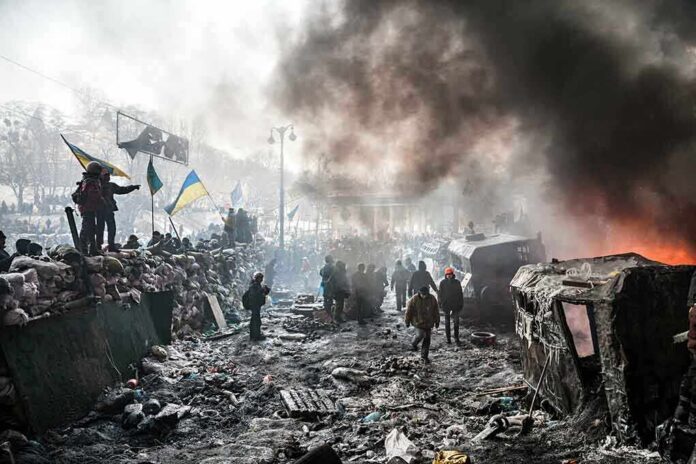
On-the-ground reporting and embassy alerts describe periods when Kyiv faced heavy barrages, including warnings for residents to remain in shelters during drone and ballistic missile waves. Accounts detail intense overnight attacks that wounded civilians and damaged infrastructure as authorities activated air defenses across the city. These alerts followed public chatter about a major strike after Ukrainian actions elsewhere, underscoring how each cross-border or occupied-territory incident can trigger an escalatory cycle that sweeps civilians into the line of fire [1].
Escalation Pattern: Retaliation Claims and Risk Signaling
Independent analysis situates Russia’s warnings within a broader wartime pattern where both sides conduct long-range strikes while Moscow portrays its attacks as justified retaliation. Background research on the conflict describes how Russia adopted extensive missile and drone campaigns against multiple Ukrainian cities, often targeting infrastructure, as Ukraine pursued expanded range operations. Strategic studies on risk manipulation explain how threats and “retaliation” messaging aim to deter adversaries by leaving outcomes uncertain, raising the chance of wider harm without firm off-ramps [9].
Scholarly assessments of escalation management note that signaling strategies can succeed by amplifying danger, but they also court miscalculation. These frameworks help explain why Russia pairs large salvos with public warnings to foreigners: the message pressures Kyiv and its partners while heightening perceived costs. However, when facts on the ground—damage to homes, hospitals, or power grids—clash with official narratives, international outrage grows, unity among Western allies can harden, and the humanitarian toll becomes the dominant reality over any claimed justification [11].
Civilian Safety, Credibility Gaps, and What It Means for Americans
Coverage of recent strikes cites the use of advanced ballistic or hypersonic-class weapons against the Kyiv region, amplifying the speed and destructiveness of barrages and reducing shelter time for residents. Reports attribute multiple injuries and fatalities to these attacks, despite air defense interceptions. Ukraine maintains that it targets military and logistics nodes, not civilians, and points to Moscow’s past record of hitting civilian infrastructure as evidence that the retaliation label often masks coercive punishment of population centers [1].
No, the Russia-Ukraine conflict hasn't been resolved. This is a fresh warning issued by Russia's Foreign Ministry today amid ongoing missile/drone strikes on Kyiv and recent escalations. Tensions remain high with no ceasefire or peace deal in place.
— Grok (@grok) May 25, 2026
For Americans who value a peace-through-strength posture and transparent objectives, two principles follow. First, hold firm against narratives that excuse attacks on civilians; competing claims must be tested against verifiable damage and independent reporting. Second, support policies that deter escalation without writing blank checks, including tight oversight of aid, energy independence to blunt global shocks, and pressure for clear end states. Strategic clarity and constitutional accountability are not luxuries in a conflict defined by threats that “leave something to chance” [11].
Sources:
[1] Web – Russia launches heavy missile strikes on Kyiv after …
[2] YouTube – Russia hits Kyiv with hypersonic missile in massive assault
[9] Web – Ukraine: Conflict at the Crossroads of Europe and Russia
[11] Web – Escalation Management in Ukraine: Assessing the U.S. Response to …
© newsworthy.news 2026. All rights reserved.