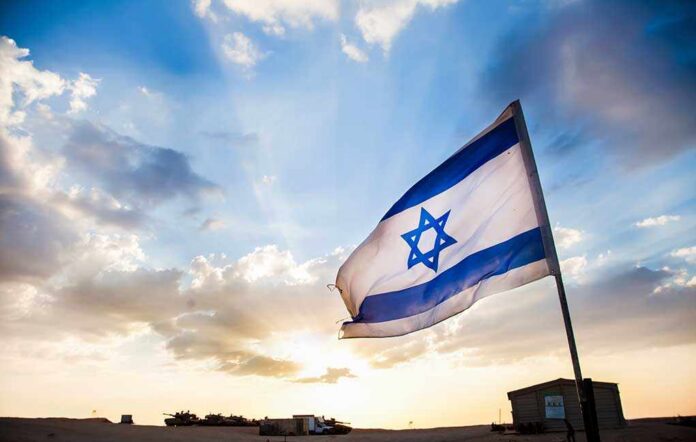
Reports that Israel ran a covert base in Iraq with Washington’s knowledge raise explosive questions about sovereignty, accountability, and who is authorizing what in America’s name.
Story Snapshot
- Wall Street Journal reporting, echoed by multiple outlets, alleges Israel built and defended a secret logistics base in western Iraq during the Iran war timeline [1][3][4][5].
- A shepherd’s tip reportedly prompted an Iraqi probe before airstrikes hit approaching Iraqi troops, preventing exposure of the site [1].
- Accounts conflict on whether the United States knew; some summaries say unaware, while the original framing cites Washington’s knowledge [1][2].
- Iraq filed a United Nations complaint blaming the United States for the strikes, while a source insisted U.S. forces were not involved [1].
Alleged Secret Base And The Shepherd’s Tip-Off
Wall Street Journal-sourced reporting, relayed by i24News and regional outlets, says Israel established a covert logistics and search-and-rescue hub in Iraq’s western desert shortly before major operations against Iran, with assertions that Washington knew about the setup [1][3][4][5]. Coverage says a local shepherd noticed unusual helicopter activity in early March and alerted Iraqi authorities. Iraqi troops moved to investigate and were then struck by airstrikes that stopped them from reaching the site, according to those accounts [1].
BREAKING: Israel reportedly built a secret base inside Iraq ahead of a possible war scenario with Iran, according to WSJ. Middle East tensions are escalating. 👀#Israel #Iran #Iraq #MiddleEast #Geopolitics #BreakingNews #WSJ #WorldNews #IsraelIranConflict
— CMJ (@cmjanaofficial) May 10, 2026
These reports add that Israeli forces used the location to support air operations and potential pilot recovery, though Israeli military officials declined comment, neither confirming nor denying the facility [1]. Outlets summarizing the Wall Street Journal’s story emphasize anonymous sourcing from people described as familiar with the matter, including United States officials, with no released imagery or documents publicly corroborating the base’s exact coordinates or infrastructure [1][2][3][4][5]. The lack of on-record Israeli confirmation keeps the narrative in a gray zone while regional media debate legality and intent.
Competing Claims On U.S. Knowledge And Iraqi Attribution
Accounts diverge on American awareness. The Wall Street Journal’s framing, as relayed by i24News, says the base was set up with Washington’s knowledge, and ties the effort to securing air operations during intense exchanges with Iran [1]. Separate summaries and commentary, however, claim the United States was unaware of the activity, creating a visible contradiction for readers trying to sort out the chain of custody and command [1][2]. That split matters for constitutional oversight, war powers, and transparency.
Iraqi officials escalated diplomatically, filing a United Nations complaint that attributed strikes on Iraqi troops to the United States, while one person cited in the reporting insisted U.S. forces did not conduct the strikes [1]. Lt. Gen. Qais Al-Muhammadawi, deputy commander of Iraq’s Joint Operations Command, reportedly stated the operation occurred without Baghdad’s approval, underscoring the sovereignty dispute without offering forensic disproof of an Israeli presence [1]. The unresolved attribution fuels regional friction and invites miscalculation.
Evidence Gaps, Anonymous Sourcing, And What’s Verifiable
Several core details remain unverified. Israeli officials declined comment; no named U.S. officials went on record; and no satellite imagery, inspection reports, or declassified logs have been presented publicly to confirm the base or the exact strike sequence [1][2]. Secondary reporting introduced claims about casualties and Iraqi counter-terror confirmations not matched by the Wall Street Journal’s specifics, highlighting how derivative coverage can stretch or muddle original assertions [1][2]. Without primary evidence, responsible readers should treat the narrative as plausible but unproven.
Still, multiple outlets across the spectrum repeated the base claim and the shepherd-triggered probe, indicating the story’s traction and the geopolitical stakes that come with it [3][4][5]. For conservatives who expect clear lines of authority, the contradiction on U.S. knowledge is the flashing red light. Either Washington green-lit an ally’s forward operating site on contested ground, or it was kept in the dark about actions that risked drawing American forces into a direct dispute with Baghdad—both scenarios demand scrutiny [1][2].
Why This Matters For U.S. Accountability And Security
American voters deserve to know what is undertaken with our country’s name, especially when Iraqi officials are lodging United Nations complaints implicating the United States for strikes our side says we did not carry out [1]. Clarity protects our troops, prevents diplomatic blowback, and upholds constitutional checks on the use of force. If Washington had knowledge, Congress and the public should see the legal rationale. If Washington lacked knowledge, the administration must explain how it prevents entanglement and misattribution.
Concrete steps can resolve the fog. Freedom of Information Act requests to the Department of Defense, United States Central Command, the State Department, and the United States Air Force could surface contemporaneous communications, operation logs tied to “Israeli operations in Iraq February–March 2026,” and any pilot rescue coordination references connected to the reported timeline [1][2]. Iraqi Joint Operations Command records, if released, and commercial satellite imagery from the cited window could either corroborate or contradict the narrative. Facts—not anonymous whispers—should drive policy.
Sources:
[1] WSJ: Israel Operated Secret Base In Iraq During Iran War … – i24 News
[2] Israel constructs secret military base in Iraq amid Iran conflict
[3] Report: Israel built secret Iraq base, struck forces that nearly exposed it
[4] Israel built secret base in Iraqi desert during war with Iran – report
[5] Israel said to have built secret base in Iraqi desert to support Iran air …