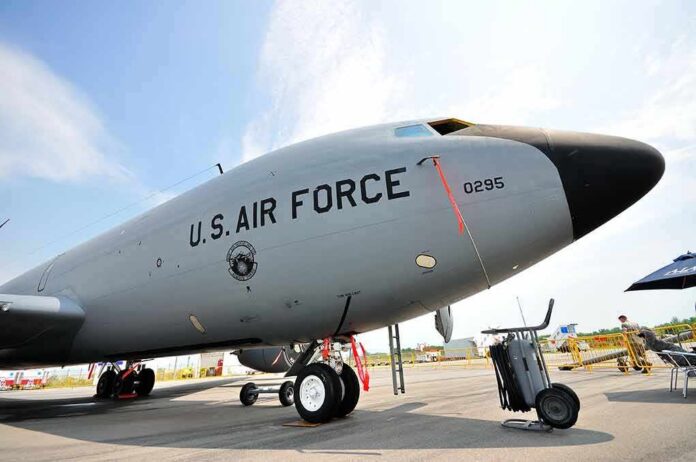
Air Force’s Dragon Cart program turns everyday cargo planes into missile trucks, flooding enemies with dozens of standoff strikes without needing pricey new bombers.
Story Highlights
- Dragon Cart achieved Program of Record status on April 30, 2026, securing Congressional funding for rapid deployment.[1][2]
- C-17 Globemaster III carries up to 45 cruise missiles; C-130J handles 12, using standard pallets with no aircraft mods.[5][6]
- Live-fire success in December 2021 destroyed a naval target with AGM-158 JASSM from MC-130J.[2][3]
- Affordable Family of Affordable Mass Munitions integrate at under $200,000 each for mass salvos.[6]
Program Transitions to Official Status
Air Force Life Cycle Management Center announced on April 30, 2026, that the Rapid Dragon program, now Dragon Cart, became a Program of Record.[1] Management shifted to the center’s Combat Readiness Directorate on April 1.[1] This status guarantees Congressional funding in future budgets.[2] The Air Force uses Middle Tier Acquisition-Rapid Fielding pathway for quick rollout.[1] Prototype contracts award in May 2026.[1]
Dragon Cart builds on experimental Rapid Dragon tests.[2] The system deploys palletized munitions from cargo aircraft like C-130J Hercules and C-17 Globemaster III.[2] Pallets use standard airdrop procedures without aircraft modifications.[5] Government controls weapons data and technology, speeding transition unlike legacy programs.[2]
Proven Testing and Massive Firepower Potential
In December 2021, an MC-130J airdropped a four-cell Rapid Dragon pallet over the Gulf of Mexico.[2] The system received targeting data in flight from a distant command node.[2] A live AGM-158 Joint Air-to-Surface Standoff Missile destroyed its naval target.[2][3] Earlier tests at White Sands and Eglin Air Force Base validated pallet deployment.[2]
C-17 accommodates five pallets with nine missiles each, totaling 45 Joint Air-to-Surface Standoff Missile-Extended Range munitions.[5][6] Each missile reaches 570 to 1,200 miles.[2] C-130 launches 12 such missiles.[5] The program started in December 2019, achieving first powered flight and live fire in 24 months.[3][4]
Affordable Munitions and Strategic Edge
Dragon Cart integrates Family of Affordable Mass Munitions, including Zone 5 Technologies Rusty Dagger and Co-Aspire Rapidly Adaptable Affordable Cruise Missile.[2] These cost under $200,000 each with over 575-mile range.[6] Air Force plans $12 billion for nearly 28,000 such missiles over five years.[6] Pallets support disposable, weapon-agnostic launches.[5]
🚨 Major USAF update: Rapid Dragon is now officially Dragon Cart. A full Program of Record! Announced April 30, 2026, this means guaranteed funding and rapid progress. By 2027, standard cargo aircraft like the C-130J Hercules and C-17 Globemaster III will be able to roll… pic.twitter.com/2IMjvEsiXz
— F-15 Eagle Vet🇺🇸 (@F15sRdaBest) May 10, 2026
U.S. Special Operations Command Europe conducted an overseas operational event.[4] The system expands strike options from standoff distances using government-owned battle management.[3] Fielding targets 2027, enhancing flexibility against peer threats without diverting bomber fleets.[6] Cargo aircraft operate beyond enemy defenses, multiplying firepower.[5]
Sources:
[1] U.S. Air Force Plans to Deploy Cruise Missiles from Cargo Aircraft by …
[2] Rapid Dragon (missile system) – Wikipedia
[3] RAPID DRAGON – Air Force Research Laboratory
[4] [PDF] RAPID DRAGON – Air Force Research Laboratory
[5] U.S. Air Force Targets 2027 Deployment for Cargo-Launched Cruise …
[6] Air Force’s Rapid Dragon, which turns cargo aircraft into missile …