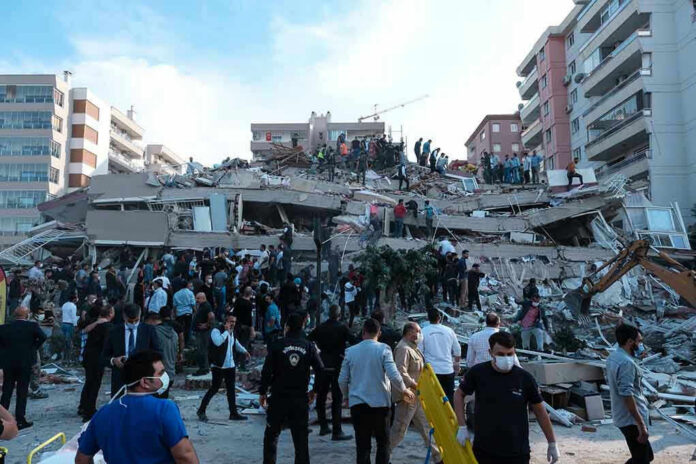
Israel’s military has intensified demolitions of residential buildings in Gaza City, issuing evacuation warnings before strikes — but critics and residents fear the destruction goes far beyond military necessity, raising urgent questions about what is really happening on the ground.
Story Snapshot
- The Israeli military has demolished multiple residential towers in Gaza City, including the Al-Ru’ya tower housing more than 30 families, after issuing last-minute evacuation warnings.
- The Israel Defense Forces (IDF) cite Hamas use of tall buildings to observe and attack Israeli troops, but the military declined a request to provide evidence in at least one documented case.
- Over 103 demolition operations were documented between October 10–30, 2025, continuing even after a ceasefire was reached, including in areas outside designated withdrawal zones.
- Nearly 80% of Gaza’s buildings have been damaged or destroyed, with 1.9 million people displaced — a scale of destruction that draws comparisons to the most devastating urban warfare campaigns in modern history.
IDF Cites Hamas Threat, But Evidence Remains Scarce
The Israel Defense Forces (IDF) have justified the demolition of high-rise and residential buildings in Gaza City by claiming Hamas used these structures to observe troop movements and launch attacks. IDF spokesperson Lt. Col. Nud Shashani stated there was “no strategy to flatten Gaza” and that the aim was to destroy Hamas. However, when pressed on at least one specific case — the Mushtaha Tower — the Israeli military declined a request to provide evidence of the alleged underground infrastructure it claimed Hamas operated beneath the building. [5]
Hamas has denied using tall buildings for military observation or attacks. While Hamas denials carry obvious credibility limitations given the group’s interests, the absence of publicly released IDF targeting dossiers, intelligence assessments, or post-demolition forensic findings leaves the military necessity argument unverified in the public record. Independent forensic analysis of demolition sites has not been conducted, and no neutral third party has confirmed or denied the presence of weapons caches or tunnel entrances in the rubble of targeted structures. [5]
Civilians Caught in the Crossfire of Urban Warfare
The Al-Ru’ya residential tower in western Gaza City was home to more than 30 families at the time of its demolition, with dozens of additional displaced persons sheltering in tents surrounding the building. The United Nations confirmed that last-minute evacuation warnings were issued before the strike, but no data has been released on whether all residents successfully evacuated, or whether any casualties resulted from the demolition. The gap between issuing a warning and ensuring safe evacuation in a war zone is significant. [2]
Resident accounts paint a grim picture. One Gaza City resident told Reuters he feared the destruction was aimed at permanently clearing the population from the area — a concern echoed by the United Nations Human Rights office. With nearly 80% of Gaza’s buildings damaged or destroyed by mid-2025 and 1.9 million people displaced, the humanitarian toll is staggering regardless of the military justification offered. [3] The United Nations has also confirmed famine conditions, compounding the civilian crisis well beyond the immediate impact of individual demolitions. [7]
Post-Ceasefire Demolitions Raise Serious Questions
Perhaps the most difficult aspect of this story for any objective observer is what happened after a ceasefire was reached. An investigation by Al Jazeera’s Sanad unit verified 103 demolition operations carried out by Israeli soldiers between October 10 and October 30, 2025 — after the ceasefire was in place and including sites outside designated Israeli withdrawal areas. [4] This timeline directly undermines the argument that all demolitions were operationally necessary responses to active Hamas threats.
Reports have also surfaced of private Israeli contractors being paid over $1,000 per day to conduct demolition work, with some posting videos of the destruction online. [1] This raises legitimate questions about the line between military necessity and something far more troubling. Urban warfare history offers sobering context: from Fallujah to Mosul to Raqqa, militaries have repeatedly justified massive structural destruction as essential to defeating embedded non-state actors — and the post-conflict reckoning has rarely been clean. Gaza’s reconstruction, already stalled amid a halted U.S. rebuilding plan, faces an almost incomprehensible scale of rubble. [6] The path forward demands transparency that, so far, neither side has fully provided.
Sources:
[1]
[2] GAZA / RESIDENTIAL BUILDINGS DESTROYED | UNifeed
[3] Destruction of cultural heritage during the Israeli invasion of the …
[4]
[5]
[6]
[7]