
Treasury says it traced about $14.7 billion in activity tied to Iran’s “shadow banking” and then moved to cut those pipelines off.
Story Highlights
- Treasury flagged about $14.7 billion in activity potentially linked to Iran’s shadow banking since 2025.
- Sanctions hit more than two dozen exchange houses, front firms, and personnel connected to those flows.
- Prior actions mapped how these networks moved billions for sanctioned Iranian banks and defense bodies.
- The pattern shows a long cat-and-mouse fight over oil money, foreign currency, and trade access.
Treasury’s New Findings and Enforcement Push
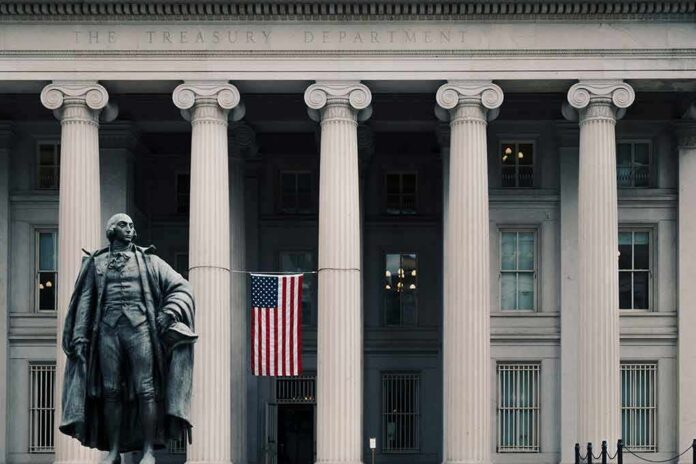
The Department of the Treasury’s Financial Crimes Enforcement Network (FinCEN) reported about $14.7 billion in financial activity from January 2025 through August 2026 that was potentially connected to Iranian shadow banking. The Office of Foreign Assets Control followed by sanctioning more than two dozen exchange houses, front companies, and key personnel. Officials framed the step as a strike on the last major channels Iran uses to reach global finance. The figures describe potential links, not court-adjudicated crimes.
Operation Economic Outcast is the banner for the latest round. It adds to earlier actions that mapped how Iranian intermediaries move money for sanctioned banks and defense bodies across several countries. Treasury says these networks rely on layers of shell companies, foreign “cover” firms, and trusted brokers. The goal is to hide ties to sanctioned institutions while converting oil proceeds and other funds into usable currencies like dollars, Chinese yuan, and United Arab Emirates dirhams.
How the Shadow Banking Networks Work
Treasury’s 2024 designations named Tehran-based exchange houses linked to Bank Sepah and detailed how they used foreign front firms. The releases also described specific transfers by a named exchange house in multiple currencies between August and November 2023, allegedly for Iran’s defense ministry and an oil command tied to the Islamic Revolutionary Guard Corps. Later releases said other exchange houses moved billions each year for sanctioned Iranian banks through layered entities.
FinCEN’s broader trend analysis points to a steady, not isolated, system. It described about $9 billion in possibly related activity in 2024 and then the larger total reported since early 2025. The mechanism is familiar: oil sales and other trade generate proceeds; intermediaries use offshore companies and informal clearing to mask origins; and funds re-enter the formal system abroad. This is why Treasury warnings push banks and traders to tighten screening and reject risky counterparties.
Why This Matters to Americans
Sanctions policy aims to cut cash reaching hostile regimes and their military arms, without choking lawful trade or aid. When networks move billions around controls, that undermines the point of the rules and shifts costs onto honest players. Banks then “de-risk” by exiting whole regions or sectors, which can slow normal commerce and drive up prices. The pattern also feeds a sense that global finance favors insiders while regular families fight inflation and higher energy costs.
For conservatives, the move matches a tougher stance: squeeze money that could fund proxy wars or missile programs. For liberals, the concern is precision: punish illicit finance while protecting humanitarian channels and basic trade. Both sides share frustration when the government announces wins but does not show measurable relief at home. Clearer metrics could track whether actions raise Iran’s costs, reduce oil-linked flows, and avoid broad harm to lawful business and aid delivery.
Measuring Impact and Next Steps
Officials say the designations will isolate named firms and warn banks worldwide to block them. The open question is how much trade and currency access Iran actually loses versus rerouting through new cutouts. The administration can bolster confidence by publishing more declassified methods, typologies, and anonymized patterns that explain the $14.7 billion estimate and how screening should improve. Independent data on post-action trade and payment delays would help too.
The story fits a long cat-and-mouse cycle. Iran adapts with new brokers, offshore fronts, and digital tools; the United States maps, names, and sanctions the replacements. Today’s step claims to hit core pipelines, not just fringe actors. The scale FinCEN reported suggests a system, not a one-off scheme. The public will watch for proof that these cuts force real choices in Tehran and reduce risk to the banking system, while keeping space open for lawful trade and relief.
Sources:
redstate.com, home.treasury.gov
© newsworthy.news 2026. All rights reserved.