
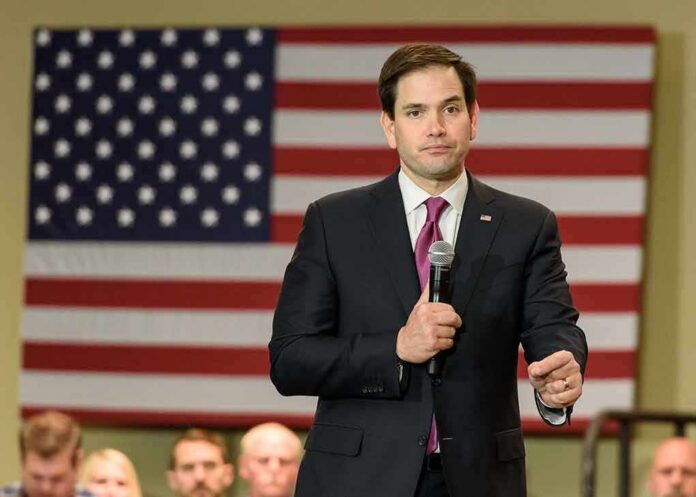
After days of nationwide outages, Secretary of State Marco Rubio said there is “zero evidence” the incidents were linked — but he offered no public proof to back that sweeping assurance.
Story Snapshot
- Rubio said Microsoft, aviation, and banking problems were unrelated and not a coordinated attack.
- The White House echoed that there was no sign of a state-backed cyber operation.
- Critics like Tucker Carlson questioned the quick dismissal but offered no confirmed cause.
- Experts note complex systems often fail from routine changes, not hacking.
Rubio’s Denial And The Government’s Message
On November 18 in Manila, Secretary of State Marco Rubio told reporters the United States had “zero evidence” that a string of recent outages were connected. He said the Microsoft disruption, an aviation problem at the Federal Aviation Administration, and banking glitches were “completely unrelated one from another.” He added there was no reason to think a malign actor tied them together. His remarks aimed to calm fears of a broader attack during a tense week of failures.
The administration’s message stayed consistent. A White House note cited Director of National Intelligence Jay Clayton as saying the events were not a cyberattack or a coordinated state action. That statement matched Rubio’s view that there was no master plan behind the outages. The government’s core claim was simple: timing alone does not prove a link, and current information did not show shared causes or a common actor across sectors.
What The Public Still Does Not Know
Rubio said “all the evidence indicates” the incidents were separate, yet he did not release any supporting technical reports. He did not name which agencies or companies had finished forensic reviews or what logs, alerts, or indicators they checked. That gap matters for trust. People across the political spectrum want facts, not only conclusions. Without public data, many will ask whether the review is complete and whether hidden ties in vendors or software might exist.
Officials also did not explain whether they tested for less obvious links. Shared cloud tools, identity systems, or third-party software can fail in ways that hit many sectors at once. Past events show how a single update or misstep can ripple across airlines, banks, and hospitals without any hacker in sight. That kind of common dependency can make separate problems look coordinated even when they are not related to an attack.
Tucker Carlson’s Pushback And Public Skepticism
Commentator Tucker Carlson challenged Rubio’s dismissal on his program. He pointed to the tight timing of problems at major firms and agencies and raised the idea of a larger infrastructure threat. He noted wars involving Iran and Ukraine and the global race in artificial intelligence as context for worry. His show, however, did not claim to prove the outages were linked, and he and his guest said they did not know the true cause.
This tension reflects a broader frustration with Washington. Many Americans believe leaders rush to control the story while releasing little proof. Quick official assurances can sound like spin when families cannot bank, fly, or work online. Skeptics on the right and left hear “trust us” and think of past failures, secrecy, and the sense that the system protects the powerful first. That anger grows when clear evidence is kept behind closed doors.
What We Can Say With Confidence Right Now
Rubio’s on-record statements draw a firm line: no evidence ties the events together, and no sign points to a state-backed cyber campaign. That is a factual summary of the government’s position. It is also true the statements do not include public technical proof. These two facts can stand at the same time. The absence of a shared cause today does not prove independence forever, and suspicion alone does not prove a coordinated attack.
Experts say most outages stem from change errors, aging gear, or vendor problems. Studies and recent history, including the global disruption from a faulty security update in 2024, show how one mistake can break many services at once. Reporting also says officials briefed lawmakers that patching and upgrades explained some recent issues. This does not end the debate, but it gives a real-world frame that is not about secret plots or simple reassurances.
What Accountability Should Look Like Next
Americans deserve clarity, not slogans. Agencies and companies should release unclassified timelines, root-cause reports, and indicators checked across incidents. Congress should ask when forensics finished, what evidence was compared, and whether supply-chain overlaps were ruled out. A cross-sector review could check cloud logs, identity systems, and shared vendors for common threads. Transparency would either confirm Rubio’s claim with facts or surface risks that need fixing, which serves everyone.
Sources:
afp.com, state.gov, jen.jiji.com, yahoo.com, the-independent.com, live.euronext.com, datacenter.uptimeinstitute.com
© newsworthy.news 2026. All rights reserved.