
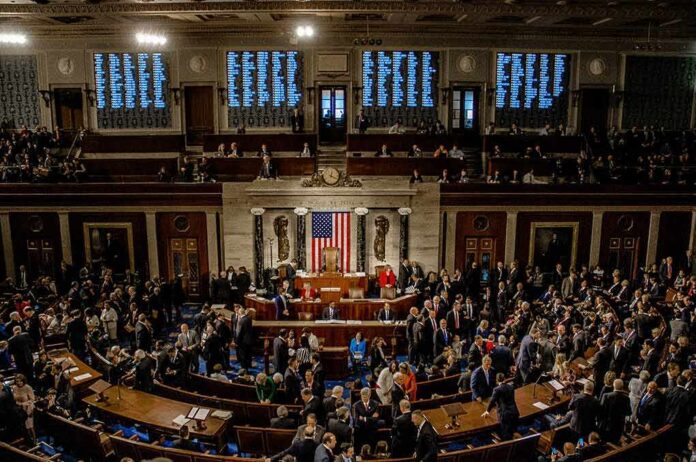
Senate Democrats moved to block a Republican voter ID and proof-of-citizenship push, while saying they support voter ID in principle, sharpening a fight over how U.S. elections should run.
Story Snapshot
- Democrats say they back voter ID but call the GOP’s SAVE Act voter suppression.
- Republicans argue Democrats are dodging meaningful ID rules supported by most voters.
- The clash reflects a deeper fight over access, fraud prevention, and trust in elections.
- Studies and fact-checks show mixed evidence on whether strict ID laws cut turnout.
What Triggered The Latest Showdown
Senate Democratic leaders said they will block the Republican-backed SAVE Act, which pairs a photo ID voting rule with proof-of-citizenship checks for registration. Senate Majority Leader Chuck Schumer said Democrats do not oppose photo IDs as a concept, but argued this bill would suppress votes and is “not a voter ID bill”. Republicans say the bill protects election integrity and reflects what most Americans want from voting rules.
President Trump has pushed national voter ID and proof-of-citizenship as core goals. He argues Democrats fight “meaningful” checks and do so for political gain. Democrats counter that they support voter ID when paired with flexible options, like allowing many forms of identification and non-photo alternatives, as they proposed in prior legislation and amendments. This split centers on how strict the rules should be, not whether identification matters at all.
Democrats’ Case: Prevent Disenfranchisement
Schumer and his caucus say the SAVE Act could block eligible voters, including seniors, students, and low-income citizens who face hurdles getting documents. He labeled the bill “voter suppression” and warned it could disenfranchise millions, though the exact number is disputed. Democrats point to long-standing concerns that strict rules fall hardest on people with lower incomes and less education, raising fairness and access issues in close elections.
Academic work cited by Democrats has found that strict identification laws can reduce turnout among minority voters in some settings. A study in the Journal of Politics reported differentially negative effects on racial and ethnic minorities’ turnout under strict rules. Other research finds modest or uneven effects, and some studies report little to no overall turnout impact, which fuels an ongoing evidence fight in Washington.
Republicans’ Case: Set Clear, Uniform Rules
Republicans say clear rules boost confidence, make fraud harder, and treat everyone the same at the polls. They argue Democrats are trying to water down voter ID into a patchwork of easy workarounds. GOP leaders cite public polling and media reporting that most Americans support photo ID to vote, and frame the SAVE Act as matching that broad demand for stronger safeguards. They say Democrats’ opposition shows a preference for weaker standards.
Republicans also point to Americans needing identification for daily tasks as proof voting should not be the exception. They argue proof-of-citizenship for registration is common sense and prevents mistakes in voter rolls. Democrats answer that existing checks already guard citizenship status and that new federal mandates risk kicking eligible voters off the rolls by error, especially those who lack ready access to original documents.
Why This Fight Resonates Beyond Washington
People across the spectrum feel the system is not serving them. Many think leaders in both parties protect their power instead of fixing basic processes. The voter ID battle taps that mood. Conservatives see elites blocking simple rules that protect honest votes. Liberals see elites erecting barriers that keep regular people out. Both sides worry about trust in elections, and both say the stakes include who gets heard in a tight economy with rising costs and deep divides.
The research record is mixed, but the political pattern is clear: each side returns to the same core claims. Democrats favor flexibility to avoid errors and burden. Republicans favor strict standards to deliver confidence and uniformity. With President Trump and a Republican Congress pressing for national rules, and Democrats vowing to block them, the question is whether a deal can blend strong verification with simple, low-cost ways for every eligible citizen to vote.
Sources:
thegatewaypundit.com, apnews.com, foxnews.com, washingtontimes.com, rev.com, nypost.com, republicanleader.senate.gov, democrats.senate.gov
© newsworthy.news 2026. All rights reserved.