

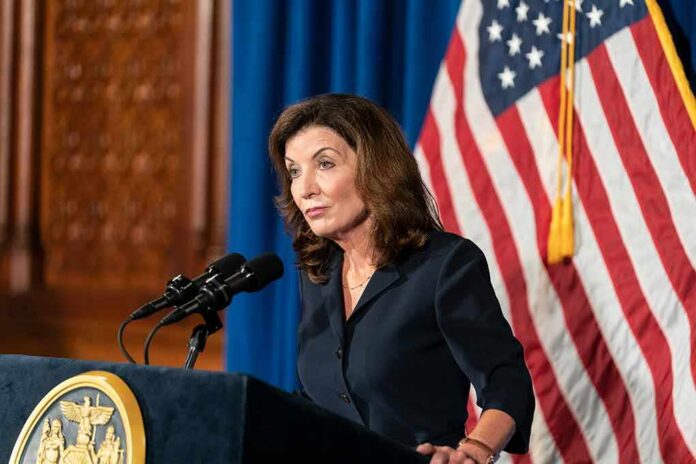
New York’s top court shut down noncitizen municipal voting while Governor Kathy Hochul doubled down on legal protections and services for immigrants, sharpening a fight over costs, safety, and political power.
Story Highlights
- State court blocked New York City’s plan to let some noncitizens vote in local races.
- Governor Hochul advanced funding and legal shields for immigrant communities.
- Bruce Blakeman says these moves attract and protect undocumented migrants.
- Research generally finds sanctuary policies do not raise crime, but do cut deportations.
What the Court Decided on Noncitizen Voting
New York’s highest court ruled that New York City cannot allow noncitizens to vote in city elections. The court said the state constitution and state election law limit voting to United States citizens, blocking Local Law 11 from taking effect. The city’s plan covered lawful permanent residents and people with work permits, not undocumented immigrants, and only for local offices like mayor and council. The decision leaves state and federal voting rules unchanged and citizen-only.
The court’s move ended a years-long push at City Hall. City leaders had argued that hundreds of thousands of tax-paying residents deserved a say in local matters. Supporters filed appeals after lower courts struck the measure. The Court of Appeals’ final word now binds localities statewide. The ruling matters beyond New York City. It signals that any local attempt to expand voting to noncitizens will face the same state constitutional limit on citizenship in statewide law.
Hochul’s Immigration Approach and Spending
Governor Hochul backed policies to shield immigrants from aggressive federal immigration enforcement and to expand legal aid. Her office announced new funds for legal services for unaccompanied children and youth. She also signed and promoted measures that codify access to education regardless of immigration status and classify threats to report immigration status as coercion or extortion. In 2023, the state launched an institute to support immigrant integration, including undocumented people.
Republican challenger Bruce Blakeman frames these actions as magnets for undocumented migration and as a strain on taxpayers. He links the state’s sanctuary posture and limits on local cooperation with federal Immigration and Customs Enforcement to crime and higher public costs. On the trail and in debate, he argued that Hochul banned formal cooperation agreements and spent billions on shelter, food, and transport for migrants, which he says puts residents last. Those cost claims remain political talking points rather than audited totals in the record here.
Crime, Safety, and the Sanctuary Debate
Peer-reviewed research and national studies do not show a rise in crime in places that limit cooperation with federal immigration authorities. One study in the Proceedings of the National Academy of Sciences found sanctuary policies reduce deportations without increasing violent or property crime. Other reviews report similar results, including no link to higher homicide. These findings support the view that crime fears tied to sanctuary rules often exceed what data show, even as individual cases can drive public anger.
That evidence matters because both parties use safety to argue their case. Blakeman ties sanctuary policies to danger. Hochul and allies say protections help keep families stable and encourage victims and witnesses to work with police. Voters are stuck between pocketbook worries and safety fears on one side, and humanitarian and due process concerns on the other. The shared thread is trust: many believe leaders spend big without fixing root problems or setting clear limits that the public understands.
Political Power and Guardrails on Voting
The fight also touches political power. Some Democrats in New York City sought to include lawful noncitizens in local voting to boost civic input. The state’s top court closed that door, saying the state’s citizen-only rule controls. Independent fact-checkers state that undocumented immigrants cannot vote in New York’s statewide or national elections, and federal law bars noncitizens from voting in federal races. These guardrails remain in force, despite city-level efforts and legal tests.
"We will no longer be a sanctuary state when I become governor."
Bruce Blakeman, who's challenging Gov. Kathy Hochul in November, vows to overhaul New York's immigration policies on "Hannity," claiming the state spends $81,000 per illegal migrant. pic.twitter.com/VsOUNn0K71
— John Fitzgerald Kennedy Jr. (@MrJohnJnr) October 15, 2026
For readers frustrated with both parties, here is the bottom line. The court set a clear limit on who votes. The Governor expanded legal help and protections for immigrants. The challenger warns those steps reward unlawful entry and shift costs to residents. Research says sanctuary rules do not raise crime, but they do reduce deportations. The real test for leaders is honest math on costs, clear lines on enforcement, and policies that help communities feel both safe and heard.
Sources:
npr.org, spectrumlocalnews.com, patch.com, governor.ny.gov, timesunion.com, breitbart.com, oleantimesherald.com, nydailynews.com
© newsworthy.news 2026. All rights reserved.