

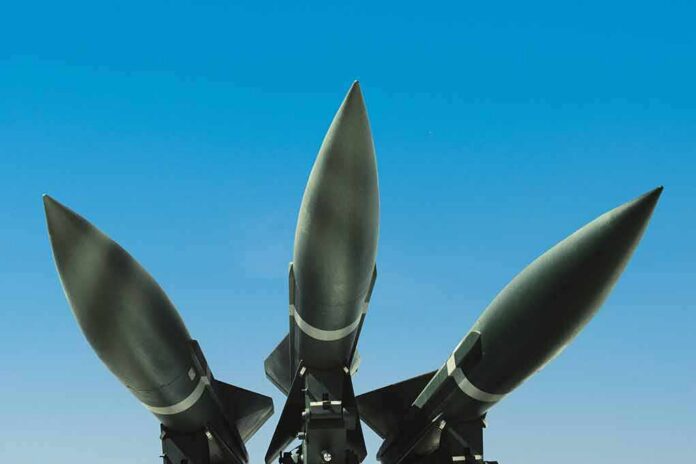
Seized shipments in Yemen reportedly held Chinese-made missile parts tied to an Iranian design, raising the stakes for Red Sea security and global trade.
Story Highlights
- Conflict Armament Research-linked reports say 2025 Yemeni seizures held custom parts for a Kheibar Shekan-type missile.
- The parts suggest an effort to build medium-range missiles in Yemen with about 1,200 miles of reach.
- China’s envoy to Yemen denies company involvement and offers to investigate if given evidence.
- Analysts also allege Russian help, but those claims rest on thinner public proof.
What Interdicted Shipments Reportedly Contained
Wall Street Journal reporting, citing Conflict Armament Research, says Yemeni officials seized two shipments in 2025 with custom-machined missile motor and airframe parts. The reported hauls included stabilizing fins, solid-fuel motor components, heat-resistant materials, tools, and testing gear. Analysts linked the items to an Iranian-designed Kheibar Shekan-type precision missile. The reporting ties many components to Chinese origin, though it does not publish the lab notes or serial records that would let the public verify each link.
The same reporting says these parts could help the Houthis build medium-range missiles inside Yemen. The assessed reach is about 1,200 miles, which could threaten targets deep in Saudi Arabia and reach Israel. Other outlets echoed the core details, describing an upgrade from parts smuggling to local production. But they also stress what is not yet shown: a completed system, a test launch, or proof that a working missile has entered combat use.
What Is Alleged About China—and What Is Denied
Analysts quoted by the Wall Street Journal and related summaries suggest Chinese-made parts moved through illicit networks into Yemen. A former United Nations panel expert reportedly said such imports continued for at least two years. Beijing’s chargé d’affaires to Yemen pushed back. He called the claims baseless, pointed to China’s export controls and United Nations rules, and said China would cooperate with Yemeni authorities if they shared evidence for a full review.
This denial highlights a key gap in the public record. The reporting shows components traced to Chinese suppliers. It does not show documents that prove the Chinese state ordered or approved the shipments. Analysts warn that dual-use goods can pass through traders who hide the final buyer. That makes it hard to assign blame to a government without licenses, payment trails, or corporate ownership proof on the record.
What Is Alleged About Russia—and Why Proof Looks Thinner
A National Interest piece links Russia to wider support. It describes alleged help with weapons, fuel, and satellite-based targeting data passed through Iran’s Islamic Revolutionary Guard Corps. Other write-ups say the satellite claim relies on a private firm’s look at orbital movements, not intercepts or declassified intelligence. One outlet notes Moscow has denied giving intelligence aid to Tehran in related contexts, which complicates firm attribution on the public evidence so far.
None of this means the claims are false. It means the supporting files the public can see are limited today. Without declassified imagery, signal records, or court-tested exhibits, the Russian angle remains less grounded than the seized-parts story. That difference matters for accountability and sanctions policy. It also matters for readers who want facts, not spin, when great-power rivalry crosses into proxy warfare.
Why This Matters for Americans, Trade, and Security
Houthi attacks since 2023 have disrupted one of the world’s busiest sea lanes. Carriers rerouted ships around Africa, adding time and fuel costs. Studies estimate Red Sea traffic fell sharply during peak disruption, hitting prices and delivery schedules. When parts for long-range missiles surface in that same theater, the stakes rise. Longer reach could harden the threat to ports, oil sites, and shipping—pressuring supply chains that already feel fragile and costly for families and small firms.
Building directly upon our earlier November 5 baseline synthesis, newly ingested telemetry over the immediate monitoring window (04 NOV 2026 1400Z – 05 NOV 2026 1430Z) captures a late-night double-projectile strike on a commercial tanker 50 nautical miles north of Madinat ash…
— DANIEL WINN (@WinnD923) November 6, 2026
Americans across the spectrum see a pattern. Global elites move goods and money across borders with ease. But our government struggles to track illicit parts, stop proxy attacks, and protect trade that sets prices at the store. Voters on the right and left want facts, enforcement, and results. Publishing the full technical evidence, tracing the money and licenses, and tightening export controls would be a start. Clear proof, not slogans, is how we fix a broken system.
Sources:
realcleardefense.com, wsj.com, tovima.com, timesofisrael.com, independent.co.uk, mei.edu, rferl.org, congress.gov
© newsworthy.news 2026. All rights reserved.