Todd Blanche spent his hearing denying he is Donald Trump’s “yes man” while senators pressed him on loyalty and independence.
Quick Take
- Blanche told senators that his attorney-client relationship with President Trump still exists, but he said it would not control his decisions.
- Democrats pressed him on whether a former personal lawyer can run a department that must stay independent.
- Blanche’s slip, calling himself Trump’s lawyer before correcting it, became a sharp symbol of the trust problem.
- The hearing also fit a larger fight over whether the Justice Department serves the law or the president.
What Senators Focused On
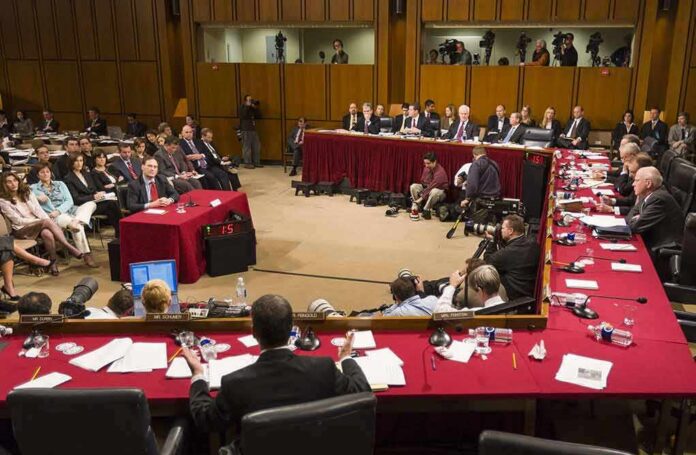
Senators used the hearing to test Blanche on a simple question: can a former Trump defense lawyer act with real distance inside the Justice Department? According to reporting from the Senate and news outlets, Blanche confirmed that his attorney-client relationship with Trump remains in place, even as he argued that he would not let political ties shape his work. The exchange turned the hearing into a stress test for public trust.
That distrust was not abstract. AP reported that Democrats focused on Blanche’s recent defense of Trump, his description of the charges against Trump as “partisan lawfare,” and the fear that he could face pressure from the president once in office. Politico also noted that some Senate Republicans wanted Blanche to explain the line between serving as attorney general and serving as Trump’s personal lawyer. Those concerns made the hearing broader than one man’s nomination.
Why The “Yes Man” Question Mattered
Blanche’s own words gave critics fresh material. Reporting from the Independent said he said, “I’m his lawyer,” then quickly corrected himself to, “Was his lawyer.” That slip mattered because it captured the exact doubt his critics wanted answered. If a nominee still sounds like a private lawyer for the president, senators will question whether he can make hard calls on investigations, prosecutions, and internal discipline without looking over his shoulder.
Blanche tried to answer that challenge by promising independence and saying he would follow the department’s rules. The broader record shows why the issue keeps coming up. The Department of Justice has long been seen as vulnerable when presidents appoint close personal lawyers to top roles, because the public may doubt whether those officials serve the law first. That is not a new fight, but Blanche’s hearing made it very visible again.
A Fight About More Than One Nominee
The hearing also reflected a larger clash over the Justice Department itself. Blanche has defended Trump’s claim that past Biden-era enforcement amounted to political weaponization, and that argument shaped how he presented himself to senators. Supporters see that as standing up against double standards. Critics see it as a warning sign that law enforcement is being pulled into a political battle where each side accuses the other of abusing power.
Excellent breakdown of Todd Blanche Confirmation Hearing by @MuellerSheWrote & @KlasfeldReports unfortunately our Senators seemed unprepared & not coordinated. Please call your senators to NOT confirm Blanche‼️ Congressional Switchboard 202-224-3121https://t.co/PVYimuHCdC
— Melinda 🗽 (@jeanienyc) July 15, 2026
That split helps explain why the hearing drew attention beyond Washington. Democratic senators later asked the Justice Department inspector general to review Blanche’s testimony, showing that their concerns did not end when the hearing did. The issue goes beyond one confirmation vote. It touches a basic question many voters on both the left and right now share: whether top federal institutions can still act with enough distance from the president to deserve public trust.
Sources:
youtube.com, judiciary.senate.gov, npr.org, congress.gov, politico.com, welch.senate.gov, nytimes.com, instagram.com, oig.justice.gov
© newsworthy.news 2026. All rights reserved.