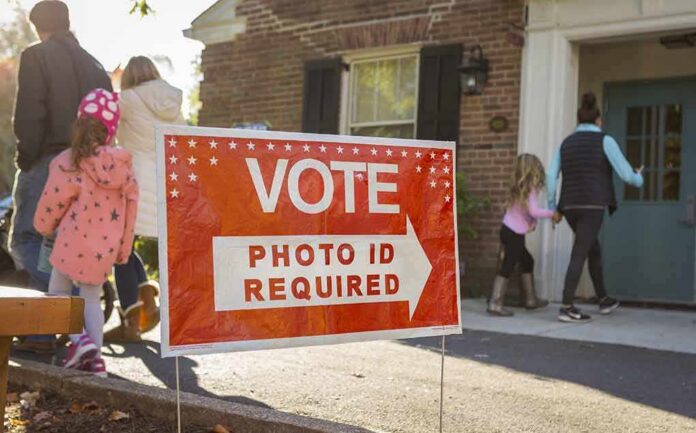
California’s top lawyer just helped shut down a local voter ID rule by quietly changing its ballot label from “voter ID” to “voting restrictions,” and many voters are wondering what, exactly, their own government is so afraid of.
Story Snapshot
- Huntington Beach voters approved a charter change to allow **voter ID** for city elections starting in 2026.
- California’s Attorney General and Secretary of State sued, saying the local rule conflicts with state election protections.
- The Legislature then passed a new law, Elections Code section 10005, to ban all local voter ID mandates statewide.
- State courts and the California Supreme Court sided with the state, striking down the city’s voter ID measure as illegal.
How Huntington Beach’s Voter ID Plan Ran Into a State Wall
Huntington Beach is a coastal charter city in Orange County whose voters backed Measure A, a charter amendment letting the city require identification to vote in municipal elections starting in 2026. Supporters said this local voter ID power was about “voter integrity” and public trust in elections, not about keeping people from the ballot box. They argued that a charter city should be free to set its own rules for city elections, especially when many residents worry about fraud even if it is hard to prove.
California Attorney General Rob Bonta and Secretary of State Shirley Weber saw the same measure very differently. In April 2024, they sued Huntington Beach, arguing that the local ID rule would clash with state voting protections and could block low-income, minority, young, elderly, and disabled voters from casting ballots. Their complaint said elections in California are a statewide concern and must follow uniform rules, so cities cannot add extra hurdles that might keep eligible people from voting.
The New State Law That Erased Local Voter ID Experiments
As the lawsuit moved forward, California’s Democratic Legislature passed Elections Code section 10005, effective January 1, 2025. This statute explicitly bars any local government from requiring voter identification to cast a ballot unless state or federal law itself demands it. Lawmakers said they wanted to stop a “patchwork” of different rules and keep access to the polls equal across the state. Governor Gavin Newsom signed the bill, completing a statewide ban on local voter ID requirements.
The new law fit into California’s existing approach to voting rules. Under current rules, most voters do not have to show ID at the polls, except in narrow cases such as some first-time mail registrants. By contrast, Measure A would have allowed Huntington Beach to require identification for all in-person municipal voters. That broad local mandate put the city on a direct collision course with state policy, which favors easy access and targeted checks rather than blanket ID rules at every polling place.
Courts Step In: Voter ID Declared a Statewide Concern
In early 2025, a California Court of Appeal answered the core legal question: is voter identification a local detail or part of the broader “integrity of the electoral process” that the state must control? The court concluded that voter ID falls squarely under electoral integrity, which the California Supreme Court has already labeled a matter of statewide concern. Applying the home-rule test for charter cities, the judges ruled that Elections Code section 10005 preempts Huntington Beach’s charter change, making the local voter ID provision invalid.
The appellate court ordered the trial court to issue a writ blocking enforcement of the charter provision and to declare it preempted by state law. Huntington Beach tried to fight on, asking the California Supreme Court to review the case. In early 2026, the high court unanimously refused, letting the appellate decision stand. Attorney General Bonta and Secretary Weber said this final denial “fully resolves” their lawsuit in the state’s favor and confirms that local governments cannot impose extra voting ID rules on eligible voters.
Why This Fight Resonates Beyond One Beach City
This clash speaks to a larger struggle that many Americans, left and right, feel with their government. A majority of Californians reportedly support some form of voter ID, yet the state’s leaders acted to stop cities like Huntington Beach from moving in that direction. For conservatives, the case looks like elites blocking common-sense safeguards that they believe protect honest voting. For many liberals, it still raises hard questions about who decides voter rules and how to balance access with security.
Nearly 70% of Californians support Voter ID.
Prop 39 is on the November ballot. But when it passes and gets challenged in court, Rob Bonta will not show up to defend it.
He sued Huntington Beach over their local voter ID law. I will show up. Every time.
Follow us to save… pic.twitter.com/xK85iNBd7j
— Vote Michael E. Gates for California Attorney Gen. (@MichaelGatesESQ) July 19, 2026
At the heart of the case is distrust. Local voters used the tools of democracy to change their charter, only to see that decision erased by state officials, new legislation, and the courts. State leaders say they are defending equal voting rights and preventing discrimination. Many residents feel they are watching a distant political class override their choices and tighten control over the system. In a time when faith in institutions is low, this kind of top-down reversal deepens the sense that the rules of democracy are being written far from the people who live with them.
Sources:
redstate.com, oag.ca.gov, apnews.com, law.justia.com, latimes.com, calmatters.org, democracydocket.com, caselaw.findlaw.com, horvitzlevy.com, youtube.com, perkinscoie.com, fairus.org, codifylegalpublishing.com, calmatters.digitaldemocracy.org
© newsworthy.news 2026. All rights reserved.