

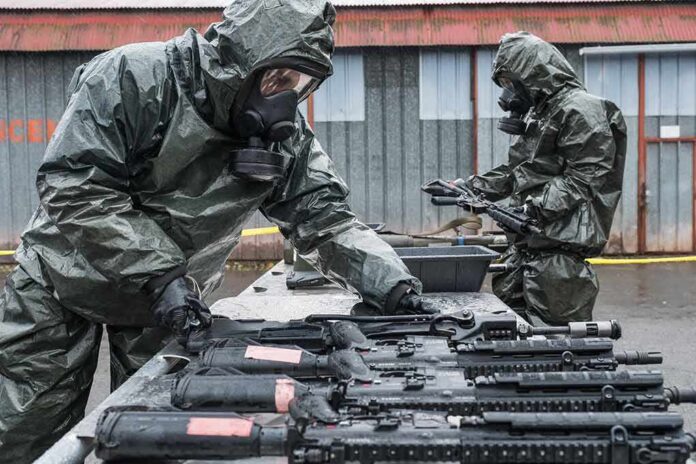
Under an emergency Environmental Protection Agency permit, the U.S. Army detonated unstable lead azide in Iowa while monitors initially showed no airborne lead at reported sites.
Story Highlights
- Emergency permit allowed a controlled blast to remove an imminent explosive threat.
- Federal appeals court lifted a stay and cited built-in safeguards.
- Army used water walls and other barriers to limit lead dust spread.
- Early readings reported zero airborne lead at monitoring locations after the blast.
Emergency Authorization And Why The Army Acted
The Environmental Protection Agency issued an emergency hazardous waste permit on November 13. The permit allowed the Army to store and then treat the unstable lead azide by a controlled detonation to remove an imminent explosive hazard to people and the environment. The Environmental Protection Agency found that a controlled blast posed less risk than an uncontrolled explosion. Court records note that Environmental Protection Agency rules allow such action in these emergency conditions.
A federal appeals court cleared the operation days later. The Eighth Circuit lifted a temporary stay and said the permit built in safeguards to reduce lead dust spread and manage exposure paths. The ruling did not test the air itself. It judged the challengers unlikely to win on the permit claim. That decision opened a narrow window for the Army to act while the material remained unstable.
How The Blast Was Mitigated On The Ground
The Army said it installed “unprecedented” physical controls to trap debris and keep dust down. Plans described water barriers, containment structures, and other shields around the site to limit the lift and travel of particles. Crews prepared to soak areas and manage the blast zone. The goal was to break down the explosive safely while keeping lead-bearing fragments close to the ground and inside the controlled area.
The Army and its partners set up a monitoring plan to check the air and the ground right away. Fixed air sensors ringed the site and nearby communities. Mobile teams stood ready to follow the plume path and take soil, surface water, and surface wipe samples where needed. Officials emphasized that they would post results when they became available. That approach aimed to verify the models with field data and adapt to wind and weather in real time.
What Early Readings Showed Right After The Blast
Shortly after the detonation, officials said Environmental Protection Agency real-time monitors reported zero detection of airborne lead across reported locations in the region. The Army also reported readings not above 0.0 by mid-morning Central Time on the day of the blast. News footage and local reports showed visible plumes during the event. A visible plume does not reveal its chemical content, which requires sampling and lab analysis.
The U.S. Army has safely destroyed nearly 4.5 tonnes of unstable lead azide explosives in a controlled blast at an ammunition plant in Iowa. The hazardous material was stored in 68 deteriorating barrels, prompting nearby residents to evacuate or take shelter indoors. Following… pic.twitter.com/1kXhnxlb5L
— Indian Defence Times (@IndianDefenceT) November 26, 2026
The Eighth Circuit’s order noted that the permit included steps to limit dispersal and reduce exposure risks, which supported moving forward under emergency rules. That legal finding focused on the permit and its safeguards, not on a final health assessment. Officials say more sampling of soil, water, and surfaces will continue, with results to be released. Those reports will show how the on-site controls performed beyond the first air readings.
Why This Matters Beyond One Iowa Blast
This event fits a long-running tension in handling hazardous munitions. Leaders must choose between a small chance of a deadly, uncontrolled blast and the harder to measure chance of environmental harm. Defense documents say open-air destruction has grown rare and is mostly limited to emergencies like this. That is because detonation can leave lead residues that require careful cleanup and long-term checks in surrounding areas.
What To Watch Next
Watch for full release of monitoring data, including air, soil, water, and surface wipe results, and how those compare with pre-event levels. Look for details on sensor placement and detection limits to judge how well the network covered the plume’s path. Review any updates on cleanup and disposal of debris at the site. These steps will show if the safeguards achieved their aim and how the government measures and reports risk in future emergencies.
Sources:
youtube.com, army.mil, cbs2iowa.com, nbcchicago.com, wqad.com, apnews.com, law.justia.com
© newsworthy.news 2026. All rights reserved.