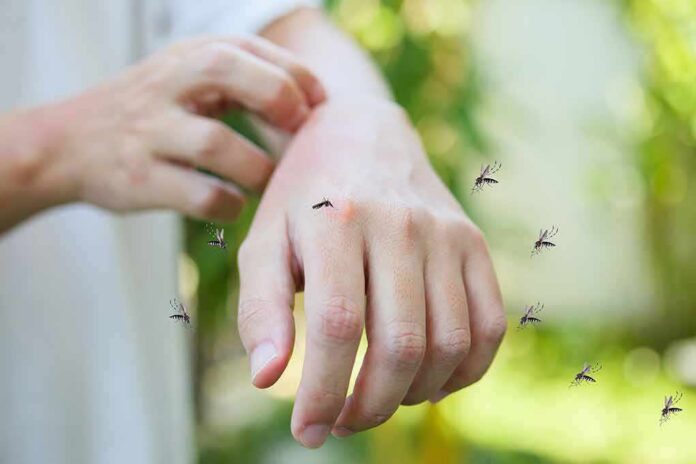
Florida health officials confirmed that an 80-year-old Tampa woman died from dengue fever during a local outbreak that has surged across Hillsborough County.
Story Snapshot
- Officials confirmed Florida’s first dengue-related death of 2026 in Hillsborough County.
- Family identified the woman as Gay Small, who died at Tampa General Hospital on her 80th birthday.
- A death certificate cited dengue infection with septic shock and multi-organ failure.
- Local cases rose sharply this summer, prompting expanded mosquito control operations.
Confirmed Death Linked to Local Outbreak
Florida’s Department of Health confirmed the state’s first dengue-related death of 2026 in Hillsborough County, marking a serious turn in a season already marked by unusual spread. Officials said the death occurred amid a sharp rise in locally acquired cases in the Tampa area, where infections climbed quickly over the summer. The confirmation followed earlier language that the case was under investigation, reflecting a typical process where health agencies verify cause and exposure before a formal statement.
Family members identified the decedent as 80-year-old Gay Small of Tampa and said she died early on her birthday at Tampa General Hospital. Relatives said she had not traveled recently and likely encountered an infected mosquito near her Bayshore Boulevard home, within a few miles of where county officials focused control efforts. Local reporting described a rapid decline after diagnosis, which tracked with severe dengue complications that can escalate in older adults and those with other health risks.
Cause of Death and Medical Details
Reporters who reviewed the death certificate said it listed dengue infection as the cause, with septic shock and multi-organ failure as contributing conditions. That wording aligns with how severe dengue can damage blood vessels and organs, leading to shock if not reversed quickly. While most dengue cases are mild, severe disease can be fatal, especially for seniors. Tampa General Hospital did not comment on patient specifics, which is common under privacy rules, but the official confirmation anchors the medical determination.
Health officials first addressed the case publicly while the investigation was still open, saying they were evaluating whether dengue played a role in a Hillsborough County resident’s death. That cautious approach mirrors how epidemiology works during outbreaks. Teams verify laboratory results, check travel history, and decide if a case was locally acquired or tied to travel. The later confirmation closed that loop for this case and placed it within the broader county surge.
Rising Cases and Government Response
Hillsborough County saw a sharp increase in locally acquired dengue infections during the summer, overtaking typical seasonal patterns and placing added strain on mosquito control teams. County crews expanded aerial and ground spraying, using helicopters and targeted traps to reduce the Aedes aegypti mosquito that spreads dengue. These steps are standard when data show clusters in specific neighborhoods. Officials urged residents to drain standing water, repair window screens, and use repellents to lower bite risk.
Florida is experiencing one of its worst surges of dengue fever in decades, and the toll now includes a death in the Tampa Bay area. https://t.co/aMMGT8pijS
— South Florida Sun Sentinel (@SunSentinel) September 18, 2026
Public health experts say Florida’s dengue seasons often reflect repeated virus introductions linked to travel, followed by short bursts of local spread when weather and mosquito levels align. This pattern can frustrate residents because the response depends on fast local action and steady personal protection. When agencies communicate late or in technical terms, families can feel on their own. The county’s wider spraying push, paired with confirmed case updates, aimed to bridge that gap during the Hillsborough surge.
What This Means for Everyday Life
For families in Tampa Bay, the confirmed death shows how a single bite can carry high stakes, especially for older adults. Simple steps help. People should dump water from buckets, gutters, and planters weekly. They should wear long sleeves and use Environmental Protection Agency-registered repellents. Neighbors can work together to scan yards and alleys, since mosquitoes only need a bottle cap of water to breed. These local actions matter when government systems feel slow and stretched.
Residents across the political spectrum share a core worry: basic public health should just work. When disease control leans on consent forms, hotlines, and slow notices, trust erodes. Clear updates, visible neighborhood spraying plans, and easy access to testing sites can rebuild that trust. The state’s confirmation of the cause of death, along with targeted mosquito control, is a necessary step. But people want proof that the system can move faster than the mosquito. That is the measure that counts this summer.
Sources:
medicaldaily.com, tampabay.com, wusf.org, cbsnews.com
© newsworthy.news 2026. All rights reserved.