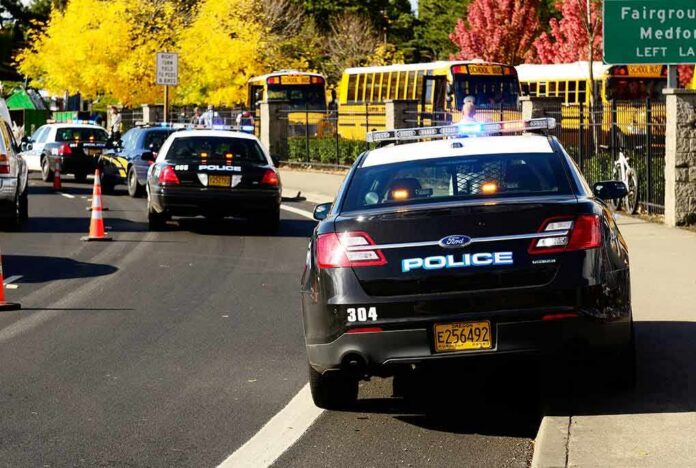
A toxic chemical leak at a nearby aerospace plant shut down a California high school overnight, turning graduation week into an emergency scene and raising fresh questions about how well officials protect students when industry goes wrong.
Story Snapshot
- A massive chemical leak at a Garden Grove aerospace facility forced evacuations and widespread school closures.
- Nearby high schools, including campuses set to host graduations, were suddenly shut down “until further notice.”
- Officials said a tank holding methyl methacrylate could spill or explode, prompting a one-mile evacuation radius.
- Later testing found no ongoing public risk, underscoring that closures were precautionary, not proof of campus poisoning.
A leak that turned school into a hazard zone
On a May morning in Orange County, California, a chemical tank at a Garden Grove aerospace facility started leaking vapors, triggering one of the largest recent hazardous materials responses in the region. The tank held thousands of gallons of methyl methacrylate, a chemical used to make plastics and resins. Fire officials warned that the tank might either rupture or explode, sending a toxic cloud across nearby neighborhoods and schools. Emergency crews quickly set up a one-mile evacuation zone around Chapman Avenue and Western Avenue.
Garden Grove Unified School District leaders said law enforcement and emergency responders ordered several campuses closed while crews tried to contain the incident. The list included Barker, Bryant, Carver, Enders, Garden Park, Lawrence, Wakeham, and Patton elementary schools, Bell and Alamitos intermediate schools, and Pacifica and Rancho Alamitos high schools, plus a preschool and bus yard. Classes and events at these schools were canceled “until further notice,” turning what should have been normal school days into sudden emergency closures for thousands of families.
Why officials moved fast to shut schools
Orange County Fire Authority leaders described the damaged tank as highly volatile and warned it could “inevitably fail and potentially explode,” language echoed in broader national coverage of the incident. Methyl methacrylate can be both flammable and harmful if people breathe high levels of the vapors, especially in a large release. Faced with that risk, district officials followed the direction of emergency managers instead of waiting for more data. The closure order did not claim that each school’s air was already poisoned; it treated every campus inside the hazard radius as at risk until tests could rule out danger.
This “better safe than sorry” approach is common in chemical emergencies. Federal and state guidance tells responders to worry first about explosions, vapor clouds, and unknown exposure levels, then refine the response as more information comes in. We have seen similar decisions at other California schools when toxics were found nearby. In Oakland, for example, McClymonds High School was closed after trichloroethylene, a cancer-causing solvent, was discovered in groundwater under the campus, even though drinking water tested safe. In that case, officials wanted to be sure the chemical was not entering classroom air before allowing students back.
From “it might blow” to “no risk to the public”
As crews worked at the Garden Grove site, they cooled the tank, vented vapors, and ran air monitors in the area. Within days, Unified Command officials, including fire, law enforcement, federal environmental regulators, and county health staff, announced that there was no active chemical leak, no threat of explosion, no threat of fire, and no risk to the public. Evacuation orders were lifted. That shift from fear of a blast to an all-clear showed how much uncertainty drives the first hours of these events. The schools had been closed not because tests proved toxic levels inside classrooms, but because models and worst-case scenarios said they could be in harm’s way.
For families, the swing from “get out now” to “you are safe” can feel whiplash. Some parents see the closures as proof that government still works when lives are at stake. Others feel the response shows deeper problems. Many Americans on both the left and right already think the system lets dangerous industry sit next to homes and schools while officials look the other way until something goes wrong. This incident reinforces those worries. A giant tank of hazardous chemical sat near multiple campuses, and only when it threatened to fail did the government step in.
Students caught between industry and government
The sudden shutdowns hit students hardest, especially high school seniors who expected normal graduations. At least one Kennedy-named high school in the broader area saw its ceremony canceled as part of the chemical emergency response, with the district linking the decision directly to evacuation orders and safety concerns. For teenagers who spent years working toward that day, the message was clear: in a crisis, their milestone is expendable. This feeling feeds a growing belief that everyday people come last, while powerful companies and agencies sort things out on their own timelines.
The record from this leak and from earlier school contamination cases shows how much power sits in the hands of emergency and education officials. They decide when a school is “safe enough” to occupy, often based on technical reports most parents never see. Without public access to air-monitoring data, plume models, and clearance letters, families have to trust the same institutions they worry may be too close to industry. That trust gap fuels anger across the political spectrum. Conservatives and liberals may argue about energy policy or regulation, but both sides share a core worry: the people running big systems are not nearly as focused on the health and future of regular kids as they claim.
Sources:
nypost.com, ongoingnow.com, audacy.com, public.ksc.nasa.gov, coderedconsultants.com, epa.gov, dehpra.acgov.org, inhabitat.com, nbcnews.com
© newsworthy.news 2026. All rights reserved.