newsworthy.news — When the Speaker of the House says Americans’ rights come from God—not government—he revives a foundational promise and a fierce modern fight over who actually guards your liberty.
Story Snapshot
- Speaker Mike Johnson cited the Declaration of Independence to argue rights are endowed by a Creator, not granted by the state [1].
- Johnson linked the claim to Abraham Lincoln’s Gettysburg Address to frame a civic creed that must be taught and defended [1].
- An MS NOW panel challenged the framing, arguing the Constitution—not the Declaration—defines enforceable rights and church-state limits [2].
- The evidence available is a clip and summaries; full segment transcripts and broader corroboration remain limited [1][2].
What Johnson Said and Why It Resonates
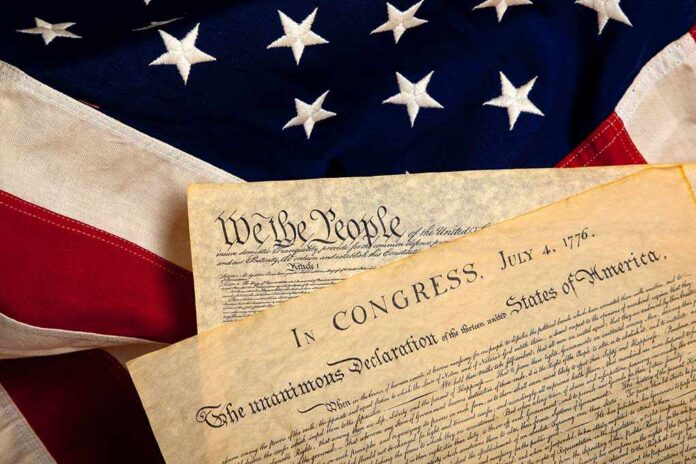
Speaker Mike Johnson told viewers that “our rights do not come from the government. They come from God himself,” explicitly anchoring his claim in the Declaration of Independence’s “self-evident” truths and describing the document as America’s “birth certificate” [1]. Johnson presented this not as a novelty but as a civic creed that must be fought for and taught to the next generation so they inherit liberty, opportunity, and security [1]. He connected the theme to Abraham Lincoln’s language about a nation “under God” and government “of the people” [1].
Johnson’s framing taps a long-running American debate about whether rights are pre-political, universal claims that government must respect, or legal guarantees that exist only once constitutionally codified. The Declaration asserts that people are “endowed by their Creator with certain unalienable Rights,” while the Constitution and subsequent amendments set out enforceable structures and protections. Johnson’s emphasis on origins elevates natural-rights philosophy as a guardrail against government overreach [1].
"What about this passage from Mike Johnson declaring that our rights do not derive from government; they come from our creator… Is this him putting God above the Declaration of Independence?"
Truly the MSNBC clip to end all MSNBC clips.pic.twitter.com/Fy72cVrkgN
— Greg Price (@greg_price11) May 19, 2026
How Cable Critics Pushed Back
An MS NOW panel positioned Johnson’s remarks inside a broader argument about church-state boundaries and government sponsorship of religious expression, challenging the claim that the Declaration’s Creator language operates as binding law [2]. Panelists referenced the Constitution’s design—no religious tests for office and strong protections for free exercise—to argue that enforceable rights flow from constitutional text and institutions, not theological premises [2]. They framed the issue as legal authority versus philosophical aspiration, cautioning against state-backed religious messaging [2].
This counter-position stressed institutional limits rather than disputing the Declaration’s words. It did not offer a line-by-line historical refutation of the specific passages Johnson quoted, and it did not present founding-era correspondence or ratification debates to reinterpret the Declaration’s “Creator” phrase differently [2]. Instead, it argued that modern constitutional governance—not the Declaration—supplies the operative source for rights enforceable in courts, even as the Declaration informs civic identity and moral ideals [2].
Where the Evidence Is Strong—and Thin
The on-record clip shows Johnson making the rights-from-God claim plainly and rooting it in founding texts, which strengthens the accuracy of the quotation and the philosophical through-line he draws [1]. His invocation of Lincoln’s rhetoric situates the claim in a familiar civic register, not as an isolated flourish [1]. However, the current record relies on a broadcast excerpt rather than a full transcript, and lacks multiple independent outlets confirming every line and context, which narrows verification confidence for the surrounding exchange [1].
The panel’s rebuttal accurately distinguishes between philosophical and legal sources of rights as commonly taught in constitutional law, but the summarized coverage does not supply primary founding-era analysis to negate Johnson’s textual reading of the Declaration [2]. Both sides therefore rest on partially different terrains: Johnson on natural-rights philosophy and national creed; the panel on constitutional enforceability and institutional neutrality. The absence of full segment transcripts and comprehensive contemporaneous reporting limits definitive adjudication of nuances [1][2].
Why This Debate Matters Beyond One Clip
Americans across the spectrum see a federal government that too often protects its own power rather than their freedoms. Johnson’s claim appeals to people who fear that if rights are government-made, they are government-takable; the panel’s reply appeals to those who worry that theological framing by officials blurs constitutional guardrails. The shared anxiety is control: who decides where liberty begins and ends, and by what authority that decision can be checked [1][2].
Practical stakes follow. Courts enforce constitutional text, not the Declaration, yet jurists and lawmakers regularly invoke the Declaration’s ideals to interpret liberty’s scope. Voters who distrust Washington’s elites may hear Johnson as re-centering limits on state power; voters wary of state-backed religion may hear the panel as defending pluralism. Both impulses track a common concern: keeping concentrated power—political, bureaucratic, or cultural—from redefining rights to suit the moment [1][2].
What to Watch Next
Watch for release of full broadcast transcripts or unedited video to clarify context around Johnson’s remarks; publication of any prepared texts or congressional-record entries repeating the formulation; and expert analyses that map the Declaration’s philosophy to the Constitution’s enforceable guarantees. Those steps would clarify where creed ends and law begins—and whether the country is drifting toward a government that merely manages rights or a people determined to guard them [1][2].
Sources:
[1] YouTube – House Speaker Mike Johnson speaks after Trump budget bill’s final …
[2] Web – Mike Johnson says our rights come from God, ‘not government’
© newsworthy.news 2026. All rights reserved.