President Trump’s signature economic agenda squeaks through House by a single vote, signaling Republican determination to restore America’s economic foundation despite ferocious Democratic opposition.
Key Takeaways
- The “One Big Beautiful Bill Act” passed with a razor-thin 215-214 vote, with two Republicans joining all Democrats in opposition.
- The 1,100-page legislation extends the 2017 tax cuts and eliminates taxes on tips, overtime pay, and car loan interest.
- The bill allocates $175 billion for border security, including $46.5 billion specifically for the border wall.
- New work requirements for Medicaid and SNAP recipients aim to reduce dependency while maintaining support for those truly in need.
- The bill establishes innovative “Trump” savings accounts for children born between 2025-2029, with $1,000 in government seed money.
Historic Victory for Trump’s Economic Agenda
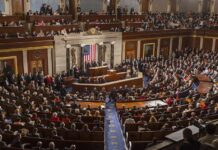
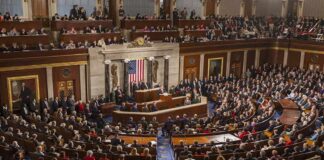
In a dramatic display of party discipline, House Republicans delivered a crucial win for President Trump’s economic agenda, passing the comprehensive “One Big Beautiful Bill Act” by the narrowest of margins. The final vote tally of 215-214 underscores the high-stakes nature of the legislation, which encompasses the cornerstone elements of Trump’s economic vision. Speaker Mike Johnson successfully navigated the challenging task of uniting the diverse Republican conference, even as GOP Representatives Thomas Massie and Warren Davidson broke ranks to join Democrats in opposition, while Rep. Andy Harris voted present. The 1,100-page legislation represents the most significant economic policy package since Trump’s first term.
The passage came after intense negotiations and last-minute changes designed to secure support from conservative holdouts. Using budget reconciliation rules, which allow for expedited consideration in the Senate without threat of filibuster, Republicans demonstrated their commitment to fulfilling campaign promises despite holding only a slim majority in the House. The bill now moves to the Senate, where Republican leaders have already signaled their intention to make modifications before sending it back to the House for final approval.
Tax Relief and Economic Growth Measures
At the heart of the legislation is an extension and expansion of the highly successful 2017 Tax Cuts and Jobs Act, which previously drove unprecedented economic growth and record-low unemployment before the pandemic. Building on that foundation, the new bill introduces several innovative tax relief measures designed to benefit working Americans directly. Chief among these provisions is the temporary elimination of taxes on qualified tips, overtime pay, and car loan interest – initiatives that will immediately increase take-home pay for millions of hardworking citizens.
The legislation also increases the State and Local Tax (SALT) deduction cap and raises the debt ceiling by $4 trillion to ensure continued government operations while the broader economic reforms take effect. Perhaps most forward-thinking is the establishment of “Trump” savings accounts for children born between 2025 and 2029, providing $1,000 in government seed money to jumpstart their financial futures. This innovative approach to encouraging financial literacy and long-term saving represents a significant investment in the next generation of Americans.
Border Security and National Defense Priorities
President Trump’s commitment to securing America’s borders and strengthening national defense is prominently featured in the legislation. The bill allocates a substantial $175 billion for border security initiatives, with $46.5 billion specifically designated for the construction of the U.S.-Mexico border wall. This significant investment directly addresses the immigration crisis that has spiraled out of control in recent years, reestablishing the rule of law and protecting American communities from the influx of illegal drugs, human trafficking, and unvetted migrants.
National defense receives a much-needed boost with $150 billion in additional funding allocated for critical military priorities. These resources will support the expansion of the Navy fleet, strengthen missile defense systems, and ensure America’s fighting forces have the tools and technology they need to maintain superiority on the global stage. The legislation also introduces a fast-track system for natural gas exploration permits, promoting energy independence and ending the previous administration’s mandate requiring two-thirds of new car sales to be electric by 2032.
Welfare Reform and Fiscal Responsibility
In a return to common-sense governance, the bill implements reasonable work requirements for Medicaid and SNAP recipients who are able-bodied and without dependents. These reforms are designed to encourage self-sufficiency while maintaining a safety net for those truly in need. By reducing dependency and promoting workforce participation, these measures aim to transform welfare programs from permanent entitlements into temporary assistance that helps Americans achieve independence and prosperity through meaningful employment.
Critics of the legislation have focused on Congressional Budget Office projections that the bill could increase the deficit, but supporters point out that these static analyses consistently fail to account for the economic growth generated by tax reductions and regulatory relief. The Trump administration’s previous tax cuts demonstrated that pro-growth policies can significantly outperform CBO projections, leading to record government revenues despite lower tax rates. Senate Republicans have signaled they will work to refine the bill further before it reaches the President’s desk.