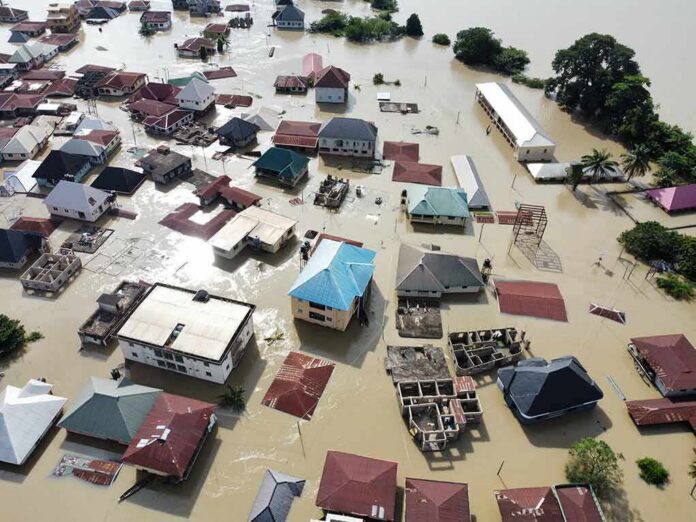
Floodwaters have now touched more than 4 million people across 50 Thai provinces, making this the country’s worst disaster in years.
Story Snapshot
- Flooding since mid-September has hit 50 provinces and over 4 million people, damaging about 270,000 hectares of farmland.
- Bangkok was declared a disaster zone as rain overwhelmed the city’s drainage system in late September.
- Death tolls climbed through early October, reaching 44 by October 8 as more rain kept falling.
- Officials blame a strengthening low-pressure system combined with the southwest monsoon for the extreme rainfall.
Rain Overwhelms a Nation
Heavy rain began soaking Thailand in mid-September 2026 and did not let up. By early October, flooding had spread across 50 provinces, affecting more than 4 million people and damaging roughly 270,000 hectares of farmland, according to NASA’s Earth Observatory. The scale made it one of the broadest flood disasters the country has faced in recent memory.
The Thai Meteorological Department warned on September 25 that heavy to very heavy rain would hit the country through September 27. The U.S. Embassy in Thailand echoed that warning a day later, telling Americans that “a strengthening low-pressure system and southwest monsoon will bring heavy rain to many areas”. Those two forces combined to dump extreme volumes of water on cities and farmland alike.
Numbers Climbed Day by Day
Thailand’s government tracked the disaster closely as it grew. On September 28, officials reported flooding across Bangkok and 27 provinces, with 576,449 households hit in 4,087 villages. Just one day later, the count rose to 29 provinces plus Bangkok, with 2,602,309 people affected across 167 districts, according to the Department of Disaster Prevention and Mitigation. The fast-moving totals show how quickly the crisis spread in just 48 hours.
By October 5, more than 3.5 million people nationwide remained affected, and 31 deaths had been confirmed across eight provinces, including four in Bangkok, according to wire reporting. The toll kept rising. By October 8, reports put the death count at 44 people, with more than 3.1 million still affected as additional rain moved through the region. Each figure was accurate for its moment, even as the overall picture kept shifting.
Farms and the Capital Both Take a Hit
Farmland losses piled up alongside the human toll. Thailand’s Ministry of Agriculture and Cooperatives reported that flooding damaged 1,644,172 rai of cropland, equal to about 263,067 hectares, spread across 42 provinces, according to wire reporting in early October. That number closely tracks NASA’s estimate of 270,000 hectares, showing the damage hit rural livelihoods just as hard as the capital.
Bangkok drew heavy attention as drainage systems buckled under the rain. The government announced emergency flood measures to protect the capital and later reported that Suvarnabhumi Airport cleared a baggage backlog as rainfall eased and the city shifted toward recovery. Still, rural damage in central, northern, eastern, and northeastern provinces ran just as deep, even if it drew fewer headlines than the capital’s struggles.
Floods kill 60; 3.18 million people remain affected
Flooding across 50 provinces and Bangkok killed 60 people and affected 4.29 million people in 1.50 million households between September 16 and October 9, 2026, according to the Department of Disaster Prevention and Mitigation… pic.twitter.com/cVzFVAe81Q
— Thai Enquirer (@ThaiEnquirer) October 9, 2026
A Pattern Thailand Keeps Facing
This flood fits a pattern experts have flagged for years. Thai climate researchers have pointed to faster, heavier rain bursts overwhelming drainage systems built for an older climate, along with aging infrastructure and fragmented water management across river basins. Those structural strains do not replace the direct weather trigger, but they help explain why a single rain event can snowball into a nationwide emergency affecting millions within days.
For ordinary Thais, the disaster means more than disrupted flights or stalled traffic in Bangkok. It means flooded rice paddies, lost livestock, and displaced families in provinces far from the capital’s spotlight. As government agencies shift from emergency response to recovery, the next test will be whether farmland losses and rural displacement get the same attention and support that flowed quickly to the capital.
Sources:
science.nasa.gov, thailand.prd.go.th, thailand.go.th, jen.jiji.com, abcnews.com, reuters.com
© newsworthy.news 2026. All rights reserved.