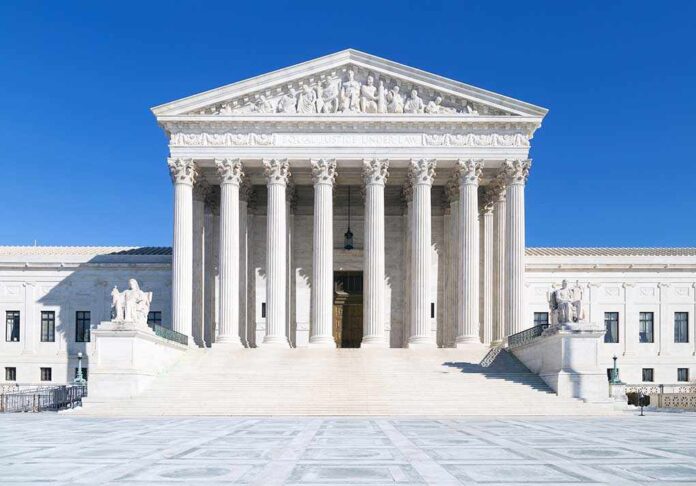
In a move that could reshape the American legal landscape, the Supreme Court’s shadow docket has become a tool for rapidly advancing the Trump-Vance administration’s policies.
Story Highlights
- Shadow docket use escalates, allowing swift policy changes.
- Key cases challenge long-standing legal precedents.
- Conservative justices support the administration’s enforcement agenda.
- Liberal justices express concern over due process erosion.
Supreme Court’s Shadow Docket Sparks Controversy
The Supreme Court’s shadow docket has emerged as a pivotal instrument in the Trump-Vance administration’s strategy to implement significant policy changes. This tool allows for emergency orders without full briefing, facilitating rapid shifts in immigration profiling, military policies, and federal agency operations. The administration has submitted an unprecedented 28 emergency applications since mid-September 2025, compared to eight during the previous 16 years under Bush and Obama.
Critics argue that this process undermines the Court’s deliberative function, eroding constitutional protections and due process. The liberal justices, including Justice Sotomayor, have voiced strong dissent, particularly against policies that allow racial profiling in immigration enforcement. This division among the justices highlights the ideological split, with conservative justices such as Justice Kavanaugh supporting the administration’s enforcement efficiency.
Key Court Cases to Watch
Three pivotal cases are set to challenge legal norms. The first, Trump-v. Slaughter, questions the “for cause” removal protections for FTC commissioners, directly impacting the career of Rebecca Slaughter. The second case, Trump-Vance v. Cook, involves the removal of Fed Governor Lisa Cook, with arguments centered on due process for pre-office conduct allegations, and is scheduled for January 2026. The third case challenges Illinois’ election day law, raising questions about federal versus state authority in setting election rules.
These cases, expected to be argued in the spring, could redefine federal powers and affect thousands of civil servants and voters. The outcomes may overturn long-standing precedents and alter the balance of power between the executive and other branches of government.
Implications of Potential Rulings
Should the Court uphold the administration’s positions, it could normalize the use of the shadow docket, allowing future administrations to bypass traditional checks and balances. This would have profound implications for civil liberties, potentially leading to mass deportations without hearings and stripping civil servants of job protections. Additionally, the erosion of “for cause” protections could destabilize federal agencies, weakening their ability to function independently from political pressures.
The broader impact of these rulings could extend to the economy and social structures, with federal fund cuts and due process voids affecting minorities and families. As the Court’s session begins on January 12, 2026, all eyes will be on these high-stakes cases and their potential to reshape American jurisprudence.
Sources:
The People’s Guide to the U.S. Supreme Court: 2025-2026
Oyez – U.S. Supreme Court Cases
Supreme Court Oral Arguments Calendar
Cornell Law – Supreme Court Order Lists