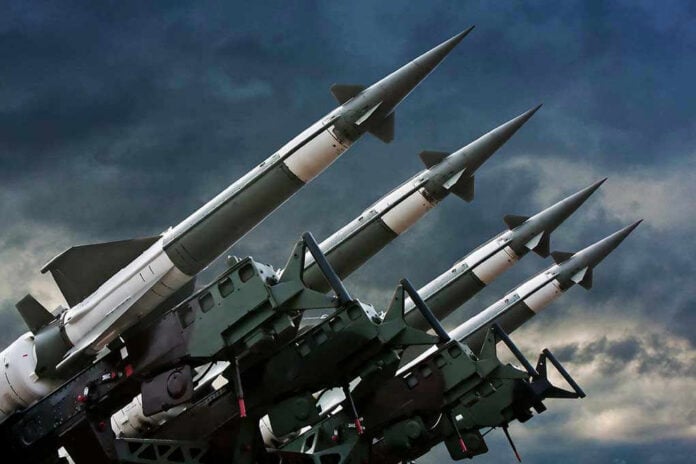
Saudi Arabia’s coalition says it stopped another Houthi missile attack before it could land, but the strike still showed how often the Yemen war spills across the border.
Quick Take
- The Saudi-led coalition said it intercepted three ballistic missiles fired from Yemen toward Najran and Jizan.
- Earlier reporting shows similar attacks have been met with repeated Saudi claims of successful interceptions.
- Past missile attacks have still caused injuries, damage, and fear in Saudi border areas.
- The pattern points to a long-running cross-border war that keeps testing Saudi air defenses.
Coalition Says It Shot Down the Missiles
The Saudi-led coalition said its air defenses intercepted three ballistic missiles fired by Yemen’s Houthi movement toward the southern Saudi regions of Najran and Jizan. Coalition spokesman Colonel Turki al-Malki made the announcement on Saudi state television, which presented the interception as a successful defense against the attack. The report fits a familiar pattern in the Yemen conflict, where each new launch quickly becomes a test of Saudi missile shields and public messaging.
Saudi officials have used the same language in earlier incidents, saying missiles were intercepted before they hit their targets. In some cases, Saudi civil defense later reported injuries from falling debris, including minor wounds in Riyadh and more serious harm in Najran. That record matters because it shows how “intercepted” does not always mean harmless. Even a destroyed missile can still send shrapnel into homes, roads, and crowded areas.
A Long Border War With Repeated Missile Claims
This episode sits inside a wider pattern that has defined the Saudi-Houthi fight for years. The Center for Strategic and International Studies said Saudi coalition forces reported more than 162 intercepts of Houthi ballistic missiles between March 2015 and April 2020, and the public count reached 177 by September 2020. In other words, this is not a one-off event. It is part of a sustained missile campaign that has continued despite Saudi air defenses and repeated coalition claims of success.
That long record has also raised questions outside official Saudi statements. The Associated Press reported that after one Houthi launch, Saudi Arabia claimed to have intercepted all seven missiles, even as later analysis pointed to possible gaps in what was visible or publicly confirmed. The basic facts of each interception are usually not disputed, but the full picture of what landed, what broke apart in the air, and what damage followed is often harder to verify in a fast-moving war zone.
What the Attack Means on the Ground
For people in southern Saudi Arabia, each missile alert reinforces a hard truth: the border remains active, dangerous, and politically unresolved. Reuters reported that previous Houthi missile strikes have injured civilians in Riyadh and Najran, while other reports described shrapnel damage in residential areas. Even when missiles are stopped, the threat still forces residents, airlines, security forces, and local officials to prepare for a strike that can arrive with little warning.
The Saudi-led coalition says its air defence systems intercepted ballistic missiles launched by Yemen’s Houthi movement toward Saudi Arabia’s Southern Region, amid rising tensions following recent developments in the conflict. pic.twitter.com/jOAwNfSSkg
— The Candor Post (@TheCandorPost) July 13, 2026
The wider war has also become a symbol of state power under strain. Saudi Arabia has spent years presenting its defenses as a shield against Houthi fire, while the Houthis keep proving they can reach deep into Saudi territory. That gap between official confidence and battlefield reality feeds anger on both sides of the political divide, especially among people who see governments as quick to issue statements but slow to solve the conflict that keeps putting civilians in the line of fire.
Sources:
insiderpaper.com, reuters.com, bbc.com, dw.com, allarab.news, missilethreat.csis.org
© newsworthy.news 2026. All rights reserved.