

Critics say a major newspaper hid key context about a viral campaign clash, and the facts back up parts of that charge.
Story Snapshot
- Reports say the questioner was a Republican staffer, not just “Tommy.”
- The Washington Post did not note his political background in its story.
- Video shows Abdul El-Sayed said he disavowed the Muslim Brotherhood.
- The record does not show what the Post knew at publication time.
What Sparked The Backlash
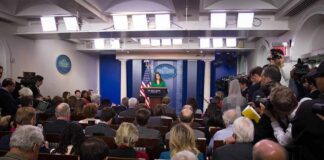
Video from a Michigan campaign event showed Senate candidate Abdul El-Sayed facing a question about the Muslim Brotherhood. The Washington Post described the questioner as “a young man” named “Tommy,” without political labels. Soon after, other outlets reported that “Tommy” was Thomas Teepell, a Republican operative who had worked for Senator Josh Hawley. That gap in context triggered charges of “journalistic malpractice” from media watchers and political commentators.
PolitiFact reviewed the video and reported that El-Sayed answered, “Sure, yeah, absolutely,” when asked to disavow the Muslim Brotherhood. He then challenged the premise, arguing the question implied divided loyalties because of his faith. The exchange spread fast online, where quick takes often shape public memory. Claims that he refused to disavow were shown as false by the tape, but the person who asked the question also became part of the story.
Who “Tommy” Is And Why It Matters
Mediaite reported that independent journalist Marisa Kabas identified “Tommy” as Thomas Teepell, and that The Wall Street Journal and The Guardian confirmed his identity and Republican work history. Newsweek and other reports also linked Teepell to Senator Hawley’s staff and to Republican strategists. That background makes the question look less like an ordinary voter ask and more like a partisan line that mirrored a Republican nominee’s messaging at the time.
That context is relevant because knowing a questioner’s role can help readers judge the moment. A staffer or operative may test a talking point to create a clip that travels online. The evidence supports Teepell’s Republican employment. It does not prove he was sent on a mission that night. There is no public record of a directive, payment, or plan tied to that event. So the stronger claim is about undisclosed affiliation, not a coordinated sting.
What The Washington Post Omitted — And What We Do Not Know
Mediaite said the Post article used neutral terms like “a young man,” “the questioner,” and “the man,” and did not call him a Republican or operative. That absence fueled anger from critics across the spectrum who see big media as serving insiders, not readers. Still, the public record does not show whether Post reporters knew the identity when they filed, or if they learned it only after publication. The outlet has not issued a detailed public explanation.
This gap feeds a larger trust problem. People on the right see legacy outlets skipping facts that hurt Democrats. People on the left see selective framing that boosts partisan attacks. Studies show corrections and added context often arrive late, after simple first frames harden. That is why transparency on sources and roles matters at the moment of publication, not days later when the clip is everywhere.
How To Read Viral Moments In 2026
Campaigns and operatives look for short, sharp exchanges that light up social feeds. Reporters often have minutes to file from noisy rooms. That speed creates risk. A fair baseline helps: name who asked the question, note known affiliations that bear on motive, and say when information is still being verified. Readers also need to separate two claims: who someone is, and whether they acted under orders. The first is often provable; the second usually is not on day one.
Here, the strongest verified points are clear. The man in the video has been identified as Thomas Teepell, who worked for Republicans. The Washington Post did not include that context in its first write-up. The video shows El-Sayed said he would disavow the Muslim Brotherhood. The unanswered part is what the Post knew at the time. Until outlets close that loop, the fight will stand as another case where missing context lets cynicism grow — and the audience loses.
Sources:
mediaite.com, newsweek.com, newsy-today.com
© newsworthy.news 2026. All rights reserved.