

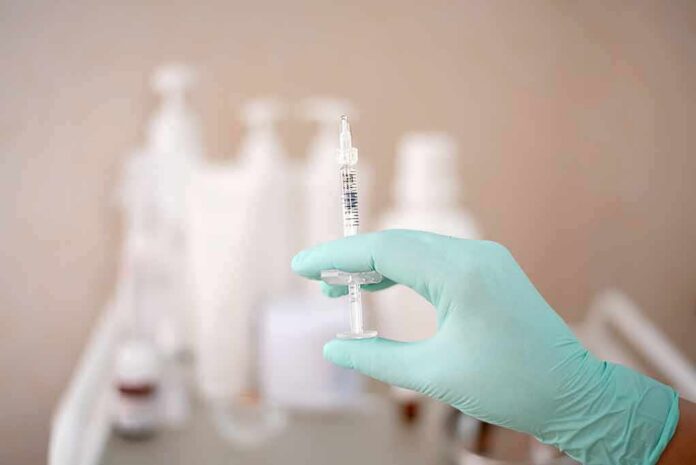
Scientists injected a matchstick-thin, battery-free implant next to a rat’s sciatic nerve and wirelessly fired the nerve to move its leg.
Story Highlights
- Researchers showed a tiny, leadless implant can activate a peripheral nerve in a living rat.
- The device has no battery or wires and can be injected through a standard needle.
- A wearable transmitter powers the implant through tissue at low frequency.
- The study did not test pain relief in people and remains preclinical.
What the researchers built and proved
University of Florida researchers led a team that created an injectable implant that stimulates nerves without a battery or wires. The team placed the device next to the sciatic nerve in rats. They then powered it from outside the body and triggered clear muscle movements, showing the nerve fired on command. The published description reports a needle-injectable, fully passive design with no onboard electronics. The reported size is about 1.4 millimeters wide and 9 millimeters long, roughly 14 cubic millimeters.
The system uses a small external transmitter worn on the body. That transmitter sends energy through tissue to the implant at about 65 kilohertz, which is a low radio frequency. The implant then delivers pulses to the nearby nerve. Researchers say clinicians could adjust stimulation in real time from outside the body. They also say imaging methods like ultrasound and computed tomography can help confirm where the implant sits after injection.
Why an injectable, passive design matters
Today’s nerve stimulators often need surgery to place leads and batteries. That raises costs, risks infection, and can limit who gets care. This device aims to cut those hurdles. It can be delivered through a needle near the target nerve. It leaves no wires under the skin and no battery pocket to maintain or replace. The team argues that this could lower the barrier to nerve stimulation and widen access if safety and benefits hold up in human studies.
During the rat study, the implant reportedly stayed in place near the nerve with little visible tissue reaction. That early sign of stability helps, since movement or scarring can blunt nerve stimulation over time. Still, the report covers a short window, not months or years. The team’s statements highlight the promise of a simpler procedure and simpler hardware, but they do not claim long-term durability or full readiness for clinical use yet.
How this fits in the neuromodulation race
Many groups are chasing wireless, injectable ways to talk to nerves. Some systems use soft hydrogels to reach deep brain sites. Others use tissue-coupled power paths to run tiny implants placed in different body areas. Several animal studies have shown motion or behavior changes after stimulation. This new device belongs to that larger push but is distinct in its passive, leadless, needle-injectable setup targeted at peripheral nerves rather than the brain.
The field often shows nerve activation in animals first. The harder steps come next: proving real symptom relief, finding the right dose, showing the device stays put and safe, and repeating the results in larger studies. That is why this result should be seen as an engineering advance and a stepping stone toward therapy. It is not yet a treatment for chronic pain, even if that is the long-term goal many hope to reach.
What this could mean for pain care—and the caveats
Chronic pain steals work, sleep, and savings from millions. Many patients bounce between pills, injections, and surgery. A small, injectable stimulator that can quiet a painful nerve without a battery swap or a lead revision sounds like progress. If it works in people, it might cut clinic time, lower costs, and offer an option when drugs fail or cause side effects. But those are future claims that must be earned through strict human trials with clear endpoints.
The team says they plan to shrink the device further before human testing, which signals more engineering is ahead. They will also need to show the implant stays stable over months, does not heat tissue, and can be found and, if needed, removed. Regulators will expect careful data on power transfer, tissue safety, and repeat performance. Until that work is done, this remains a strong proof of concept, not a proven pain treatment.
Sources:
sciencedaily.com, news.ufl.edu, innovate.research.ufl.edu, nyuad.nyu.edu, pubmed.ncbi.nlm.nih.gov, natureworldnews.com, pmc.ncbi.nlm.nih.gov
© newsworthy.news 2026. All rights reserved.