

Revolutionizing its online delivery empire against Amazon—and you won’t even know they exist when driving past.
Key Takeaways
- Walmart is testing unmarked “dark stores” that exclusively fulfill online orders without allowing public access, with the first operational in Dallas and another planned for Bentonville.
- The retail giant aims to reach 95% of the U.S. population with delivery options of three hours or less, with deliveries in this timeframe already up 91% in Q1 compared to last year.
- These facilities lack external signage to deter customers but internally resemble regular Walmart stores, optimized for efficient order processing.
- Walmart is also expanding drone delivery to 100 additional locations, becoming the first retailer to offer this service across five states.
- This strategy directly targets Amazon’s dominance in the fast delivery space as Walmart positions itself for e-commerce growth.
America’s Retail Giant Goes Digital-First
Walmart is aggressively expanding its e-commerce capabilities with the introduction of “dark stores” – retail locations closed to the public that function solely as fulfillment centers for online orders. This strategic shift represents Walmart’s response to the changing retail landscape where digital shopping continues to gain market share. The first of these specialized facilities is already operational in Dallas, Texas, with another location planned for Bentonville, Arkansas, where the company is headquartered. These locations mark a significant departure from Walmart’s traditional business model that has historically centered around in-store customer experiences.
“Delivery speed continues to help drive our business. We’ll soon reach 95% of the population in the U.S. with delivery options of three hours or less,” said Douglas McMillon, Walmart CEO.
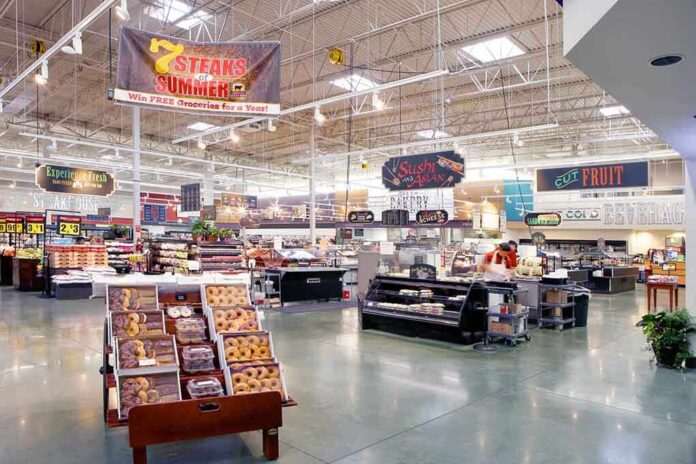
While the dark stores physically resemble regular Walmart locations inside, they’re specifically designed for maximum efficiency in order fulfillment. The absence of in-store shoppers eliminates common retail obstacles like aisle congestion, checkout lines, and the need for customer-facing displays. This allows Walmart to optimize every square foot for storage, product selection, and dispatch operations. What’s particularly notable is that these facilities maintain a low profile by design, with no external Walmart signage to deter curious shoppers from attempting to enter, creating a stealth retail operation hidden in plain sight.
Battling Amazon on Delivery Speed
The dark store initiative is clearly aimed at challenging Amazon’s dominance in rapid delivery services. Walmart’s emphasis on delivery speed has already shown impressive results, with CEO Douglas McMillon reporting a 91% increase in deliveries completed in less than three hours during the first quarter compared to the previous year. This dramatic improvement demonstrates that Walmart’s logistics transformation is already yielding significant competitive advantages. The company’s ambitious goal to provide three-hour-or-less delivery options to 95% of the U.S. population would put Walmart in direct competition with Amazon Prime’s quick delivery promise.
“For Walmart U.S, the number of deliveries in less than three hours grew by 91% for Q1 versus a year ago,” said Douglas McMillon, Walmart CEO.
President Trump’s administration has consistently emphasized American business innovation and job creation, and Walmart’s investment in these next-generation retail solutions aligns with that vision. While traditional retail jobs may shift in nature, these fulfillment centers create new opportunities in logistics, technology integration, and last-mile delivery. The dark stores represent a strategic adaptation to consumer preferences that increasingly favor convenience and speed over traditional shopping experiences, particularly among younger demographics that Walmart needs to capture to ensure long-term market share growth.
Beyond Dark Stores: Walmart’s Technological Revolution
Walmart isn’t stopping with dark stores in its technological evolution. The company is simultaneously expanding its drone delivery program to 100 additional locations, positioning itself as the first major retailer to offer aerial delivery services across five states. This multi-pronged approach to delivery innovation demonstrates Walmart’s commitment to exploring all available channels to improve its logistics capabilities. These investments in technology and infrastructure represent a significant pivot for a company that built its empire on the big-box retail model, showing Walmart’s recognition that the future of retail will be increasingly digital.
“We regularly test new tools, features, and capabilities to better connect with and serve our customers — wherever and however they choose to shop. Regardless of the channel, our goal remains the same: to deliver a fast, seamless, and engaging customer experience,” stated Walmart.
The dark store concept also provides Walmart with valuable data on optimizing fulfillment operations, potentially influencing how even its traditional stores manage their increasingly important online order fulfillment functions. By testing these dedicated facilities, Walmart can refine processes that may eventually be implemented throughout its extensive retail network. With over 4,600 stores across the United States, Walmart possesses an unmatched physical infrastructure that, if properly leveraged for e-commerce, could provide significant advantages over purely digital retailers like Amazon that continue building out their physical presence from scratch.