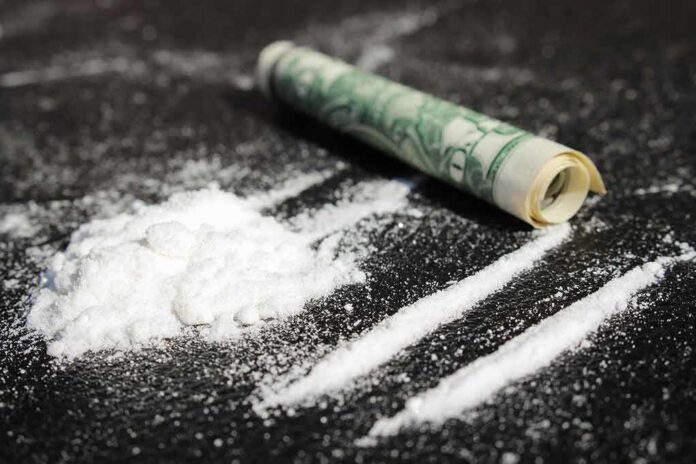
Methamphetamine trafficking from Southeast Asia’s Golden Triangle has reached catastrophic levels, with a record-breaking 236 tonnes seized last year—representing only a fraction of the drugs actually reaching the market.
Key Takeaways
- Methamphetamine seizures in Southeast Asia surged to 236 tonnes in 2024, a 24% increase from the previous year
- Myanmar’s ongoing civil war and military takeover since 2021 has facilitated massive expansion of drug production and trafficking networks
- Thailand alone seized over 100 tonnes of methamphetamine and approximately 1 billion methamphetamine tablets in a single year
- Trafficking routes have diversified across land and maritime corridors, including expansion into Laos, Cambodia, Malaysia, Indonesia, and the Philippines
- Mexican cartel-produced methamphetamine has been discovered in several Asian countries, indicating global criminal syndicate cooperation
Golden Triangle Emerges as Global Methamphetamine Factory
The “Golden Triangle” region where Myanmar, Laos, and Thailand converge has transformed into the world’s most prolific methamphetamine production hub. Drug manufacturing and trafficking have escalated dramatically since Myanmar’s military takeover in February 2021, with production centered in Myanmar’s Shan State. Criminal organizations have established industrial-scale operations, capitalizing on regional instability and weak governance. The chaos of Myanmar’s civil war provides perfect cover for these activities, with drug flows increasing dramatically across East, Southeast, and South Asia, particularly into Northeast India.
“We are clearly seeing unprecedented levels of methamphetamine production and trafficking from the Golden Triangle, in particular Myanmar’s Shan State,” said Benedikt Hofmann, UNODC acting regional representative.
Despite ongoing conflict in Myanmar, drug production zones remain operational. “There is a degree of stability in certain parts of the country, especially those known for large-scale synthetic drug production,” Hofmann noted. This suggests complex relationships between armed groups, criminal syndicates, and possibly corrupt officials maintaining these production enclaves amidst broader regional turmoil. The UNODC reports that methamphetamine tablets now sell for as little as $0.60 in Myanmar, reflecting the massive scale of production driving prices down.
Evolving Trafficking Routes and Criminal Networks
Criminal syndicates have developed sophisticated trafficking networks that continuously adapt to enforcement pressures. Traditional routes from Myanmar into Thailand have expanded to include multiple corridors through neighboring countries. “The trafficking route connecting Cambodia with Myanmar, primarily through Laos PDR, has been rapidly expanding,” said Inshik Sim, a drug trafficking expert.
Maritime trafficking has emerged as a significant alternative to land routes, with complex networks connecting Malaysia, Indonesia, and the Philippines. Sabah in Malaysia has become a strategic transit hub for regional distribution. These criminal networks demonstrate remarkable agility, rapidly shifting operations when confronted with law enforcement pressure. The UNODC reports that transnational drug gangs in East and Southeast Asia have effectively countered law enforcement efforts by evolving their tactics and exploiting regional vulnerabilities.
Adding to the complexity, methamphetamine from North America—specifically tied to Mexican cartels—has been identified in several Asian countries. This indicates growing international criminal cooperation and the globalization of the methamphetamine trade. Additionally, some drugs enter Southeast Asia from the “Golden Crescent” region of Afghanistan, Pakistan, and eastern Iran, creating a multinational web of drug trafficking operations that transcend regional boundaries.
Technological Advancement and Criminal Innovation
Modern drug traffickers increasingly employ digital tools and emerging technologies to facilitate their operations. These criminal enterprises are infiltrating legitimate businesses as fronts for their activities while developing sophisticated money laundering mechanisms. There’s a growing convergence between trafficking groups and those providing specialized criminal services like underground banking, creating a more integrated criminal ecosystem. These developments make detection and enforcement increasingly challenging for authorities already struggling with limited resources.
“The 236 tons represent only the amount seized; much more methamphetamine is actually reaching the market,” warned Benedikt Hofmann, highlighting the limitations of enforcement-only approaches.
The social impact of this massive drug trade is evident in changing user demographics. The UNODC reports an overall increase in methamphetamine and ketamine use across the region, with a concerning rise in older drug users in countries like Malaysia, Singapore, and Thailand. While some prevention campaigns may be reducing usage among younger demographics, comprehensive strategies combining enforcement, prevention, and treatment remain essential to address this growing crisis threatening communities throughout Southeast Asia and beyond.