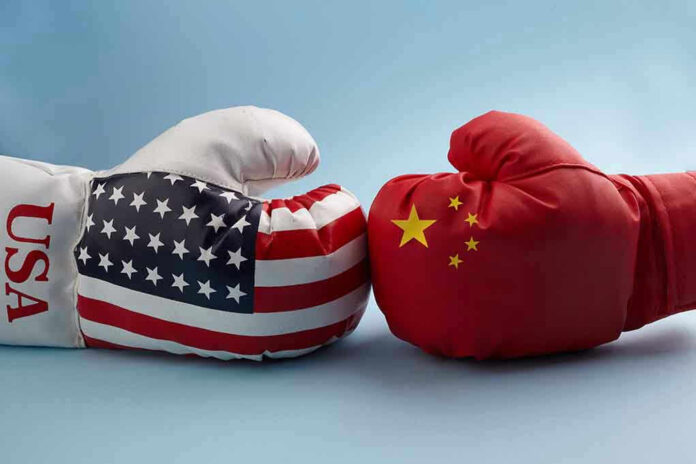
China’s aggressive Christmas Day sanctions on 20 American defense giants and their top executives signal a direct assault on U.S. resolve to defend Taiwan against Beijing’s territorial ambitions.
Story Snapshot
- China’s Ministry of Commerce imposed asset freezes, travel bans, and business prohibitions on 20 U.S. defense firms and 10 executives over arms sales to Taiwan.
- Sanctions target companies like Lockheed Martin, Raytheon, and Boeing CEOs, escalating amid $20 billion in U.S. arms packages since 2020.
- President Trump vows to hit back harder, underscoring America’s commitment to Taiwan under the 1979 Taiwan Relations Act.
- U.S. firms report minimal impact, bolstering confidence in decoupling from China’s economic leverage.
Sanctions Announced on Christmas Day
China’s Ministry of Commerce announced sanctions on December 25, 2025, against 20 U.S. defense companies and 10 senior executives. The measures freeze assets in China, ban travel, and prohibit dealings with Chinese entities. Beijing cited massive U.S. arms sales to Taiwan as violations of the one-China principle. This marks the largest such action by China, targeting firms like Lockheed Martin and Raytheon for supplying F-16 jets, HIMARS systems, and missiles. The timing coincides with U.S. holiday distractions and post-inauguration tensions.
Escalation from Years of U.S. Arms Support
U.S. arms sales to Taiwan fulfill the 1979 Taiwan Relations Act, providing defensive weapons against Chinese threats. Packages total over $20 billion since 2020, including September 2024’s $2.2 billion Harpoon missiles and December 2025’s $1.8 billion F-16 upgrades. China views these as arming separatists, intensifying after 2024 elections where Lai Ching-te won. Previous incidents include 2020 sanctions on Lockheed and 2022 actions post-Pelosi visit. Taiwan relies on this support amid rising PLA incursions.
U.S. and Taiwan Responses Signal Defiance
The U.S. State Department labeled the sanctions unwarranted on December 26, pledging continued Taiwan support. Taiwan’s Ministry of Defense stated it will not be intimidated, accelerating local arms production. Lockheed Martin reported no material impact due to minimal China operations. President Trump posted on Truth Social: “China playing games—we’ll hit back harder.” Deliveries like HIMARS proceed unabated, reinforcing U.S. commitments against Beijing’s revanchism.
These developments test the Trump administration’s America First stance, prioritizing alliances that counter communist aggression while minimizing economic vulnerabilities to China.
Minimal Economic Bite, Strategic Ramifications
U.S. firms face negligible revenue losses, with China comprising under 1% of their exposure; Lockheed shares dipped just 0.5% pre-market. Executives endure symbolic travel bans with low personal impact. Long-term, sanctions accelerate supply chain decoupling, reducing reliance on Chinese dual-use parts. Taiwan gains security boosts but highlights dependency risks. Globally, allies like Japan and the Philippines watch closely as defense stocks remain volatile.
Experts like CSIS’s Bonny Lin call the moves symbolic yet indicative of China’s direct targeting strategy. Drew Thompson notes U.S. firms lose little in China markets. This bolsters conservative hawks who see leverage in standing firm against overreach.
Sources:
Reuters: “China hits 20 U.S. arms makers with sanctions” (Dec 25, 2025)
Global Times: Official list (Dec 25)
U.S. DSCA: Arms notifications (2024-2025)
CRS: “Taiwan Arms Sales” R48044 (2025)
CSIS: “China’s Sanctions Playbook” (2025)