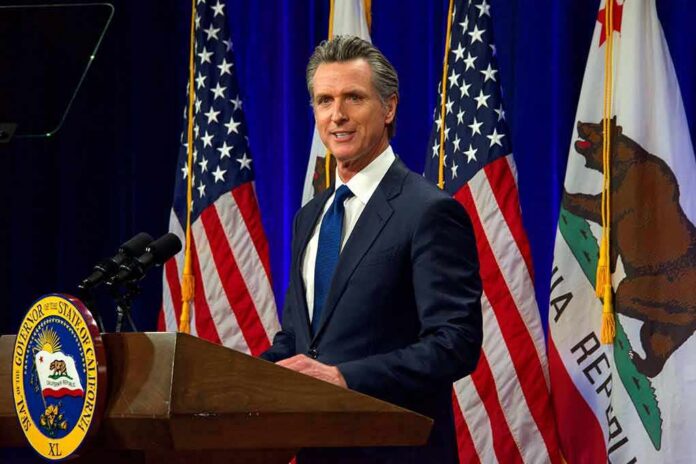
California Governor Gavin Newsom signed roughly 1,160 bills in 2026, covering everything from election security to driver’s licenses to immigration enforcement, and most take effect January 1, 2027.
Quick Take
- Newsom signed about 1,160 bills sent by the Legislature in 2026 and vetoed 10.3% of them, according to a veteran Sacramento lobbyist tracking the numbers.
- New laws touch immigration enforcement, elections, reproductive care, electric vehicles and Department of Motor Vehicles (DMV) services.
- A late-September package responded directly to federal immigration enforcement, while another targeted ballot and election record seizures.
- Most signed bills become law on January 1, 2027, under California’s standard legislative timeline.
A Flood of Bills Lands on the Governor’s Desk
California lawmakers sent Newsom about 1,160 bills in 2026. He signed roughly 90% of them and vetoed the rest, according to an Orange County Register count citing a veteran Sacramento lobbyist. The governor’s office released the signings in waves through the summer and fall, often grouping dozens of bills by topic in a single announcement rather than one giant list.
Each bill gets a number, a sponsor and a short title, like AB 1126 from Assemblymember Joe Patterson, which changes Medi-Cal rules for people who already have other health coverage. That kind of narrow, technical language is typical. Most new laws fix small pieces of existing programs rather than create sweeping change, even when they get bundled into headline-grabbing announcements.
Immigration and Election Measures Draw the Most Attention
On September 29, Newsom signed 21 bills described by his office as protecting immigrant communities from federal immigration enforcement. The package covers detention oversight, enforcement transparency and public records access. The announcement framed the bills as a response to what the governor’s office called “Orwellian” federal tactics, a label that signals the political fight behind the policy.
A separate law, Assembly Bill 282 from Assemblymember Pellerin, makes it a felony to seize ballots, election records or certified voting equipment before results are certified. It also targets officials who order subordinates to interfere with vote counts. Newsom’s office tied the bill to concerns about outside interference in California elections, giving it unusually sharp language for a state statute.
Everyday Life Changes: Cars, Health Care and Paperwork
Several new laws touch daily routines more directly. Senate Bill 169 modernizes the DMV and expands mobile driver’s license access statewide, a change the governor’s office said would cut costs and reduce red tape for millions of residents. A cluster of bills signed September 20, including Senate Bill 969 and Assembly Bill 1820, aims to expand electric vehicle access and strengthen the state’s energy independence.
Reproductive health care also expanded. Bills signed September 27 broaden the scope of nurse-midwives in emergency care and protect what the state calls legally protected health care activities. Other measures cover smaller but real-world issues, like electric bicycle safety training for students and new licensing rules for electrified security fences.
In 2025 he rejected 123 of 917 bills (about 13%), and CalMatters found cost was the reason he cited most often.
The cases that match the claim are specific and recent.
**Homelessness spending.** In 2024 the state auditor reported California had spent about $24 billion on…
— Reply Guy in Witness Protection 🥸 (@smellyfarts24) October 8, 2026
Not every bill makes headlines. Dozens deal with budget trailer language, state agency regulations or professional licensing boards, the unglamorous machinery of state government that rarely draws public notice but still reshapes rules residents and businesses must follow.
Why the Volume and Framing Matter
California governors routinely bundle large numbers of bills into end-of-session announcements, and the public often reads them as a single wave of “new laws changing daily life,” even though the measures vary widely in scope. Signed bills are formally chaptered and typically take effect the following January 1, which gives these announcements a predictable rhythm every fall.
For many Californians, the sheer scale, over a thousand new statutes in a single year, raises a familiar question: whether lawmakers are solving real problems or simply generating activity. Whether a given measure changes daily life in a meaningful way often depends less on the signing ceremony than on how agencies enforce it once it takes effect next year.
Sources:
nypost.com, gov.ca.gov, californiaglobe.com
© newsworthy.news 2026. All rights reserved.