

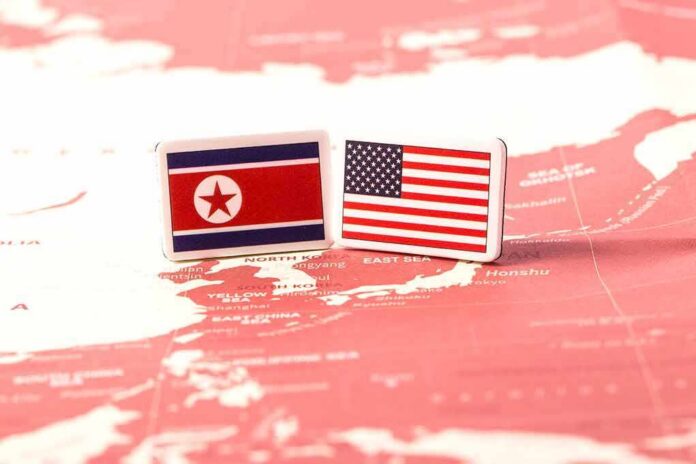
As inspectors warn North Korea is enlarging its uranium-enrichment capacity, Washington still vows “complete denuclearization” with few visible results to show.
Story Highlights
- International inspectors report fresh expansion at North Korea’s Yongbyon enrichment site.
- The United States repeats its goal of full denuclearization and enforcing United Nations resolutions.
- Pyongyang claims its nuclear status is “irreversible,” rejecting denuclearization as a topic.
- Experts say North Korea likely holds dozens of nuclear weapons, with material for more.
Inspectors See Growth At Key Nuclear Facilities
United Nations nuclear inspectors say North Korea has built an extension to its uranium-enrichment plant at Yongbyon. The International Atomic Energy Agency reported new activity that points to more weapons-grade material in the future. The agency’s broader reporting has flagged ongoing work across the program in recent years, including the light-water reactor and suspected added enrichment capacity, all in violation of United Nations Security Council resolutions. These findings confirm that North Korea is not slowing its nuclear effort, even under heavy sanctions and global pressure.
The pattern is clear across multiple reports. International monitors have tracked resumed and sustained operations at nuclear sites since at least 2024, with only brief pauses. A Congressional Research Service brief likewise summarized continued advances despite sanctions and past diplomacy. Together, these records show a steady push to increase fissile material production. More uranium enrichment means more potential warheads over time. That raises risks for U.S. allies and complicates any future bargaining.
Washington Repeats Denuclearization Pledge
The United States State Department recently restated that Washington seeks the complete denuclearization of North Korea and full enforcement of United Nations Security Council resolutions. That stance aligns with long-standing U.S. policy under Republican and Democratic administrations. President Trump’s team has kept that goal in public statements. But the strategy tools—sanctions, outreach, and deterrence—have not yet halted the program. Even strong words ring hollow when the centrifuges keep spinning and the reactors keep warm.
For citizens who feel Washington talks big but delivers little, this is a familiar story. Leaders promise tough action. Bureaucracies hold meetings. The program grows anyway. Many Americans on the right blame years of weak enforcement and mixed messages. Many on the left blame rigid demands without a workable plan. Both can agree on one thing: a government that cannot stop a small, poor state from expanding a nuclear arsenal looks ineffective, even captured by stale thinking that protects careers more than results.
Pyongyang Claims “Irreversible” Nuclear Status
North Korea’s representatives at the United Nations said the country’s nuclear-weapons status is enshrined in top law and is “irreversible,” framing the arsenal as needed against American threats. That message rejects the core U.S. demand at the start. It also sets a higher price for any talks: if denuclearization is off the table, the best Washington might get is a freeze, limits, or transparency. That position hardens the stalemate and places more weight on deterrence and allied defense planning.
Independent analysts estimate North Korea already holds several dozen warheads, with enough fissile material for more. One recent review said President Trump’s public “57” figure fits within major think tank ranges, which put the stockpile around 50 to 60 weapons, plus material for dozens more. Exact numbers are uncertain, but the direction is not. More capacity at Yongbyon today likely means a larger arsenal tomorrow, barring a deal that caps or rolls back production.
Why Pressure And Talks Keep Falling Short
Three decades of starts and stops show the core problem. Inspectors can see some activity. Sanctions can slow trade and finance. Talks can promise aid or relief. But without firm verification and phased, mutual steps, both sides stall. The United States demands full disarmament first. North Korea seeks relief and security up front. Meanwhile, the nuclear clock keeps ticking, and each added centrifuge narrows U.S. options later. That fuels public doubt about whether Washington can manage hard problems.
Diplomacy with North Korea has reached a standstill as Pyongyang ignores outreach efforts. With an arsenal now estimated at 60 warheads, the Pentagon officially classifies the regime as a direct nuclear threat. Regional security dynamics are shifting as denuclearization stalls. pic.twitter.com/uFqCsodRH7
— Azat TV (@azattelevision) November 22, 2026
What might actually change the trend line? Some experts urge a practical ladder: freeze production, lock in monitoring, then trade limited relief for concrete steps that reduce the arsenal’s size and risk, all while keeping deterrence strong. Others argue only maximum pressure works. The record suggests neither tool alone is enough. A clear plan, firm enforcement, and real verification are the minimum. Without them, America faces a growing threat and another lesson in what happens when strategy drifts while technology advances.
Sources:
wsj.com, iaea.org, en.sedaily.com, usnews.com, 38north.org, koreajoongangdaily.com
© newsworthy.news 2026. All rights reserved.