
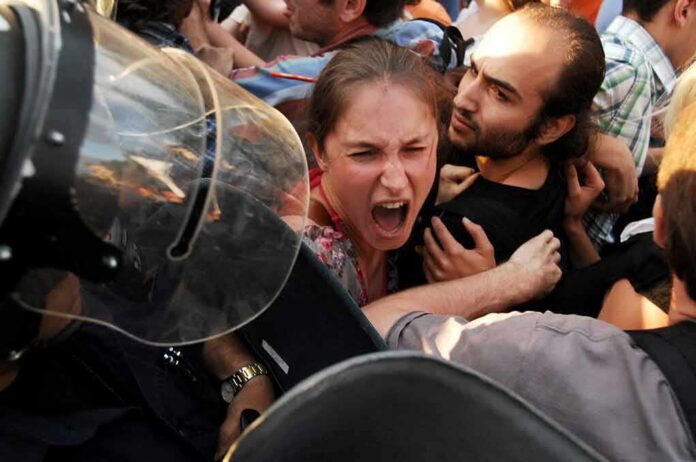
A woman protesting inside President Trump’s Youngstown rally was punched by attendees and then escorted from the arena, spotlighting how fast political crowds can turn physical before security steps in.
Story Highlights
- Several protesters were removed during President Trump’s Youngstown rally at the Covelli Centre.
- Video and reports say a woman in a “Release the Epstein Files” shirt was punched by attendees.
- The sheriff’s office said those involved were escorted out; no charges were filed as of the next day.
- The episode renews debate over protest removal and the risk of a heckler’s veto in heated venues.
What Happened Inside the Rally
On Monday night in Youngstown, Ohio, several disruptions broke out during President Trump’s speech at the Covelli Centre. Local and national outlets reported that a woman wearing a “Release the Epstein Files” shirt protested during remarks. Video and witness accounts said rally attendees punched her before security separated the parties and escorted people from the building. A local sheriff’s spokesperson later confirmed multiple removals tied to the disturbances inside the arena.
The Mahoning County Sheriff’s Office said at least three people were removed from the event. Deputies and security personnel intervened after confrontations in the crowd. Officials reported no charges had been filed by Tuesday, though law enforcement encouraged anyone assaulted to submit a complaint to support an investigation. Reports also described cheering and chants from nearby seats as the scene unfolded, showing how fast a tense moment can tip toward violence in a packed venue.
How Officials and Crowds Handle Disruption
Event hosts and police must keep order and protect safety when protests break out. Removing someone can be lawful when fights erupt or risks rise. But legal scholars warn about a pattern known as the heckler’s veto. That happens when officials silence a speaker or protester because opponents threaten disruption. Courts have cautioned that rewarding crowd hostility can chill speech and invite more intimidation at future events.
Balancing these aims is hard in close quarters. Security must stop real threats without punishing a message only because others dislike it. That line gets blurry when a protest triggers a hostile response from the crowd. Best practice urges officials to address aggressors first, separate groups, and apply clear, content-neutral rules. When violence starts, removal to restore safety can be justified. When only offense or noise is at issue, forced removal risks crossing into viewpoint bias.
Why This Resonates Across Ideologies
Americans across the spectrum see rallies, town halls, and council meetings grow hotter and less civil. Many believe elites play by different rules while regular people get lectured or pushed out. Episodes like Youngstown feed both fears. Conservatives point to rising disruptions that derail events. Liberals point to crowd hostility that can silence dissent. Both sides worry officials respond based on politics, not even rules. Equal protection and safe, peaceful assembly must not become selective perks.
Leaders, venues, and law enforcement can lower the temperature with firm, even standards. Post clear conduct rules. Train staff to spot flashpoints early. Intervene fast against anyone who throws punches, no matter their views. Keep removals tied to behavior, not beliefs. After incidents, invite reports and share findings. These steps do not end anger or heckling. But they help ensure that safety, not partisan advantage, decides who stays and who goes at charged public events.
Sources:
foxnews.com, thehill.com, inkl.com
© newsworthy.news 2026. All rights reserved.