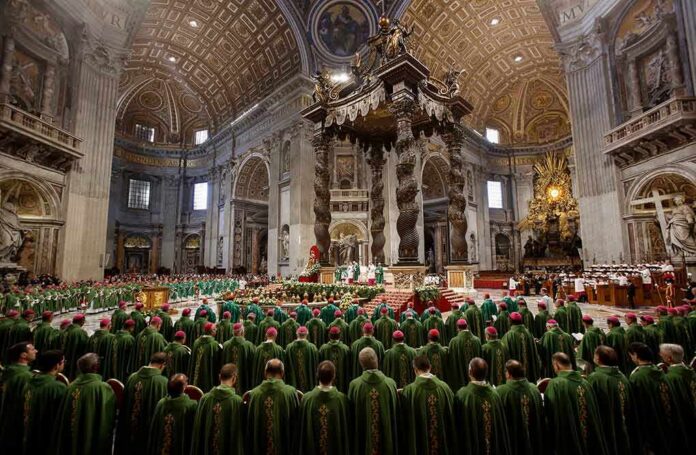
Paris authorities and the Vatican say Pope Leo XIV’s open-air Mass filled central Paris with hundreds of thousands, turning Place de la Concorde and the Champs-Élysées into a vast, tightly secured cathedral in the street.
Story Highlights
- Pope Leo XIV celebrated a 3 p.m. open-air Mass at Place de la Concorde in Paris.
- Organizers registered more than 600,000 attendees, with estimates ranging higher.
- France deployed a large security operation across central Paris for the event.
- The gathering tested France’s strict secularism as the state managed a huge religious crowd.
Mass draws a vast crowd in the heart of Paris
Pope Leo XIV celebrated a public Mass at 3 p.m. on Place de la Concorde, with the event footprint stretching along the Champs-Élysées. French and church organizers registered more than 600,000 people, and some outlets projected even larger attendance along the route. The Mass marked the first papal celebration of this scale in central Paris since 2008, underscoring strong public interest despite France’s secular identity. Crowds began arriving early as gates opened and access points filled through midday.
The Vatican’s official program set the timing and location weeks in advance, anchoring logistics and public messaging. French media and event pages guided arrivals with opening times, recommended entry before late morning, and firm gate closures early afternoon to manage flow. Organizers extended viewing areas beyond the square to handle demand along the 1.2-mile avenue, where the Pope traveled in the popemobile before the liturgy. The scale required disciplined staging to keep lines moving and emergency lanes clear.
Security operation spans Parisian landmarks
Police and interior officials mounted a large, layered security plan across central Paris. Barricades, checkpoints, and bag searches ringed the square and the avenue, with controlled entry points and surveillance in side streets. French coverage described a similar deployment to other major moments of the visit, reflecting concern about crowd safety as much as potential threats. Authorities aimed to protect worshippers, keep traffic away, and allow rapid medical response if needed.
Organizers lengthened the perimeter to reduce bottlenecks and to separate vehicle traffic from pedestrian zones. Transport and street closures stretched beyond the immediate site so arrivals could disperse safely after Communion and dismissal. The approach mirrored recent crowd management lessons in Europe. It sought to balance openness with order for a congregation the size of a large city. Officials also coordinated with church stewards to direct movement near the altar and main aisles.
Secularism meets a massive act of worship
France’s model of strict secularism again faced a high-profile test as the state managed a huge religious gathering in public space. The government does not endorse a faith, yet it must ensure basic services, safety, and access when citizens assemble. The visit highlighted that tension. Authorities framed their role as neutral managers of public order, while church leaders framed the day as prayer in the common square, open to all and respectful of local rules.
Exclusive coverage: Pope Leo XIV celebrated before an audience of 800,000 at the Place de la Concorde mass in Paris on September 26, 2026. Documented exclusively by #RunwayMagazine #PopeLeoXIV @runwaymagazine @Pontifex pic.twitter.com/ZU0bmRPwW0
— RUNWAY MAGAZINE ® (@runwaymagazine) September 27, 2026
Many citizens on both the left and the right see events like this through a shared lens of trust and competence. People worry that big systems fail under stress. Here, clear schedules, visible policing, and early communication tried to show the state could still deliver. For families, seniors, and the sick who attended, good planning mattered more than politics. When government handles basics well, it lowers the temperature in a country tired of slogans and short on results.
What the turnout says about faith and public life
The sheer size of the congregation suggests faith still draws people into civic space in Europe, even where religious practice has declined. Paris showed that worship and civic life can share the same streets when rules are clear and safety is taken seriously. The crowd also signaled that many citizens still seek meaning beyond daily news cycles and culture fights. That demand will keep testing how secular states manage belief in public without favor or fear.
Sources:
youtube.com, euronews.com, foxnews.com, lemonde.fr, osvnews.com, sortiraparis.com
© newsworthy.news 2026. All rights reserved.