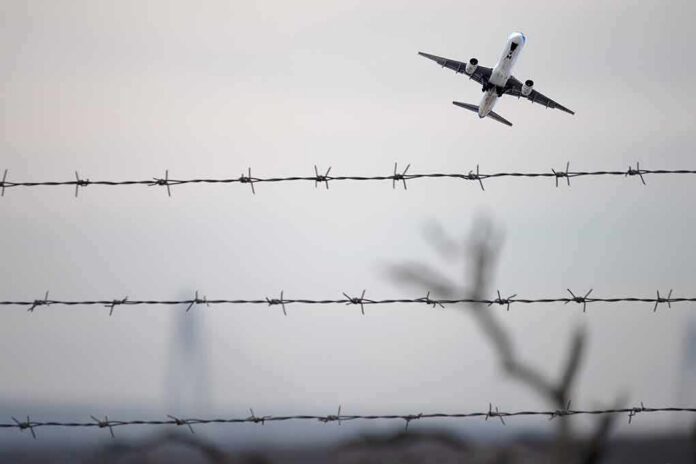
A drone carrying an explosive device shut down a key German cargo hub that helps move NATO and Ukraine supplies, raising fresh questions about how safe our critical infrastructure really is.
Story Snapshot
- An airport worker found a drone with an explosive device near a runway and close to a Ukrainian Antonov cargo plane.
- Police halted flights, diverted planes, and used a bomb robot to remove the detonator from the device.
- Prosecutors opened a politically motivated and extremist-crimes investigation, but have not named any suspects.
- A second flying object reportedly struck a cargo jet the same night, adding to fears of a coordinated attack.
What Happened at Leipzig/Halle Airport
Late Tuesday night, an airport employee at Leipzig/Halle Airport in eastern Germany spotted a drone near the southern runway, close to parked cargo aircraft. Investigators say the drone was carrying an unknown explosive device and was found in the cargo area near a Ukrainian Antonov Airlines plane. Police treated the find as an active threat, sealing off the area and sending in a bomb disposal robot to inspect the device and make it safe.
German federal police specialists used the robot to remove the detonator from the device attached to the drone, effectively defusing it. Officials later said the detonator had been taken out of an “as-yet unidentified explosive device,” suggesting they had not fully shared lab details about what kind of explosive it was. Authorities stressed there was no danger to passengers or staff by the time flights resumed, but the discovery itself was serious enough to trigger a major security operation.
Runways Closed, Flights Diverted, Second Incident Reported
Right after the drone and device were found, flight operations at Leipzig/Halle were halted and both runways were shut down. Several flights, including at least one passenger flight from Palma de Mallorca and multiple cargo flights, were diverted to other airports such as Nuremberg while police swept the area. The north runway reopened after about two hours, shortly before 2 a.m., but the south runway stayed closed as investigators continued searching and as maintenance was scheduled there.
During the same night, authorities say another flying object apparently collided with a cargo aircraft that was taxiing or attempting to land. A DHL cargo jet reportedly had to abort its landing and later showed minor damage after reaching Hanover, which investigators linked to contact with an unidentified object. This second incident has fueled talk that the airport may have faced more than one drone or object, though police have not publicly confirmed exactly what hit the cargo plane or how it relates to the explosive drone on the ground.
Why This Airport Matters for NATO and Ukraine
Leipzig/Halle Airport is not just a civilian cargo hub; it is part of Germany’s critical infrastructure and supports the movement of military goods for Germany and North Atlantic Treaty Organization (NATO) allies. It is also an operating base for Ukraine’s Antonov Airlines, whose large cargo planes help move supplies linked to the war with Russia. Photos from the scene show police and robots working near a Ukrainian Antonov aircraft, making many observers wonder if the plane or its cargo was the real target.
A DHL cargo jet was forced to abort landing at Leipzig Halle due to a drone carrying an explosive device nearby. The aircraft diverted to Hannover for inspection, with minor damage found on the forward section. Authorities are probing a possible second d… https://t.co/JAilYM2sJd
— Airline Hub (@AirlineHub1) August 6, 2026
Because of this role, the incident touches broader fears on both sides of the political spectrum. Many conservatives worry NATO supply chains are vulnerable and that foreign enemies, like Russia, can disrupt them with cheap drones instead of open attacks. Many liberals worry that key infrastructure is under-protected while leaders stay focused on political games instead of basic security. Both sides see an airport central to the Ukraine war effort shut down by one device and ask: who was watching the store?
Investigation, Geopolitics, and the Trust Gap
The probe is being led by Saxony state prosecutors who handle politically motivated and extremist crimes, showing authorities see a possible political motive. Officials have not named suspects or proven who was behind the drone, yet some public figures already point fingers. Ukraine’s ambassador to Germany was quoted asking “Who else could it be but Russia?” after the news broke, tying the event directly to the ongoing war. That kind of fast blame can lock in public views long before hard evidence is released.
Media reports add more tension by highlighting past incidents at Leipzig/Halle, including a 2024 fire linked to Russian military intelligence and a separate spying case involving China. At the same time, details in this case remain uneven. Some police statements speak of an “unidentified object” near the runway and decline to confirm it was a drone, while other reports talk plainly of an explosive drone beside a Ukrainian plane. This mix of partial facts and anonymous security sources feeds a familiar pattern: a serious incident at critical infrastructure, slow official transparency, and a public left to connect the dots.
Shared Concerns About Elites and Security
For many Americans watching from afar, this story hits a nerve that crosses party lines. People see a major NATO-linked airport shut down, an explosive drone found on the tarmac, and a cargo jet hit by some other object, and they wonder why such a basic breach was even possible. They see leaders and agencies talk about “extremist crimes” and “political motives,” but still offer no clear answers about who did it or how the drone got so close to a Ukrainian aircraft.
Conservatives frustrated with globalism and weak borders see another sign that elites cannot secure the systems they build. Liberals angry about growing inequality and the power of big corporations see critical infrastructure that seems protected on paper but exposed in practice. In both cases, there is a sense that the deep state and political class are quicker to debate Russia or partisan talking points than to provide hard facts, clear accountability, and real fixes. A single explosive drone at a foreign airport becomes another reminder that when systems fail, ordinary people pay the price while the powerful argue.
Sources:
foxnews.com, bbc.com, apnews.com, aljazeera.com, dw.com, aerotime.aero
© newsworthy.news 2026. All rights reserved.