When an appellate court throws out homicide convictions in a high‑profile death like Elijah McClain’s because jurors were misinformed on the law, it fuels the left‑right belief that the justice system protects itself better than it protects ordinary Americans.
Story Snapshot
- Colorado’s Court of Appeals reversed the criminally negligent homicide convictions of two Aurora paramedics in Elijah McClain’s death and ordered new trials.
- The court said the trial judge misinstructed the jury on the legal standard for criminally negligent homicide, making the original verdicts legally defective.[2][3]
- One paramedic’s second‑degree assault conviction for unlawful drug administration remains in place, underscoring that some misconduct findings still stand.[2]
- The case highlights how technical legal errors can override emotionally powerful jury verdicts, deepening public distrust across the political spectrum.[1][2][3]
What The Appeals Court Actually Did In The McClain Case
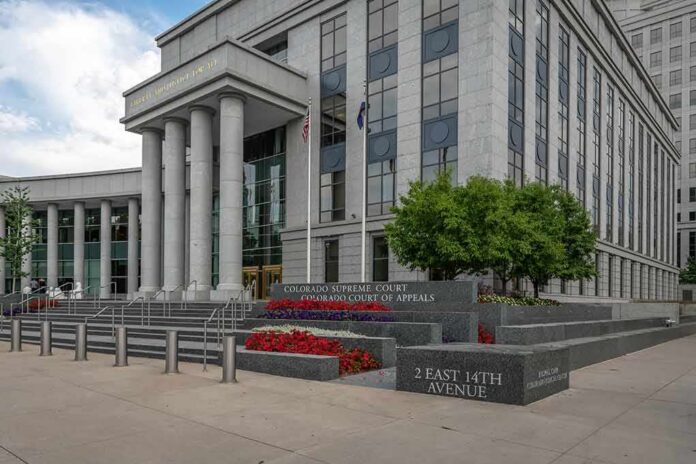
The Colorado Court of Appeals ruled that the criminally negligent homicide convictions of former Aurora paramedics Peter Cichuniec and Jeremy Cooper could not stand because the trial judge failed to correctly instruct jurors on the elements of that crime.[2][3] Judges concluded that the instructions did not accurately describe how jurors should assess the paramedics’ mental state and standard of care, a crucial issue when medical decisions are being judged as criminal conduct.[3] As a result, the court reversed those convictions and ordered both men back to the trial court for new proceedings on that specific charge.[2][3] This means the state still can pursue homicide liability, but it must present the case to a new jury under corrected legal guidance rather than relying on the flawed 2023 verdicts.[2][3]
The appellate ruling did not wipe the slate clean for everyone involved. The same decision explicitly affirmed Cichuniec’s separate conviction for second‑degree assault based on unlawful administration of drugs, a count tied to the ketamine injection given to McClain on the street.[2] That outcome leaves him with a standing felony record even as the homicide question goes back to square one.[2] Cooper’s sentence had already been structured as probation, work release, and community service, reflecting the trial judge’s view that criminally negligent homicide involves serious harm without intentional murder.[2] By selectively overturning some counts while preserving others, the appeals court signaled that it saw real problems in how the law was explained, not necessarily in the factual finding that serious mistakes were made.
How We Got Here: From Street Encounter To Reversed Convictions
The McClain case grew out of a 2019 encounter in Aurora, Colorado, where police stopped the 23‑year‑old after a citizen called about a “suspicious” person; officers forced him to the ground and paramedics later injected him with ketamine based on an inflated estimate of his weight.[1][2] Prosecutors argued that the combination of physical restraint and a heavy sedative dose turned a welfare check into a fatal incident, leading a 2023 Adams County jury to convict both paramedics of criminally negligent homicide.[2][3] That same series of trials produced a split picture for the officers: one officer was convicted of criminally negligent homicide and third‑degree assault, while two others were acquitted of manslaughter and related charges.[2] The mixed outcomes reflected how difficult juries find it to balance deference to first responders with outrage over a young man’s death, particularly in an era when trust in both policing and government oversight is badly eroded. When the appeals court stepped in years later, it was not to re‑litigate what happened medically but to review whether the legal framework given to jurors matched Colorado’s statutes.
Coverage of the opinion indicates that the judges focused tightly on the wording of the homicide instructions, not on declaring the paramedics innocent or guilty as a matter of fact.[3] That kind of narrow legal review is common in serious criminal cases, where higher courts are tasked with ensuring that trial outcomes rest on correctly applied law, even if the conduct itself remains hotly contested.[3] For many Americans on both the left and the right, though, this kind of distinction feels like hair‑splitting that benefits insiders. Supporters of stronger police and emergency‑medical accountability see yet another example of the system giving professionals a second chance when victims never get one, while critics who opposed the original prosecutions view the reversal as overdue recognition that tragedy alone does not equal crime. Both reactions grow from the same root: a belief that ordinary citizens would not get such careful reconsideration if they were the ones facing prison.
Why This Ruling Resonates With Broader Distrust In The System
The Colorado attorney general responded to the decision by emphasizing that a jury had still found two paramedics responsible for the death of “an innocent Black man who did nothing wrong,” and pledged to continue defending the convictions through the appeals process.[2][4] That statement speaks to a national climate where political leaders, under pressure from communities outraged by police‑adjacent deaths, promise accountability yet must operate inside a legal system that moves slowly and prioritizes procedure.[2][3] For conservatives who already see government as weaponizing prosecution in some high‑profile cases while ignoring everyday crime, this kind of back‑and‑forth confirms the sense that justice is selective and driven by politics. For liberals who focus on racial disparities and state violence, the reversal looks like another instance where technical errors erase hard‑won jury findings in cases involving a Black victim.[1][3] Both sides end up seeing institutions that bend over backward for insiders while leaving citizens to navigate confusing rules without similar protection.
The Colorado Court of Appeals reversed the homicide convictions and ordered new trials for the two former Aurora paramedics charged in the death of Elijah McClain, according to court documents. https://t.co/JWn7a9MWbQ
— The Press Democrat (@NorthBayNews) June 6, 2026
The McClain retrials also spotlight a deeper structural problem that transcends party lines: the growing tendency to criminalize professional failures only after public outrage, without clearly defining in advance where negligence ends and crime begins.[1][3] Emergency medical workers now face the possibility that split‑second dosage or restraint decisions could later be second‑guessed as felonies, yet the same system often fails to discipline or remove officials who design policies that push call volumes up, training quality down, and staffing thin.[2][3] Ordinary Americans watch years of litigation over a single tragic death, complete with overturned verdicts and partial do‑overs, and conclude that the system is better at protecting its own legitimacy than at preventing the next tragedy. The McClain ruling does not resolve that distrust; it merely moves the case to yet another chapter in a justice process that feels, to many on both left and right, more like a maze than a path to truth.
Sources:
[1] YouTube – Colorado court orders new trials for 2 paramedics found guilty in …
[2] Web – Killing of Elijah McClain – Wikipedia
[3] Web – The Elijah McClain Case – City of Aurora
[4] Web – Appeals court overturns convictions for paramedics connected to …
© newsworthy.news 2026. All rights reserved.