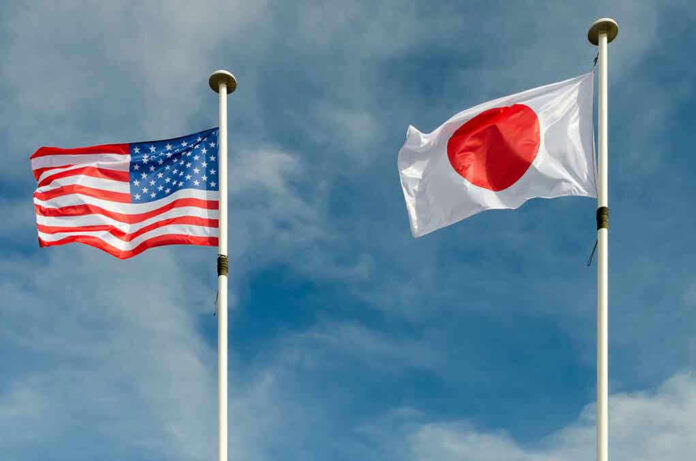
A historic meeting marks a new era as Trump and Japan’s first female leader unite against China’s dominance in minerals.
Story Highlights
- President Trump signs critical mineral agreements with Japan’s first female prime minister.
- The agreements aim to reduce reliance on China for rare earths.
- Meeting symbolizes strengthened U.S.-Japan alliance in the Indo-Pacific.
- Partnership highlights continuity of Japan’s foreign policy under Takaichi.
Trump and Takaichi’s Historic Meeting
On October 27, 2025, President Donald Trump met with Japan’s newly elected Prime Minister Sanae Takaichi in Tokyo. This significant event marked the first meeting between a U.S. president and Japan’s first female prime minister. During their discussions, the leaders signed several key agreements focused on securing the supply chain for rare earths and critical minerals, a strategic move aimed at reducing the U.S. and Japan’s dependence on China.
These agreements are part of a broader initiative to reinforce economic and strategic ties between the two nations, amid ongoing U.S.-China tensions. The meeting also included discussions on trade and energy, further solidifying the U.S.-Japan alliance.
Strengthening U.S.-Japan Economic Ties
The agreements signed by Trump and Takaichi represent a significant step in diversifying the supply of critical minerals necessary for technology and defense industries. Historically, China has dominated this market, making the U.S. and its allies vulnerable to supply disruptions. By cooperating with Japan, the U.S. seeks to mitigate these risks and promote stability in global supply chains.
The meeting at Akasaka Palace was filled with symbolic gestures, including showcasing American vehicles, to reinforce trade diplomacy. These actions underscore the commitment of both leaders to advancing their countries’ economic and strategic interests, ensuring that their alliance remains a cornerstone of stability in the Indo-Pacific region.
Implications for Global Supply Chains
The implications of these new agreements are profound, both in the short and long term. In the immediate future, the U.S. and Japan’s strengthened alliance signals a shift away from reliance on Chinese minerals. This move is expected to enhance the security of supply chains critical to industries like electronics, automotive, and defense.
In the long term, these agreements could set a precedent for other nations seeking to diversify their resource supplies. As more countries follow suit, the global reliance on China for rare earths may decrease, potentially leading to shifts in commodity prices and increased competition in the market.