
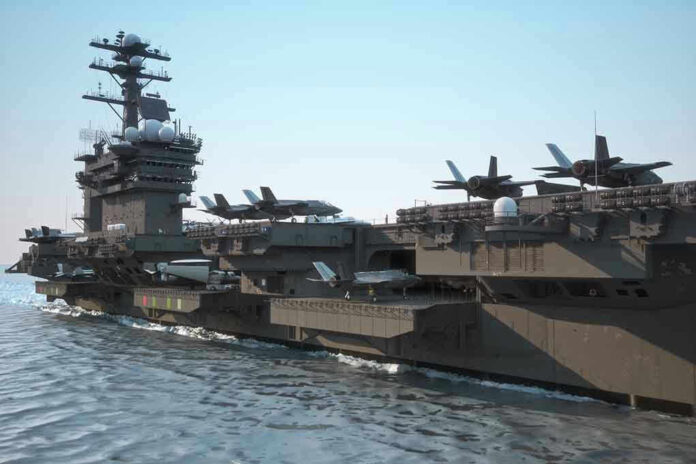
The USS Nimitz’s historic final deployment in the South China Sea delivers a powerful farewell message to China’s maritime aggression while demonstrating America’s unwavering commitment to freedom of navigation in critical international waters.
Story Highlights
- USS Nimitz conducts final deployment near disputed Chinese territories, signaling continued U.S. deterrence
- 50-year veteran carrier operates in South China Sea amid heightened tensions with Beijing
- China condemns operations as sovereignty violations, proving deployment’s strategic effectiveness
- Historic carrier set for 2026 decommissioning after decades of defending American interests
America’s Naval Legacy Takes Final Stand
The USS Nimitz embarked on its 23rd and final deployment in March 2025, marking the end of a distinguished 50-year career that began in 1975. This nuclear-powered supercarrier has served as the backbone of American naval power projection through Desert Storm, Iraq, and Afghanistan operations. The deployment strategically positions Carrier Strike Group 11 in contested South China Sea waters, directly challenging China’s illegal territorial claims and militarization of artificial islands.
Strategic Operations Counter Chinese Maritime Coercion
Throughout 2025, the Nimitz conducted high-profile flight operations near Malaysia’s Great Natuna Island and other disputed territories where Chinese coast guard vessels routinely harass Philippine and Vietnamese ships. Rear Admiral Fred Goldhammer emphasized the mission’s importance, stating the strike group is “doing more than ever to strengthen peace, stability, and deterrence across the Indo-Pacific.” These operations coincided with the Shangri-La Dialogue, amplifying America’s diplomatic message about regional security commitments.
Beijing’s Predictable Outrage Confirms Mission Success
China’s People’s Liberation Army Southern Theater Command immediately condemned the deployment, claiming U.S. actions “seriously violated China’s sovereignty and security.” This predictable outrage demonstrates the effectiveness of American naval presence in countering Beijing’s attempts to control critical sea lanes through intimidation. The Chinese reaction validates concerns about their expansionist agenda and illegal claims over international waters that facilitate global commerce worth trillions annually.
Transition Signals Naval Modernization Amid Growing Threats
The Nimitz’s scheduled 2026 inactivation represents America’s transition from Cold War-era Nimitz-class carriers to advanced Ford-class vessels, ensuring technological superiority against emerging threats. This modernization occurs as regional allies including Japan, Philippines, and Australia deepen security partnerships with the United States. The deployment flexibility demonstrated through rapid Middle East redeployment during Israel-Iran tensions showcases American global reach that China cannot match despite aggressive military buildup.
🇺🇸 USS Nimitz carrier’s final deployment sends a strong signal to China’s maritime ambitionshttps://t.co/waOEtHiFDS
— Navy Recognition (@NavyRecognition) October 22, 2025
Defense analysts recognize this final deployment as both a tribute to naval heritage and a warning to adversaries. The Nimitz’s presence reinforces international maritime law principles that protect free navigation rights essential for American commerce and allied security, countering China’s destabilizing territorial expansion.
Sources:
Map Spotlight: Tracking the USS Nimitz – ICAS
Nimitz Carrier Strike Group conducting routine flight operations in the South China Sea – U.S. Navy
Carrier USS Nimitz Transits Singapore Strait, Operates in South China Sea – USNI News