A fatal Ohio highway crash that killed a 21-year-old U.S. soccer player is exposing deep cracks in how America licenses, monitors, and polices commercial drivers in the name of “safety.”
Story Snapshot
- A 42-year-old Uzbek truck driver is charged with felony evidence tampering after a crash that killed 21-year-old goalie Tobias “Toby” Forsythe on Interstate 71 in Ohio.
- Troopers say the driver removed his dash camera after the wreck and it was later found in his pocket, raising fears of a cover-up and system failure.
- Officials have not said what caused the crash, yet activists are already blaming immigration and language rules while others blame weak trucking oversight.
- The case feeds a wider belief on both left and right that federal regulators protect industry and political narratives more than ordinary Americans’ safety.
What We Know About the Deadly I-71 Crash
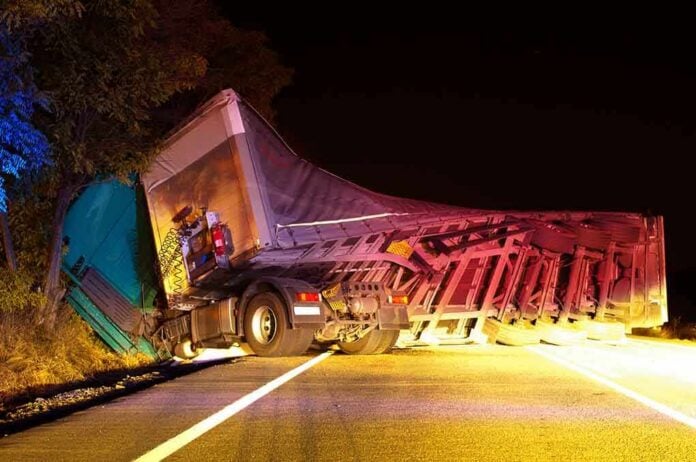
Ohio State Highway Patrol investigators say the crash happened just after 1:30 a.m. on a Sunday along Interstate 71 in Madison County, Ohio. They report that a Freightliner semi driven by 42-year-old Bekhzod Asrarov, of Uzbekistan, was heading south when it rear-ended a 2025 Honda Accord driven by 21-year-old Tobias “Toby” Forsythe of Gahanna. The impact pushed Forsythe’s car across the median into the northbound lanes, where it hit another vehicle, and Forsythe died at the scene. Asrarov was taken to a hospital with non-life-threatening injuries.
Court records show Asrarov is charged with one felony count of tampering with evidence, not with causing the crash itself. Troopers and court filings say that at some point after the wreck, Asrarov removed a dash camera that had been mounted in his truck. The camera mount in the cab was reportedly empty when officers checked, and the dash camera was later found in Asrarov’s right pocket while he was in an ambulance. Prosecutors say that move was meant to hide possible evidence as the investigation began.
Dispute Over Language, Licensing, and What Really Caused the Wreck
Officials have not released any final finding on why Asrarov hit Forsythe’s car or what factors, such as speed, fatigue, or distraction, may have played a role. That gap left space for quick political spin. Some posts and commentary claim Asrarov could not speak English and point to him as a symbol of “diversity visa” and immigration failure, turning a still-open investigation into a talking point about borders and culture. However, the news reports and charging records available so far focus on evidence tampering and crash mechanics, not on language barriers.
At the same time, reporting tied to transportation officials says Asrarov held a valid Ohio Commercial Driver’s License, meaning he legally met federal and state requirements to drive a semi at the time of the crash. Separate coverage notes claims that he had difficulties with English testing, which fuels anger that regulators issued or honored a license anyway. But no official report in the record connects language ability to this specific crash, and no agency has said that failure to speak English caused or contributed to the wreck. The investigation is ongoing, so blaming one factor now is more political than factual.
Why This Case Hits a Nerve Across the Political Spectrum
This tragedy lands in the middle of a heated national fight over who gets to drive big rigs on American roads and under what rules. Over the past few years, federal leaders have ordered tougher enforcement of English proficiency rules for truckers, arguing that drivers must be able to read signs, talk with police, and handle emergencies. At the same time, federal data do not show foreign-born drivers as a group causing more deadly wrecks than American-born drivers. That mismatch between policy moves and hard numbers feeds the sense that politicians chase headlines instead of true safety.
Trucking industry groups, for their part, often warn that tighter language and licensing rules could worsen driver shortages and raise costs for shipping and consumers. Many Americans hear that and feel they are being told to accept more risk on the roads so large companies can protect profit margins. Others look at cases like this and see a different failure: a government that loudly promises strict standards, then quietly grants licenses even when a driver struggles with basic English tests or comes from a country with little oversight. Both sides end up furious, for different reasons, at systems that seem built to serve the well-connected first.
Evidence Tampering and the “Deep State” Trust Problem
The dashcam is where this story hits a raw national nerve. When people hear that a driver in a fatal crash allegedly pulled his own camera, then had it found in his pocket in the ambulance, they understandably suspect a cover-up attempt. They also ask why it took this event, not routine checks, to flag problems with his record and equipment. Critics on both the right and left say this proves the federal and state overseers are not doing their jobs until after someone dies, and even then focus on narrow charges instead of the system that allowed it.
Tobias “Toby” Forsythe (21 years old, from Gahanna, Ohio; UMass Lowell soccer player/goalie
⁰Killed on July 5, 2026 (early morning), on I-71 in Madison County, Ohio (near West Jefferson). His Honda was rear-ended by a semi-truck.
⁰The driver was Bekhzod Asrarov (42, from… pic.twitter.com/noF6aFTIzo— Orrin🇺🇸 (@howmanyare2many) July 8, 2026
Many conservatives see an immigrant trucker, possible language failures, and a young American’s death and link it to what they view as years of globalist policies, weak borders, and cheap-labor schemes that put citizens last. Many liberals look at the same case and point to corporate pressure for endless freight and lean staffing, and to a justice system that punishes a single driver while leaving the companies and regulators untouched. Underneath the partisan anger is a shared belief: the people at the top created a system where such a driver, with such questions hanging over him, could be on the road near a college kid heading home.
What To Watch Next in the Forsythe Case
The next key step will be the full crash report from the Ohio State Highway Patrol, which should spell out official views on speed, distraction, fatigue, possible mechanical issues, and whether communication problems played any role. Investigators have also seized multiple electronic devices from the truck, including cell phones and the electronic logbook tablet that tracks hours and routes. Those records could show if Asrarov was on his phone, over his allowed hours, or facing equipment failures before impact.
Families and citizens across the political spectrum will also be watching what happens beyond this one driver. Some will press for tougher English enforcement and tighter visa screening for commercial drivers. Others will demand more aggressive oversight of trucking firms that hire drivers with known gaps and send them onto crowded highways. The deeper question is whether this case leads to real reforms that protect people like Toby Forsythe, or whether it becomes one more flash point used to stir outrage while the same unsafe system rolls on.
Sources:
twitchy.com, x.com, yahoo.com, facebook.com, youtube.com, ef.com, linkedin.com, nstlaw.com
© newsworthy.news 2026. All rights reserved.