
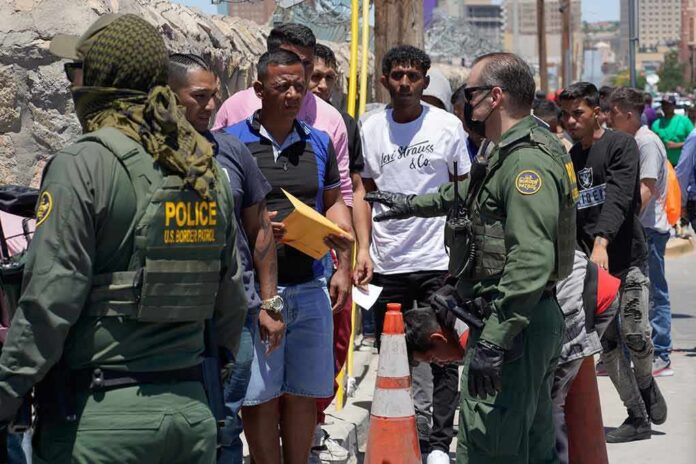
A federal judge delivered a blow to President Trump’s border security strategy by dismissing trespassing charges against 98 illegal migrants arrested in a newly established military zone in New Mexico.
Key Takeaways
- U.S. Magistrate Judge Gregory Wormuth dismissed trespassing charges against 98 migrants who entered a military zone at the New Mexico border.
- The judge ruled the government failed to prove migrants knew they were entering a restricted area despite posted warning signs.
- This ruling represents a significant setback to Trump administration efforts to impose stricter penalties on illegal border crossers.
- While trespassing charges were dismissed, migrants still face charges for illegal entry into the United States.
- The military zones are part of President Trump’s broader strategy to achieve “100 percent operational control” of the southern border.
Judge Dismisses Charges in Military Zone Cases
The dismissal of trespassing charges against nearly 100 illegal migrants represents a significant legal obstacle for the Trump administration’s enhanced border enforcement strategy. U.S. Magistrate Judge Gregory Wormuth ruled that prosecutors failed to establish that the migrants knew they were entering the New Mexico National Defense Area (NMNDA), which spans approximately 170 miles of public land along the border and is considered an extension of Arizona’s Fort Huachuca Army base. Despite the setback, the illegal migrants still face separate charges for unlawful entry into the United States.
“Beyond the reference to signage, the United States provides no facts from which one could reasonably conclude that the Defendant knew he was entering the NMNDA (New Mexico National Defense Area),” – said U.S. Magistrate Judge Gregory B. Wormuth.
Trump’s Military Zone Border Strategy Faces Legal Challenge
President Trump’s administration established two military zones along the U.S.-Mexico border as part of a comprehensive strategy to deter illegal immigration. The first zone, established on April 18, covers 180 miles along the New Mexico border, while a second zone near El Paso, Texas, spans 63 miles. These designated areas are designed to impose much steeper penalties for border crossers, with Defence Secretary Pete Hegseth warning that combined sentences could reach up to 10 years for trespassing in these restricted military zones.
“Let me be clear: if you cross into the National Defense Area, you will be charged to the FULLEST extent of the law,” said Defence Secretary Pete Hegseth.
Military personnel operating in these zones have detected over 150 unauthorized entries but have not directly detained trespassers. Instead, they are authorized to temporarily hold individuals entering the marked areas before transferring them to local law enforcement. The zones featured signs warning of restricted access, but Judge Wormuth found no evidence that the migrants detained had seen these warnings, largely due to the difficult terrain in the area.
Legal and Operational Implications
Federal prosecutors may refile the trespassing charges, which could result in a one-year sentence if convictions are secured. Despite this current legal setback, the Trump administration remains committed to expanding the military zones to achieve complete operational control of the southern border. U.S. Attorney Ryan Ellison has defended the military zones as vital to national security, while the administration has consistently characterized the unprecedented surge of illegal immigration as an “invasion” requiring extraordinary measures.
“Consequently, the Criminal Complaint fails to establish probable cause to believe that Defendant knew he/she was entering the NMNDA,” said U.S. Magistrate Judge Gregory B. Wormuth.
The public defender’s office successfully argued that the government failed to clearly mark the military zones in a way that would provide adequate notice to migrants. This ruling affects approximately 400 similar cases filed in Las Cruces, New Mexico. While the trespassing charges have been dismissed, the remaining illegal entry charges still carry their own penalties, though they are less severe than the combined charges would have been. This legal battle illustrates the continuing challenges the administration faces in implementing stronger deterrents against the ongoing border crisis.