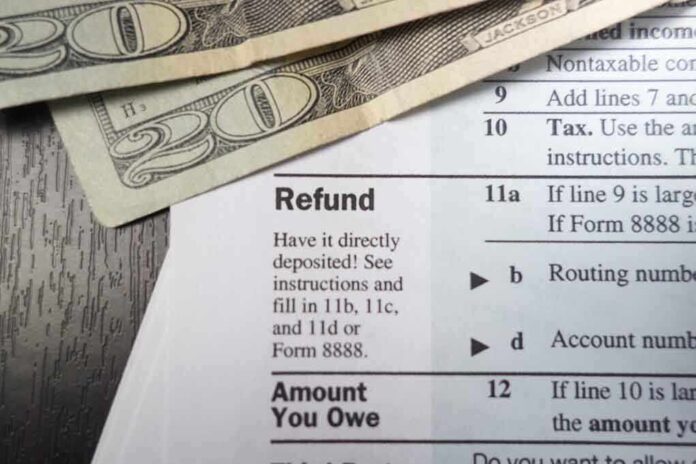
Millions of Americans are being told a surprise “payday” is coming in 2026—what if the biggest tax refund of your life is less windfall, more Washington accounting trick?
Story Snapshot
- Trump economic adviser Kevin Hassett predicts the “biggest refund cycle ever in the history of America” when 2025 returns are filed.
- A July 2025 tax package plus slow IRS withholding updates are setting up a mechanical surge in refunds.
- Independent economists project about $50 billion in extra tax savings, skewed toward higher earners.
- Voters who feel “behind” may finally see relief in their refunds—but not everyone will win equally.
The bold promise of “the biggest refund cycle ever”
Trump’s former Council of Economic Advisers chairman, now National Economic Council director Kevin Hassett, went on Fox Business and told viewers to brace for “the biggest refund cycle ever in the history of America,” complete with “massive refund checks” landing in early 2026. He backed up Trump’s own claim the night before that next spring would bring “the largest tax refund season of all time,” with some families seeing $11,000 to $20,000 in annual savings.
That kind of language is designed to cut through noise for a skeptical public. A recent Fox News poll cited in the segment shows 44% of Americans say they are falling behind financially and 74% call the economy “not so good” or “bad.” The White House clearly wants a simple, visceral proof point: ignore the gloom, wait for your refund. The open question is whether the numbers, and the distribution of benefits, will match the slogan.
How a mid‑year tax law quietly supercharges refunds
The mechanics driving this predicted “refund bonanza” are not magic—they are timing. In July 2025, Congress passed a Trump-backed tax and spending package that retroactively cut 2025 taxes. The law added an extra senior deduction, exempted tips and overtime from federal income tax, raised the child tax credit, and temporarily lifted the SALT deduction cap to $40,000 for some itemizers while helping certain pass‑through owners bypass the cap.
Those changes apply to all of 2025, but IRS withholding tables were set before the law. Employers have largely kept taking taxes out of paychecks as if the cuts never happened. That means many workers are overpaying all year and will settle up at filing time. Kevin Hassett frames that as happy news: a giant check in the mail. Fiscal conservatives might note the more sober interpretation—Washington collected too much up front and will hand some back later, with a political ribbon tied on top.
Independent forecasts: big aggregate boost, unequal gains
Oxford Economics economist Nancy Vanden Houten estimates the retroactive cuts and withholding lag will generate about $50 billion in additional taxpayer savings when 2025 returns are filed, roughly a 17% jump from about $275 billion in total refunds the prior year. With the average refund around $2,939 in 2025, a 17% bump would mean close to $500 more on average if it all showed up as refunds, though some savings will instead show up as lower final tax bills.
Her analysis, and Tax Policy Center estimates she cites, lines up with a pattern conservatives have seen in many tax debates: all income groups benefit on average, but high‑income households benefit the most. The temporarily higher SALT cap and pass‑through workarounds especially favor affluent taxpayers in high‑tax states. That does not make the policy illegitimate; rewarding work, investment, and state‑level tax pain has a logic. But it complicates the simple campaign line that “many families” will save $11,000 to $20,000 a year.
What working families will actually feel in their wallets
Hassett argues that the story is not just about refunds. He points to wage data showing roughly 3.7% nominal wage growth against about 1.6% core inflation, implying 2–2.5% real wage gains and claiming blue‑collar workers effectively received a $2,000 real raise in 2025. He ties that to a “blockbuster” November CPI report and describes an economy returning to a “3% growth, 1% inflation” Trump‑era pattern.
Oxford’s work suggests many households will feel a short, sharp boost when refunds hit. Surveys reported in that coverage show about 64% of taxpayers had already spent or planned to soon spend their prior refunds. Vanden Houten expects high‑income households to spend about 20% of their tax savings and others 25–40%, giving consumer spending a temporary lift in early 2026. She still calls the macro impact “modest,” partly because people may already be spending in anticipation of the money.
Sources:
Fox Business: Trump economist predicts ‘biggest refund cycle ever,’ massive checks ahead
Fox Business Video: Biggest tax refunds in US history are coming, Trump economist Kevin Hassett says