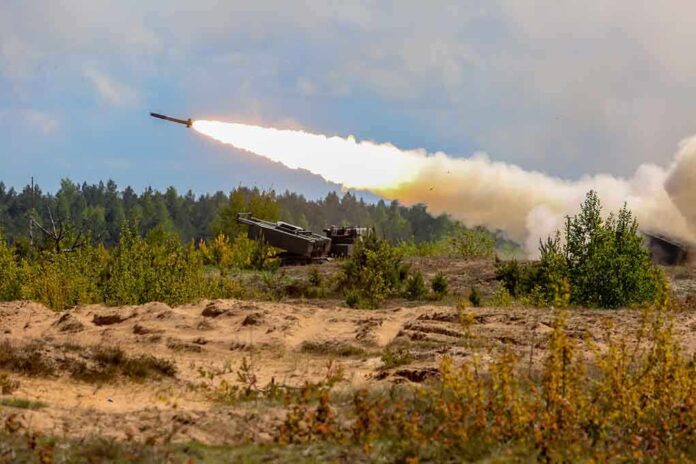
Russia’s deployment of nuclear-tipped air-to-air missiles threatens to ignite a new arms race and radically change aerial combat dynamics as President Trump responds with the ambitious “Golden Dome” missile defense program.
Key Takeaways
- Russia has deployed nuclear-armed air-to-air missiles, likely variants of the R-37M, making it the only nation with such capabilities in service globally
- President Trump has announced the $175 billion “Golden Dome” missile defense program with space-based capabilities to counter threats from Russia and China
- Russia’s R-37M missiles have an operational range of up to 300 kilometers, can reach speeds over Mach 6, and are already being used in the Ukraine conflict
- Russia maintains approximately 1,550 deployed strategic nuclear warheads and up to 2,000 non-strategic warheads in its expanding arsenal
- The U.S. is developing new weapons in response, including the AIM-260 and an air-launched version of the Standard Missile-6
Russia’s Nuclear Air-to-Air Missile Capability
According to recent reports from the Pentagon’s Defense Intelligence Agency (DIA), Russia has taken a significant step in modernizing its military capabilities by deploying nuclear-armed air-to-air missiles. This development marks a concerning shift in global strategic balance, reviving Cold War-era tactics with modern technology. The weapon, identified as likely a variant of the R-37M, known to NATO as the AA-13 Axehead, represents a capability that no other nation currently possesses in active service.
“The weapon, described as a novel addition to Russia’s arsenal, is likely a variant of the R-37M, a very long-range air-to-air missile known to NATO as the AA-13 Axehead,” reported Pentagon’s Defense Intelligence Agency [DIA].
The R-37M missile itself is already a formidable conventional weapon, with a range exceeding 300 kilometers and speeds over Mach 6. It entered production in 2014 and became operational with Russian forces in 2018. The missile’s exceptional range and speed make it particularly effective against high-value airborne targets like AWACS, tankers, and transport aircraft. The addition of nuclear warheads to this platform significantly amplifies its destructive potential, enabling it to destroy entire formations of aircraft with a single strike.
President Trump’s Golden Dome Response
In direct response to the escalating threats from Russia and China, President Trump has unveiled the ambitious “Golden Dome” missile defense program. This $175 billion initiative represents the most significant advancement in American missile defense capabilities in decades, incorporating ground and space-based components to create a comprehensive shield against various missile threats. The program aims to protect American soil from ballistic missiles, hypersonic weapons, and other advanced threats.
“Fully operational before the end of my term,” stated President Donald Trump regarding the Golden Dome program, emphasizing his commitment to fast-tracking this critical defense initiative.
The Golden Dome system will incorporate advanced interception capabilities that can neutralize enemy missiles at all stages of flight – boost phase, midcourse, and terminal approach. President Trump highlighted the system’s versatility, noting that it will be able to intercept missiles “even if they are launched from space.” General Michael Guetlein has been appointed to oversee the program’s development, with initial capabilities expected to be operational well before the full system is completed by 2029.
Russia’s Expanding Nuclear Arsenal
The nuclear-tipped air-to-air missiles represent just one component of Russia’s broader nuclear expansion strategy. Intelligence reports indicate that Russia maintains a substantial nuclear stockpile and continues to develop novel nuclear systems. This aggressive buildup comes amid heightened tensions with NATO and ongoing hostilities in Ukraine, where conventional R-37M missiles have already seen combat use against Ukrainian aircraft.
“Russia is expanding its nuclear forces by adding new capabilities, including nuclear air-to-air missiles and novel nuclear systems. Russia probably maintains a nuclear stockpile of about 1,550 deployed strategic warheads and up to 2,000 non-strategic warheads,” said Hans Kristensen.
The DIA report also notes Russia’s establishment of nuclear-capable missiles and aircraft in Belarus, further extending its nuclear reach toward NATO’s eastern flank. Despite the alarming expansion, analysts assess that Russia remains unlikely to employ nuclear weapons unless facing what it perceives as an existential threat to the regime. However, this calculated restraint does little to diminish the strategic implications of these new capabilities for global security dynamics.
Implications for U.S. and Global Security
The revival of nuclear air-to-air missiles fundamentally changes the calculus of aerial warfare and creates new challenges for U.S. and allied air forces. The exceptional range of the R-37M already poses significant problems for Ukrainian pilots in the current conflict, forcing them to operate with extreme caution. The nuclear variant would exponentially increase these dangers, potentially threatening entire air operations with a single missile launch.
“limiting our capabilities to conduct our missions. Of course, if you’re maneuvering, we are not able to provide an airstrike or something else, so the game is still very, very, very tough in the air and very, very risky. If you’re not aware of the launch of a missile, you’re dead,” Andrii “Juice” Pilshchykov explained regarding the current conventional R-37M threat.
In response to these evolving threats, the United States is accelerating development of its advanced air-to-air missiles, including the AIM-260 and an air-launched version of the Standard Missile-6. However, neither of these systems includes nuclear warheads, maintaining the long-standing U.S. policy against nuclear air-to-air weapons. The Golden Dome program represents a more comprehensive approach to countering the full spectrum of missile threats, including potential nuclear-armed projectiles, through multi-layered defensive systems rather than matching Russia’s nuclear escalation.