
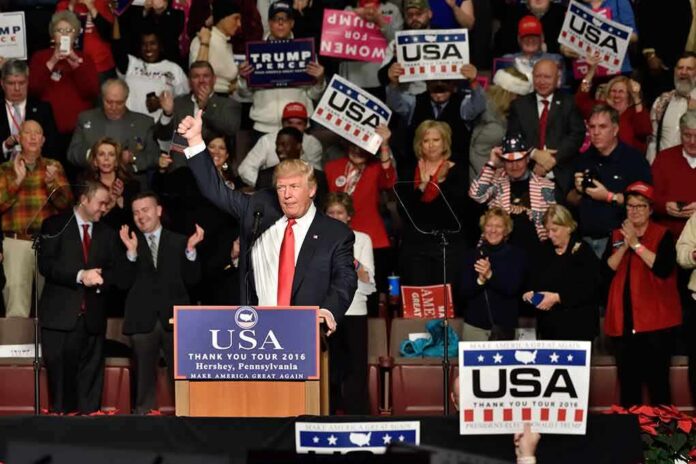
At a packed South Carolina rally, boxing great Evander Holyfield told the crowd he was thankful for President Trump and happy he was president, turning a campaign stop into a pop-culture moment anchored in personal gratitude.
Story Highlights
- Evander Holyfield thanked President Trump onstage and praised their past boxing ties.
- The remarks came at Trump’s October 21, 2026 rally near Clemson, South Carolina.
- Holyfield said Trump “gave me the opportunity” in boxing, linking sports and politics.
- Reports captured the praise but did not show a formal endorsement statement.
What Holyfield Said Onstage
At the T. Ed Garrison Arena in Pendleton on October 21, 2026, Evander Holyfield joined President Trump onstage and thanked him directly. Holyfield told the crowd he was “thankful” and “so happy” Trump was president. He also recalled a “great relationship” with Trump from his boxing years and said Trump “gave me the opportunity.” Local and national outlets reported the appearance and the remarks, which were brief but clear in tone and content.
Coverage noted the moment blended sports fame with politics in a lively rally setting. The Washington Examiner and other outlets summarized Holyfield’s praise and presence. A local station reported Trump invited Holyfield to speak, signaling a planned cameo rather than a surprise drop-in. The comments centered on thanks and personal history, not on policy points. That gave the event a human note inside a charged campaign program.
Where And Why It Mattered Politically
President Trump traveled to upstate South Carolina to boost Republican Senate candidate Darline Graham ahead of the 2026 midterms. The arena sits near Clemson, a high-energy stop for rally crowds. Holyfield’s appearance added celebrity lift to a standard campaign script. People on both right and left know these moments well: famous guests can draw attention, rally base morale, and shape headlines for a day, even when they do not change votes on their own.
Research on celebrity politics shows mixed effects. Some studies suggest famous backers can spark interest or warm feelings. Other work finds little change in voter intent. One noted example found that Oprah Winfrey’s 2008 endorsement had measurable reach through her media influence. Still, across many races, star power often raises awareness but does not guarantee ballot movement. That pattern helps frame Holyfield’s cameo as signal more than shift.
Praise Versus Endorsement: Reading The Signal
Reporters captured Holyfield’s warm words, yet they did not show him issuing a formal endorsement line. He did not tell people to vote for Trump or say, “I endorse him.” In politics, that line matters. A public thank-you at a rally still sends a strong supportive signal to many viewers. But campaigns and voters often draw a line between personal praise and an explicit ask for votes. The distinction applies here based on the available record.
https://twitter.com/WETV69/status/2113008859287871642
For many Americans, this moment also hits a deeper nerve. People across the spectrum feel that powerful insiders run the show while families face higher costs, unsafe streets, and gridlock in Washington. When a sports legend thanks a sitting president for past chances, it reminds some of real doors that open for a few, while many feel shut out. Others see it as loyalty repaid in public. Both reactions tie back to a shared worry: is the system serving regular people or only the connected?
Sources:
news.meaww.com, apnews.com, themirror.com, m.dailyadvent.com, pollar.news, washingtonexaminer.com, tandfonline.com
© newsworthy.news 2026. All rights reserved.