

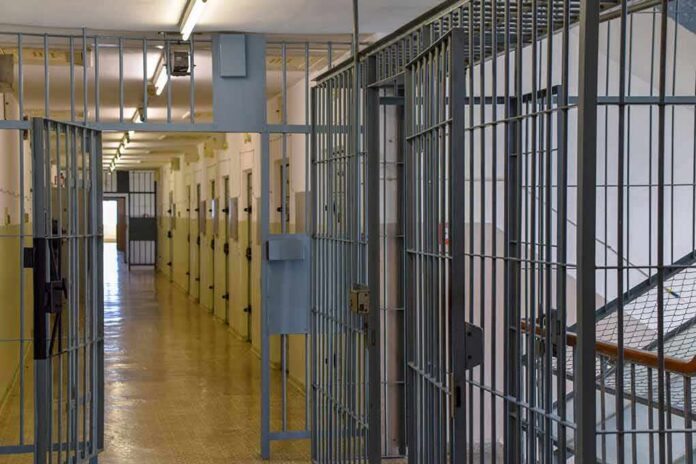
Immigration and Customs Enforcement is racing to add 5,500 new detention beds in just weeks, sharpening President Trump’s drive for mass deportations while deepening fears that the system serves Washington elites more than ordinary Americans.
Story Snapshot
- ICE asked private contractors for at least 5,500 new detention beds in four regions, with facilities expected to start holding detainees within 30 days of contract awards.
- The agency says the goal is to boost detention capacity and “maximize removal flights,” supporting Trump’s large-scale deportation agenda.
- Detention centers are already crowded, with detainees reportedly sleeping on floors as current capacity is outpaced by arrests.
- The request fits into a much bigger plan to nearly double national detention capacity toward 100,000 beds or more, often using large warehouse “mega centers.”
ICE’s 5,500-bed request and fast-track timeline
U.S. Immigration and Customs Enforcement posted a formal request seeking at least 5,500 new detention beds spread across four regions: near Denver, Seattle, Miami, and central Pennsylvania. The public notice on the federal contracting site gave companies just five business days to respond, an unusually tight window for projects this size. ICE’s terms say winning facilities must be ready to hold detainees within 30 days after the contracts are awarded, underscoring how quickly the agency wants more space. Minimum capacities are set at 1,500 beds each near Denver and Seattle, 700 near Miami, and 1,800 in Pennsylvania, and each facility must be used only for immigration detainees.
The solicitation uses a flexible “as-needed” structure, letting ICE order detention services without promising a fixed number of occupied beds up front. That design gives the government broad leeway to ramp detention up or down while keeping facilities on standby, which worries critics who see it as a blank check. Reporting indicates the size and locations match existing private detention centers run by the GEO Group, raising questions about whether the process favors certain contractors instead of simply filling urgent regional needs. Draft contract language stating that state and local laws “shall not apply” at these facilities has also stirred concern, especially in communities already wary of federal power and “deep state” overreach.
Detention capacity, overcrowding, and Trump’s deportation agenda
ICE argues these new beds are needed to “increase the overall detention bed capacity” and to operate at or above Congress’s minimum funded level while “maximizing removal flights.” The agency has said it is closing at least one existing facility to shift money toward about 1,600 additional beds elsewhere, part of an ongoing reshuffle to support more deportations. Recent data show a system already under strain: a detailed report found that as of April 14, 2025, ICE had contractual capacity for about 62,913 beds while holding 48,056 detainees, filling roughly three out of four available beds nationwide. Separate reporting found that detention centers funded for 41,500 beds have held close to or above 48,000 people, with some migrants forced to sleep on floors.
These numbers sit inside a much larger project. Under the “Detention Reengineering Initiative,” the government plans a major expansion funded by the “One Big Beautiful Bill Act,” aiming to be able to detain about 100,000 immigrants at any one time. Internal planning documents and leaked memos describe a $38.3 billion effort to build eight huge “large-scale” detention facilities that could each hold 7,000 to 10,000 people, along with 16 regional processing centers designed for short 3–7 day stays and 10 “turnkey” sites ICE would own. Media and advocacy reports say officials believe they need around 100,000 beds to meet goals of detaining up to a million people a year for arrest, processing, and deportation.
Long-standing bed quotas, private contractors, and public distrust
For years, Congress has tied funding for the Department of Homeland Security to a national “bed quota,” a requirement that ICE maintain tens of thousands of detention beds every day. That mandate started around 33,400 to 34,000 beds in the early 2010s and has risen as lawmakers backed tougher enforcement. Supporters say the quota and new beds are needed to ensure people who face deportation show up for hearings and can be removed quickly if ordered. Critics, including legal scholars and immigrant-rights groups, argue the quota encourages “arbitrary detention” by treating a bed count as a goal to be filled rather than a cap to be avoided, locking in spending and power while families, workers, and taxpayers bear the cost.
Private prison companies sit at the center of this growth. Groups like GEO and CoreCivic already run many detention centers, and newly planned warehouses and tent sites would extend that role. Advocacy research warns that expanded detention fuels “profiteering” by contractors who earn money per occupied bed, which can shape lobbying and quiet pressure for ever more capacity. At the same time, reports of deaths in detention, overcrowding, and poor conditions make both conservatives and liberals question whether Washington’s focus is on safety and law, or on contracts and control. That distrust deepens when contracts are structured to override state laws or when small firms with little detention experience land billion-dollar deals, as some documents show.
Communities, alternatives, and what this expansion might mean
Many cities and towns have begun to resist these projects, seeing giant detention centers as symbols of a federal system that feels distant, unaccountable, and driven by elites in Washington. Residents worry about local costs, emergency services, and the moral weight of hosting facilities that can hold thousands of people who often have not committed serious crimes. At the same time, the research record available today does not show whether ICE seriously weighed alternatives like case-management programs, electronic monitoring, or supervised release before pushing for more beds. Those options can be cheaper and less harsh while still making sure people attend court, but they do not match the “deportation-maxxing” mindset now shaping policy.
For many Americans, this story taps into a broader fear: that the federal government keeps building bigger systems of control while everyday concerns—fair jobs, stable prices, safe communities—slide. Conservatives who support secure borders still worry about huge, opaque contracts and federal facilities that override local rules. Liberals who back humane treatment see warehouse “mega centers” as proof that human dignity is losing to mass-processing and profit. ICE’s rush to lock in 5,500 more beds is a small but telling piece of that picture. It shows how, in Trump’s second term, both parties’ frustrations can meet around one uncomfortable point: a growing detention machine that feels run from the top down, with little clear proof that it truly serves the people footing the bill.
Sources:
pjmedia.com, projectsaltbox.com, nbcnews.com, americanimmigrationcouncil.org, tracreports.org, forumtogether.org, ice.gov, en.wikipedia.org, globaldetentionproject.org, immigrantjustice.org, washingtonpost.com, wired.com, workingimmigrants.com, brennancenter.org, djclpp.law.duke.edu, youtube.com, blogs.law.ox.ac.uk, oig.dhs.gov
© newsworthy.news 2026. All rights reserved.