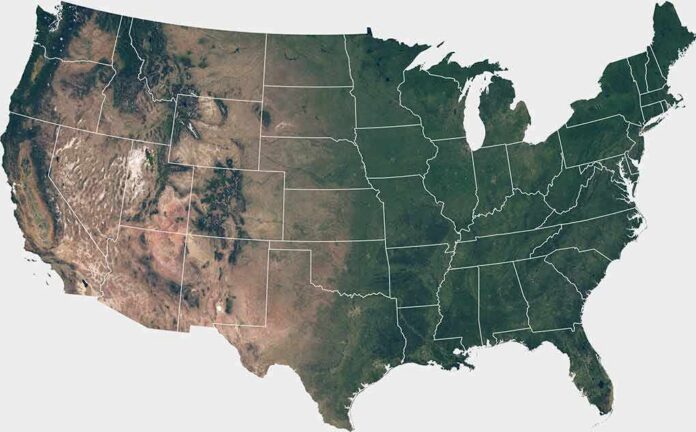
A massive heat dome now parked over the central United States is turning everyday life into a health risk for millions of Americans.
Story Snapshot
- A broad heat dome is driving triple-digit heat and dangerous “feels-like” temperatures across the central U.S.
- Weather agencies say more than half the country could face days of extreme heat with little night-time relief.
- The same pattern has hit different regions several times in 2026, raising questions about growing climate stress.
- Many Americans feel government warnings come faster than real help to cope with life-threatening heat.
Heat Dome Locks Central States Under Extreme Temperatures
Weather forecasters report that a powerful heat dome has settled over the central United States, driving a dangerous and possibly record-setting heat wave from the Plains through the Midwest and toward the East. Under this dome of high pressure, millions are seeing daytime highs in the upper 90s and 100s, with “feels-like” temperatures above 105 degrees once humidity is included. The National Weather Service has warned that more than 90 temperature records could be tied or broken in a matter of days.
AccuWeather and other private services estimate that around 200 million people could experience 90 to 100 degree heat as the dome grows and shifts during the early part of summer. In practical terms, that means entire metro areas from Dallas north toward the Dakotas and east toward the Great Lakes are under heat advisories or excessive heat warnings for several days in a row. These alerts highlight the risk of heat stroke, dehydration, and power strain, especially for older Americans, outdoor workers, and families without reliable air conditioning.
What A Heat Dome Is And Why It Is So Hard To Escape
A heat dome is not a media phrase; it is a real weather setup where a large zone of high pressure sits over a region and acts like a lid on a pot. Air sinks under that high pressure, dries out, and heats up more as it is squeezed, which pushes surface temperatures higher day after day. Storms and clouds are blocked, so there is very little relief from the sun. As the hot air stays trapped, the ground and buildings store heat, and nights remain dangerously warm instead of cooling off.
Meteorologists describe this summer’s pattern as a blocking high that keeps sliding from one part of the country to another. In March, a record-breaking heat dome baked the Southwest and shattered March records in at least 14 states before creeping eastward. By late June and early July, another dome locked the central and eastern United States into a severe multi-day heat loop over the Independence Day period. Now, yet another expansive dome is building over drought-stricken parts of the Plains and West, stacking heat risk on top of already dry land and high fire danger.
Health Risks, Strain On Daily Life, And A Sense Of Abandonment
Extreme heat is one of the deadliest weather threats, even though it often gets less attention than storms or floods. Public health experts warn that wet-bulb temperatures, which measure heat and humidity together, are reaching levels where even healthy people can face serious danger during outdoor work. This is especially true across the southern tier, where humid heat can push the body past its ability to cool itself. Older adults, people with heart or lung problems, and young children are at the highest risk, especially if they live in areas without strong local support systems.
Record-Breaking Heat Dome Expands Across Central US Threatening Millions#record-breaking #heat #dome #BreakingNewsUSA pic.twitter.com/0KH2f9ONkx
— JQJO USA Environment Arabic (@jqjousaenvarabi) July 25, 2026
For many families, the advice to “stay indoors in air conditioning” rings hollow. High power bills, aging housing, and weak local infrastructure make it hard to follow official guidance, especially in working-class neighborhoods and rural towns. The same Americans who feel ignored on issues like inflation, health care, and energy costs now see a pattern in heat response: strong warnings, but slow and uneven action on cooling centers, utility protections, and help for outdoor workers. That feeds the growing belief on both the right and the left that government talks about safety while leaving everyday people to fend for themselves.
Climate Stress And Questions About Preparedness
Climate researchers note that as the planet warms, heat domes are becoming more intense and more frequent, turning once-rare events into regular summer features. The 2026 North American heat wave, with repeated domes hitting different regions within months, fits that pattern. Central and eastern states are now facing not just one bad week, but a season where extreme heat can return again and again. That raises hard questions about how prepared the country really is: our grid, our roads, our farms, and our health systems were built for a cooler, more stable climate than the one Americans now live in.
Americans across the political spectrum see this as another test of a federal government they already mistrust. Conservatives who blame past “green” decisions for high energy prices now watch blackouts and grid warnings with anger. Liberals who worry about inequality see poor neighborhoods facing the worst heat with the least support. Both sides see a system that moves slowly while temperatures rise quickly. As this heat dome keeps baking the heartland, it reinforces a common fear: the people in charge are more focused on protecting themselves than on protecting Americans sweating through a dangerous new normal.
Sources:
washingtontimes.com, cnn.com, weather.com, washingtonpost.com, nypost.com, npr.org, facebook.com, apnews.com, theguardian.com, accuweather.com
© newsworthy.news 2026. All rights reserved.