
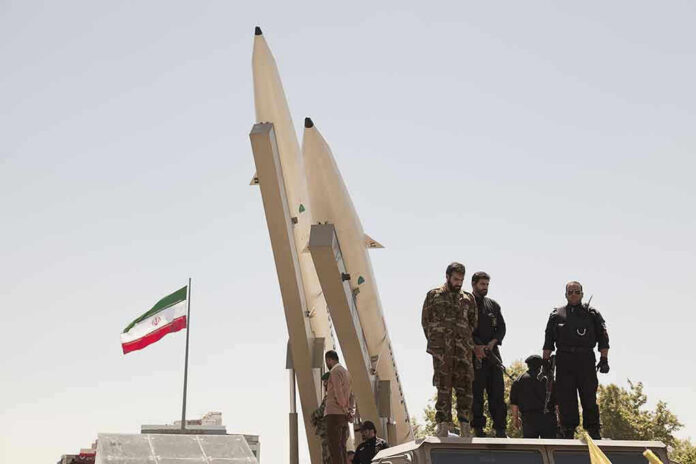
Trump is threatening to bomb Iran and seize its oil fields — while simultaneously negotiating a peace deal — and the fate of both hinges on whether Hezbollah stops fighting in Lebanon.
Story Snapshot
- Trump warned Iran it would be hit “very hard” and lose control of its oil and gas if Hezbollah keeps fighting in southern Lebanon.
- Vice President JD Vance said talks made real progress, with Iran agreeing to admit United Nations nuclear inspectors and both sides advancing on the Lebanon ceasefire.
- A draft agreement reportedly covers Lebanon directly, requiring a stop to military operations “on all fronts” including Lebanese territory.
- Israeli strikes on Lebanon nearly derailed the talks entirely, forcing a postponement of planned negotiations in Switzerland.
Trump’s Hard Line: Stop Hezbollah or Face Strikes
President Trump made his position clear: Hezbollah’s ongoing attacks in Lebanon are a deal-breaker. He warned the U.S. would strike Iran “very hard” and take “total control” of its oil and gas industries if the fighting continued. [1] Then, after what he called a breakthrough in talks, he called off planned new strikes. That back-and-forth — threats followed by pauses — reflects a deliberate pressure strategy designed to keep Iran at the table without letting up on leverage.
Trump also confirmed that key points in the emerging agreement had been approved by the United States, Israel, and other regional allies. [1] That alignment matters. It signals the administration is not freelancing — it is coordinating with partners before making commitments. For conservatives tired of watching past administrations cave to Iran while getting nothing in return, this approach is a sharp contrast to the Obama-era nuclear deal that handed Tehran billions with few real conditions.
Lebanon Is at the Center of the Iran Deal
This is not just about nukes. A reported 14-point draft agreement between the U.S. and Iran calls for an immediate halt to military operations “on all fronts including in” Lebanon and commits to protecting Lebanon’s territorial integrity. [5] That language puts Hezbollah — Iran’s armed proxy — directly inside the deal’s framework. If Hezbollah keeps shooting, Iran is in breach. That is a significant shift from past negotiations that treated Lebanon as a separate issue.
Planned talks in Switzerland had to be postponed after Israeli forces struck targets in Lebanon. [4] The surge in violence “threatened to disrupt peace negotiations between Washington and Tehran,” according to NBC News. [5] That sequence — fighting in Lebanon nearly blowing up U.S.-Iran diplomacy — proves the point: Hezbollah’s behavior is not a side issue. It is the trip wire. Letting Hezbollah operate freely while trying to negotiate with Iran is like trying to put out a fire while someone keeps adding fuel.
Vance Calls It a Good Day — But the Deal Isn’t Done
Vice President Vance said the administration had “laid the groundwork to reach a favorable outcome” and called it a “very good day” of negotiations. [7] He said Iran agreed to admit International Atomic Energy Agency nuclear inspectors and that progress was made on the Israel-Hezbollah conflict. [7] Those are real steps. But Vance also made clear that Iran had not yet agreed to the full set of U.S. conditions, and the Wall Street Journal reported that “Iran has not agreed to the proposed conditions.” [18]
LIVE NEWS REPORT — JUNE 21, 2026
1. U.S.–Iran Talks Enter Fragile 60-Day Window
U.S. and Iranian negotiators remain in a fragile diplomatic window after an interim understanding aimed at ending the Iran war and easing pressure around the Strait of Hormuz. Talks have included… pic.twitter.com/YxoLmx2C1V
— Ernie Milleur (@ErnieMilleur) June 22, 2026
Trump’s red lines for any final deal are firm: zero uranium enrichment on Iranian soil, surrender of enriched uranium stockpiles, reopening of the Strait of Hormuz, and a stop to funding terrorism. [24] Iran has pushed back, calling the enrichment demand a non-starter and insisting it has its own conditions. Tehran has warned that any breach of the draft agreement would trigger a “crushing response.” Both sides are drawing lines. The difference is that Trump is backing his with real military and economic threats — not just words. Whether that pressure produces a durable agreement or a prolonged standoff is the central question still unanswered.
Sources:
[1] Web – Trump Draws Red Line on Hezbollah As US-Iran Talks Clear First Hurdle
[4] Web – 2025–2026 Iran–United States negotiations – Wikipedia
[5] Web – Fears for US-Iran deal as talks delayed by Israeli strikes on Lebanon
[7] YouTube – US-Iran Talks End Without Breakthrough as Tensions Over Lebanon …
[18] Web – Israel and Hezbollah are destroying the meaning of red lines
[24] YouTube – Iran proposal under review as US weighs red lines amid …
© newsworthy.news 2026. All rights reserved.